Paris · Architecture
Isaiah, Ezekiel and Judges: Windows 3, 4 and 5
Sainte-Chapelle · Paris, France
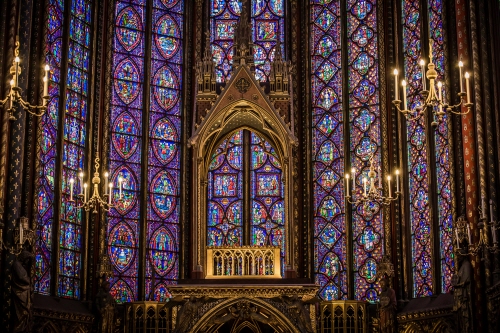
Next up are the small windows of the apse. We have just followed the history of kings along the side windows, so now it is the turn of the prophets who gave that history a voice.
Window 3 is unlike the others. Usually the two lancets of a window deal with similar figures, but here the left and right lancets are two completely separate works. On the left is the life of the prophet Isaiah, and on the right the famous image of the Tree of Jesse. The story of the Old Testament ends in this window, which is why scholars pay it special attention.
Start with the left lancet, Isaiah. In the lower tiers he scolds idol worshippers, stands before a king and foretells the birth of Christ. He is the prophet who said a virgin would bear a son, so he is a key figure in the prophecy of Christ's coming. But at the very top of this lancet, in the tip of the window, is a shocking scene: an old man caught in the trunk of a thick tree and being sawn in two. This is the legend of Isaiah's martyrdom, which is not in the Bible but comes from old tradition. A prophet who spent his life delivering heaven's words ends it as a martyr at the highest point of the window.
The right lancet is the Tree of Jesse, a family tree of Christ drawn as an actual tree. The tree grows out of Jesse's body, ancestral kings such as David and Solomon sit on its branches, and at the end Mary and Christ blossom. It also fits our reading rule perfectly. At the bottom lies an old man asleep, the root, Jesse. As you go up, ancestral kings like David and Solomon appear in turn, and at the very top are the Virgin Mary, Christ and seven doves symbolizing the Holy Spirit. Just read it from bottom to top, the way the tree grows. Most of the glass is 13th-century. Why pair the two lancets? Because Isaiah is the very man who prophesied the Tree of Jesse.
Window 4 holds some of the most fantastical and bizarre imagery in the Bible. Both lancets are filled with the visions of one prophet, Ezekiel, the most surreal images in the whole Bible. Again there are five tiers. At the bottom, Ezekiel sits by the River Chebar after being carried off to Babylon as a captive, and the visions begin here. In the second tier are creatures with four faces. Ezekiel wrote that he saw four living creatures in the sky, with the faces of a man, a lion, an ox and an eagle, and beside them wheels of fire turn. Theologians read the four creatures as symbols of the four Evangelists: the man for Matthew, the lion for Mark, the ox for Luke and the eagle for John. The vision, in other words, is read as bearing witness to Christ. Look for the burning wheels and the four-faced creatures.
In the middle tier come strange images: Ezekiel cutting off his hair and weighing it on scales, and breaking through a wall to see idol worshippers. The fourth tier shows the important scene of the Valley of Dry Bones. Ezekiel sees a valley full of dead bones, and they take on flesh, rise and live again. Look for the scattered bones and the people standing up. It symbolizes the resurrection of the dead and is read as a foreshadowing of Christ's resurrection, which is exactly why Ezekiel stands beside the Passion window. The top tier and tympanum show an angel measuring the heavenly temple, the mystery of the closed gate and the heavenly Jerusalem. The closed gate is also read as a symbol of the Virgin Mary.
Next door, Window 5 takes the Book of Judges as its subject: the heroes who appeared in each crisis to save the people before Israel had kings. Note that this window was heavily reworked in the 19th century. It too reads in five tiers. The bottom two tiers have the first heroes, notably the woman sitting under a palm tree judging the people, Deborah, a rare female judge and leader in the Old Testament. Gideon is there, receiving an angel's visit, and one tier up is his most famous scene, the miracle of the fleece. When Gideon asks God for a sign, dew falls only on a bundle of wool while the ground stays dry. Later theologians sometimes read the wet fleece on dry ground as a symbol of the Virgin Mary, who alone among humankind received grace.
The next tier has the tragic hero who had to sacrifice his own daughter; look for his daughter weeping on the mountain. Above that appears the star of this window, Samson, the Hercules of the Old Testament. An angel announces his birth, and he tears a lion apart with his bare hands, defeats an army with the jawbone of a donkey, and burns enemy fields by tying torches to foxes' tails. Higher up, his lover Delilah cuts his hair and takes his strength, the blinded Samson turns a millstone, and finally he embraces the pillars of the enemy temple and brings them down, burying himself with his enemies. Having sacrificed himself to bring everything down, Samson is read as a prefiguration of Christ.
However, the eight key scenes of the Samson story are not in this window now. They were removed during the 19th-century restoration and are now in the Musée de Cluny, so scenes such as the blinded Samson are not here. During the restoration, scholars also discovered that several pieces of old glass from this Judges window had mistakenly been placed in the Genesis window near the entrance.
So Windows 3, 4 and 5 showed us the prophets' visions and the heroes' tales. Next is the last small window, Window 6.