Paris · Architecture
Jeremiah, Tobit and the West Rose Window: Window 6
Sainte-Chapelle · Paris, France
The last window in the apse is Window 6. We've just seen the heroes of Judges, and like Window 3, this one holds two completely different stories in its two lancets: the prophet Jeremiah on the left, and a man named Tobit on the right.
Start with Jeremiah on the left, again read in five tiers. At the bottom, God appoints Jeremiah a prophet before he is even born. Above, he warns a crowned woman, who stands for Jerusalem, of the disaster coming her way. In the middle, the imprisoned Jeremiah dictates God's words to his disciple Baruch, and there is also a scene of King Zedekiah putting him in prison. At the top is Jeremiah's famous vision of a boiling cauldron, a warning that disaster will pour out of the north. Look for the medallion with the pot bubbling over.
The right lancet, Tobit, is a warm family story. Tobit is a devout old man who goes blind when bird droppings fall in his eyes one day. At the bottom are his faith, his charity and his blinding. The core of the story comes next: his son Tobias sets out on a long journey guided by the angel Raphael, who hides his identity, and catches a big fish in a river. The angel teaches him to cure his father's eyes with the fish's gall. In the middle is the wedding feast of Tobias and Sarah, and in the end Tobias restores his father's sight and the family is made whole. Medieval people reportedly loved this story, probably because it comforts us with the thought that an unseen angel walks beside us and guides us. As with the Samson panels, part of this window is now in the Cluny museum. At the very top of the tympanum are two prophets and David.
That's all six windows of the apse. Now turn around toward the entrance where we came in, to the west, and there is the end of the world, right behind you as you entered: the west rose window.
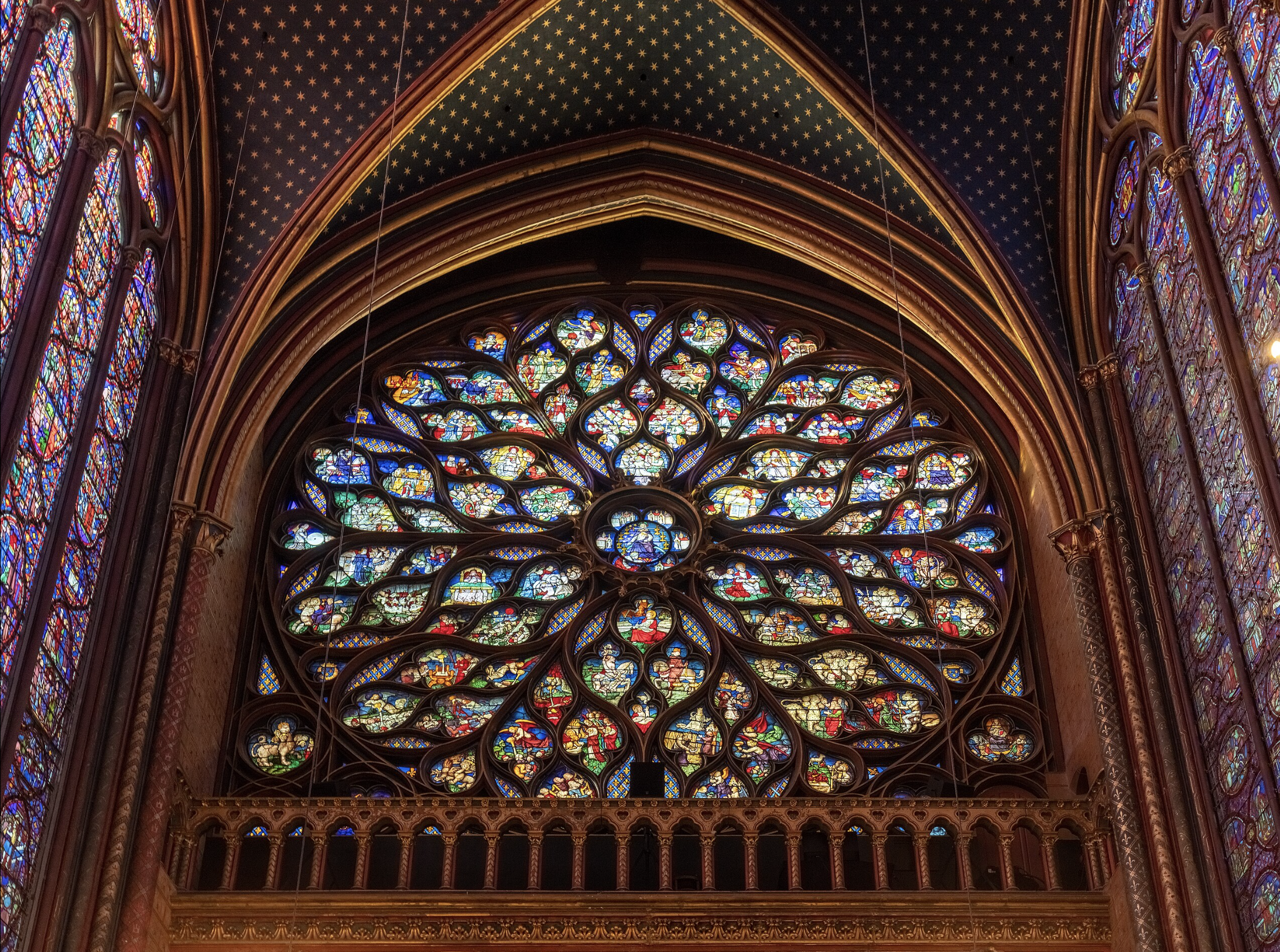
What makes it special is that every window we've seen so far was made in the 13th century under Louis IX, while this rose window was made 200 years later, in the late 15th century under Charles VIII. The style is completely different. If the 13th-century windows are medallions with simple, bold outlines, the rose is all complicated curves that seem to flicker like flames, a style called Flamboyant. It lets you compare a 200-year gap inside one church at a glance.
Its subject is the Book of Revelation, the last book of the Bible, with its visions of the end of the world, the Last Judgment, and a new heaven and a new earth. It was written by the apostle John, whom we met in Window 1, on the island of Patmos. So the upper chapel forms one great circle: the end of the world in the rose window at the entrance, the history of the world along both sides, and at the eastern end the Passion of Christ, the center of it all. You have now gone all the way around.
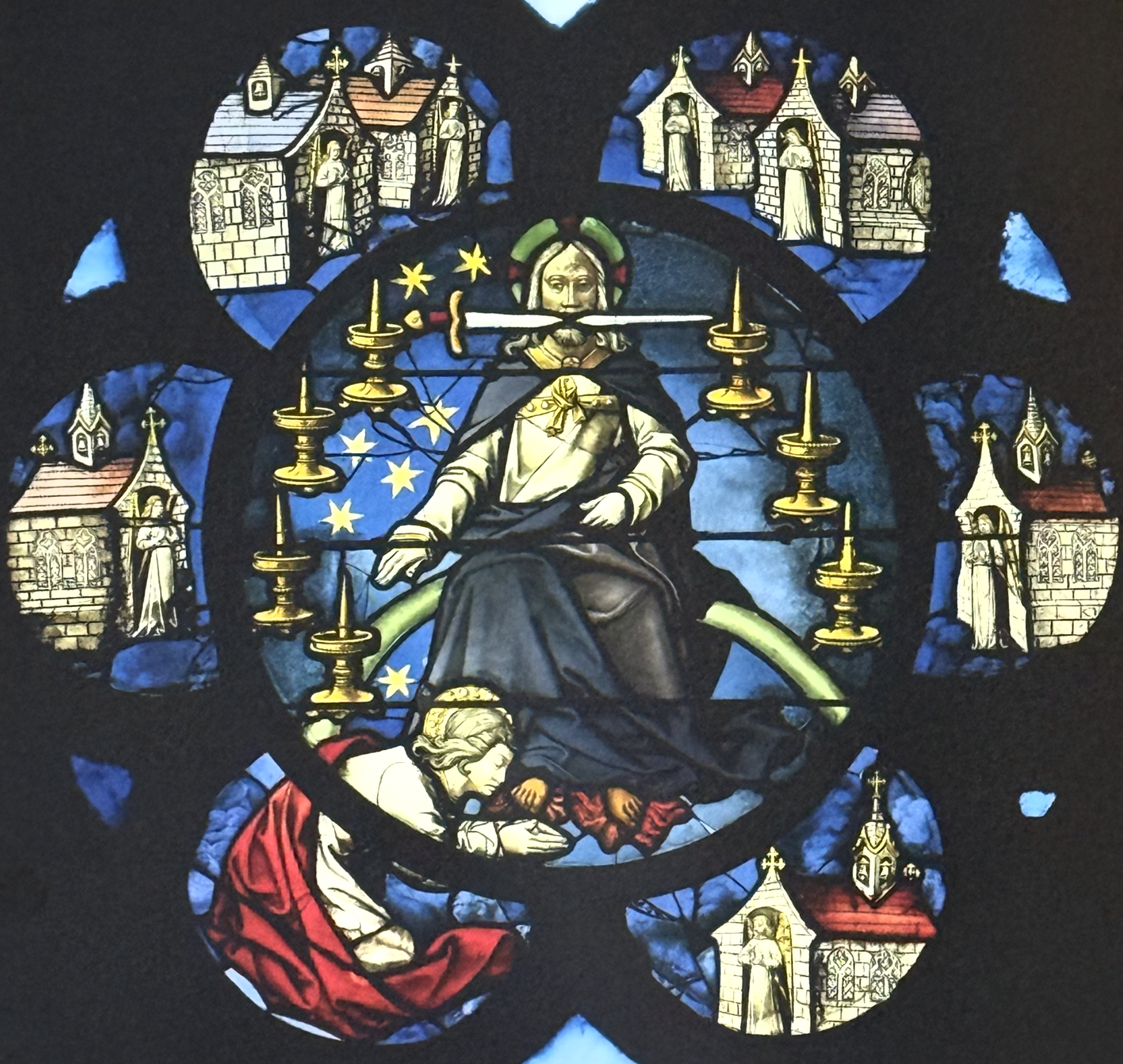
This window reads differently from the others. Because it is round, it spreads from the center outward. At the middle sits Christ on his throne, and every small piece of glass fanning out like petals holds a vision from Revelation: the seven seals, angels blowing trumpets, the four horsemen of the Apocalypse, the archangel Michael fighting the dragon, and finally the heavenly Jerusalem.
There is one more hidden detail: a letter K. Charles in Latin is Carolus, and K is its first letter. It is the signature of Charles VIII, who commissioned this new rose. Just as the 13th-century windows carry the castles of Blanche of Castile, the 15th-century window carries Charles VIII's K.
In the next track we meet the witnesses standing guard beside the Passion window.