Paris · Architecture
Witnesses to the Passion: Windows 1 and 2
Sainte-Chapelle · Paris, France
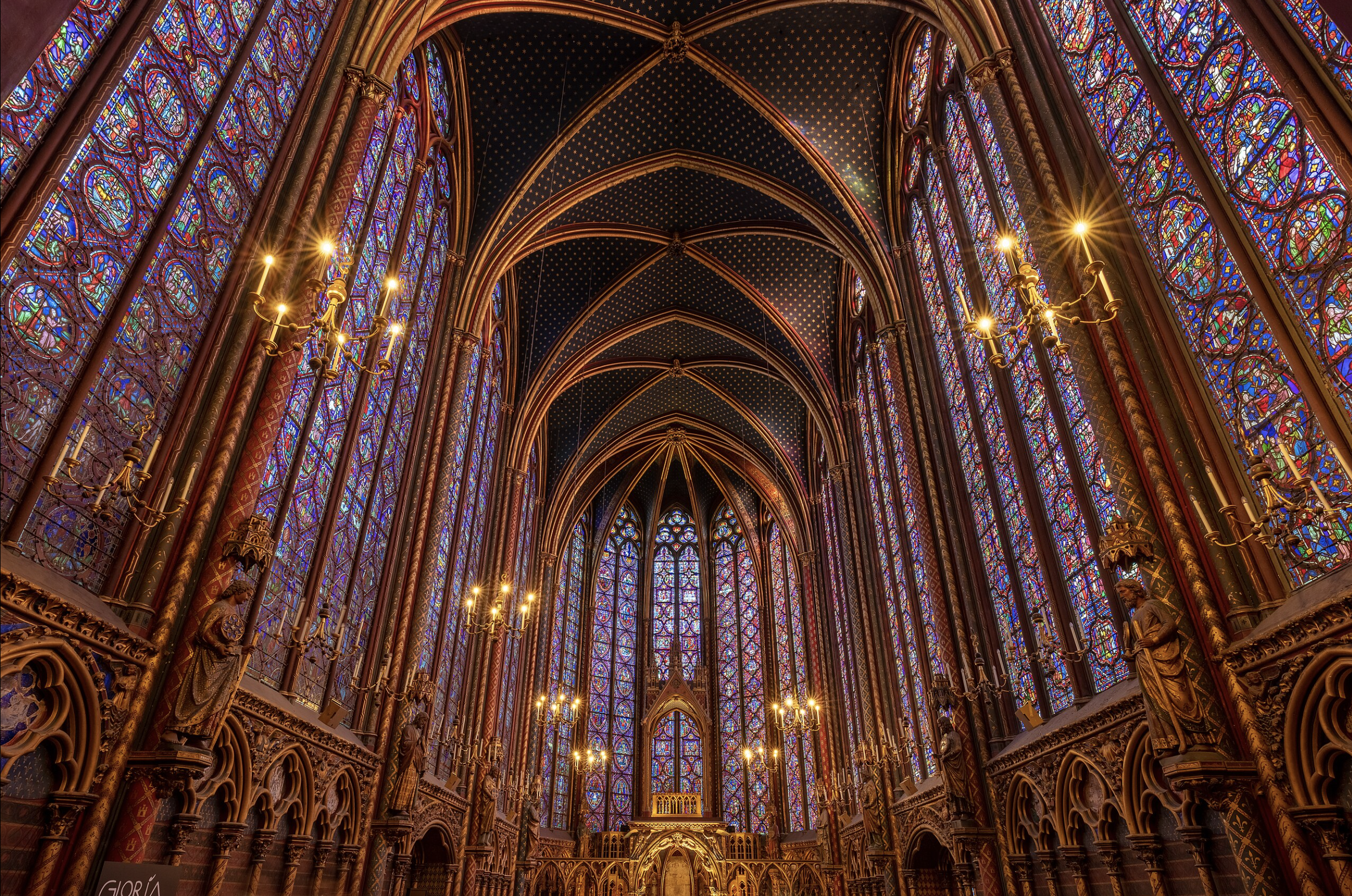
At the innermost end of the chapel, in the middle of the apse that curves around in a half circle, stands Window 0. We have just seen the end of the world in the west rose window, so before the main event, let's look at the windows on either side of Window 0.
Small windows fan out to both sides. The big side windows have four lancets, but these have only two each, so they are half as wide. Narrow and tall, they look like long bookshelves made of light. The apse has seven of these small windows, with Window 0 right in the middle. Who fills the six on either side? Prophets and witnesses: Daniel, John the Baptist, Ezekiel, Isaiah and Jeremiah ring the Passion window. All of them cried out in advance that Christ would come. So the whole apse reads as a single sentence: the prophets announce on both sides, and in the center Christ comes, just as they foretold, and suffers his Passion. Since each window carries two lancets with two different stories rising side by side, we need to read them as "left lancet is this person, right lancet is that person." Standing with your back to Window 0, we'll go in order starting from the left, nearer the north side.
In Window 1, the right lancet shows the childhood of Christ and the left lancet the world of St. John the Evangelist. A lot of 13th-century glass survives in the childhood of Christ, which reads in five tiers from bottom to top. The bottom is an unfamiliar scene: the idols in a temple tumbling down. When the infant Jesus fled to Egypt, the idols of Egypt are said to have toppled by themselves as he passed. The next tier has the Holy Family fleeing to Egypt and Herod's Massacre of the Innocents. In the middle are the familiar Nativity scenes. The Adoration of the Magi, three wise men who followed the star to worship the baby Jesus, is 800-year-old original glass. Above are the Adoration of the Shepherds and the birth in the stable, and at the top is the Annunciation, chronologically the first event, where an angel tells Mary she will conceive Jesus. In a sense the story is told backward, though this upper part was painted in the 19th century.
The left lancet, John the Evangelist, is about half 19th-century restoration. His stories here are not from the Bible but legends from the famous medieval Golden Legend, tales of the kind found in apocrypha. At the bottom an angel swings a censer. In the middle he drinks a poisoned cup and does not die, and this scene is original. Higher up, John is thrown into a cauldron of boiling oil but survives, and he writes the Book of Revelation on the island of Patmos. Why is John next to the Passion window? Because he is the author of the Revelation depicted in the rose window at the west end of the chapel. One man links the beginning and the end. In the tympanum at the very top, where the two lancets meet, are the crowned Virgin Mary, Christ beside her, and angels. This tympanum is 13th-century original.
In the next window, Window 2, John the Baptist and the prophet Daniel are waiting. The left lancet is John the Baptist and the right is Daniel, and both preserve a lot of 13th-century glass. The Baptist's lancet also reads in five tiers. At the bottom, an angel swings a censer, followed by the beheading of John the Baptist. At Herod's feast, Herod is so taken with Salome's dance that she demands John's head as her reward. Look for the banquet table, the dancing Salome and the beheaded John. It is original 13th-century glass. In the middle, time runs backward to John baptizing Christ in the River Jordan, the two men standing in the water with a dove descending from above. Above that, John preaches to the crowds in the wilderness.
The right lancet tells the story of the prophet Daniel. The famous scene is Daniel thrown into the lions' den, where the lions do not harm him. Look for Daniel sitting calmly among the lions. It is 800-year-old original glass. Higher up from the middle are the death of King Belshazzar and King Nebuchadnezzar's dream of a great tree being cut down, which Daniel interprets. At the top is the destruction of Jerusalem, a 19th-century restoration. Why put John the Baptist and Daniel in the same window? Because both saw the coming Christ in advance. John the Baptist baptized Christ himself, and Daniel foretold Jesus in a vision. In the topmost tympanum sit three prophets.
In the first two windows of the apse we have seen the childhood of Christ, the two Johns and Daniel. Now that all the witnesses are gathered, the next track brings us to the center of every story, Window 0, the Passion of Christ.