Paris · Architecture
The Passion of Christ: Window 0
Sainte-Chapelle · Paris, France
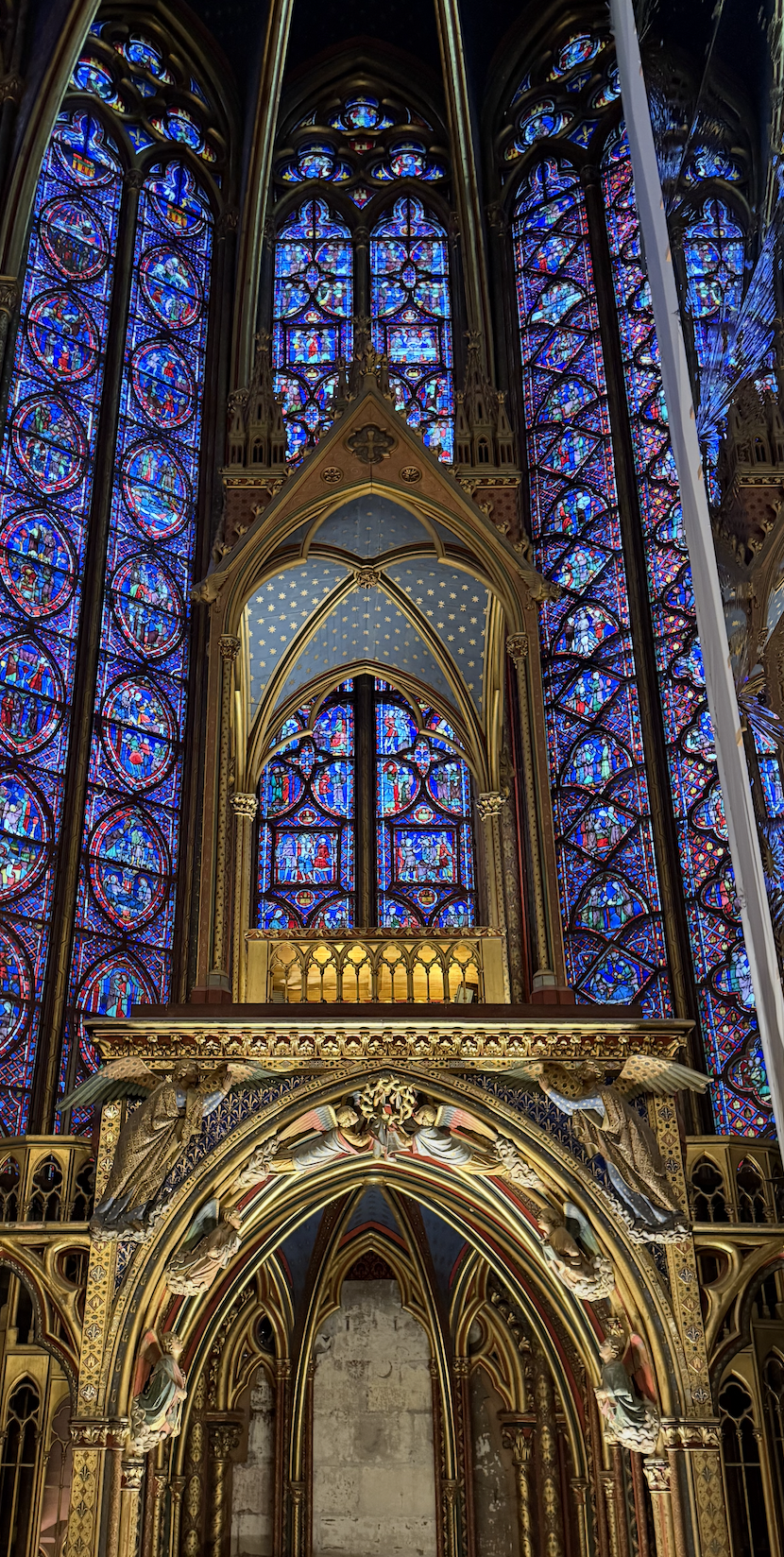
Window 0 sits dead center, where the altar stands. Having met the witnesses to the Passion on either side, we now come to the center toward which every story points. The name alone is a statement: zero means the center of every window, the absolute reference point.
This window holds the most frequently painted story in human history: Jesus arrested, tried, crowned with thorns, crucified, and raised to life three days later. Unlike the Genesis window, a great deal of 13th-century glass survives here, so most of what you see is 800 years old. Its position matters too. Eight centuries ago, the Grande Châsse stood right in front of this window, and inside it was the real Crown of Thorns.
Read it from bottom to top. At the base, four angels each hold an object: a cross, a crown of thorns, nails and a lance. It is a trailer for what is to come and a declaration: "Here are the instruments of his Passion." And in fact the Grande Châsse and the real Crown of Thorns stood right in front of this window. One tier up are the Last Supper and the moment of betrayal, where Judas kisses his teacher. It looks affectionate, but the kiss was actually a signal to the enemies: "This is the man." Now look at Judas's clothes. What color are they? Yellow. This resolves the yellow mystery we set aside in the how-to-read track. In medieval Europe yellow was the color of betrayal and deceit, and even people who couldn't read would take one look at yellow and know that man was the traitor. It works like a visual subtitle.
Just above, at about the same height, is the heart of the window: Jesus bound to a pillar and scourged, and soldiers pressing a crown woven of thorny branches onto his head. Both are 13th-century originals. The architect of the time placed the real Crown of Thorns in front of the window and this scene of the crowning together, a precisely calculated piece of staging.
The center of the window is the trial. Pontius Pilate, the Roman governor, washes his hands in a basin, saying "I am innocent of this man's blood": the famous hand-washing that washes away responsibility. Nearby, Judas throws back the silver coins he received for betraying Jesus.
From the fourth tier on, we move from the darkest moment to its reversal: the road carrying the cross, the entombment, and guards asleep before the sealed tomb, followed by the Resurrection. Look for the risen Jesus appearing first to Mary Magdalene.
The top tier is the luminous ending: the Ascension into heaven, and the two disciples at Emmaus who realize who the stranger on the road is when he breaks bread. Near the tympanum, tongues of fire descend on the apostles at Pentecost, and at the very top the Eternal Father raises a hand to bless it all.
So in Window 0 we have seen Christ's last week and the Resurrection. Next is the final key window, Window 14, which records how that Crown of Thorns came to this place. Head back toward the entrance and go to the first big window on the right-hand wall.