Paris · Architecture
The History of the Relics: Window 14
Sainte-Chapelle · Paris, France

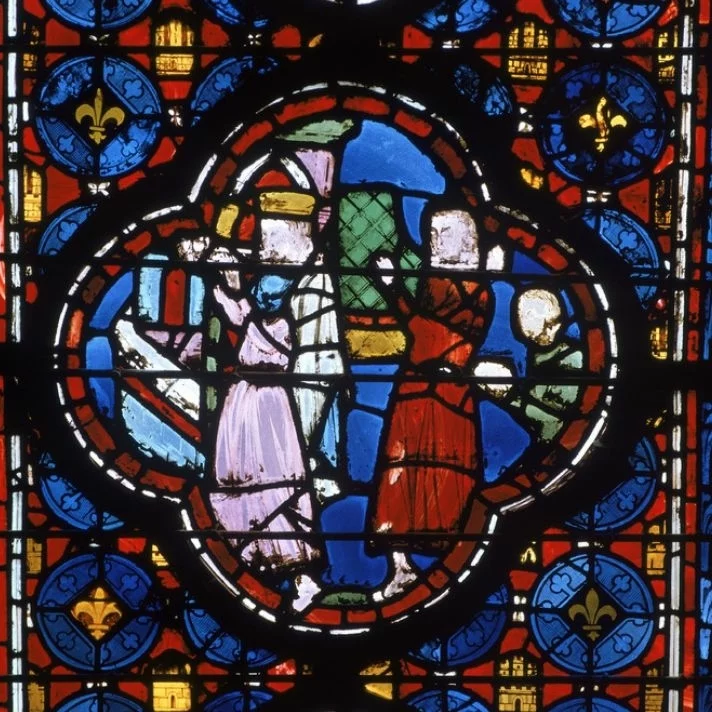
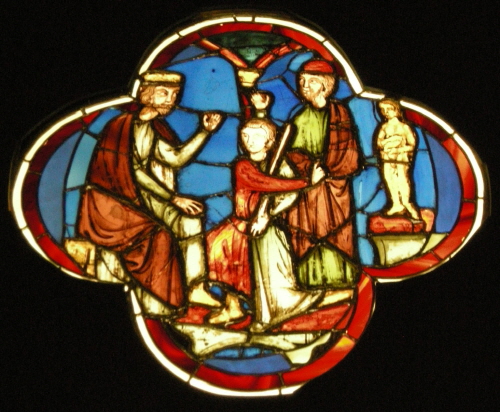
Window 14 follows the Passion window, where we saw Jesus crowned with thorns, and tells how that Crown of Thorns came to Paris. Every other window in this chapel tells a Bible story. This one is different. It is not the Bible; it is the news. A real event of the 13th century, the autobiography of Louis IX himself, is set in light alongside scripture, on equal footing.
Like the others, it reads from bottom to top, and here bottom to top runs from the oldest events to the most recent. The bottom is the 4th century, the middle the 7th, and at the top comes the 13th-century story of Louis IX himself. It grows from earth toward heaven.
Of its five tiers, the bottom tells the 4th-century story. Look for an emperor on a throne with a woman standing beside him. He is Constantine and she is his mother, St. Helena. The emperor orders his mother: go to Jerusalem and find the True Cross. Next to it, Helena interrogates Jews in Jerusalem. In 13th-century imagery, Jews are drawn in pointed hats, so look for the medallion with a group of people wearing them. Higher up, the story of Helena finding the True Cross continues. She has an old man lowered into a well to learn where the Cross lies, and when three crosses are found, each is laid on a dying woman to identify the true one. Look for the medallion of a woman lying down with a cross; when the last cross touches her, she comes back to life.
In the middle of the window, time jumps from the 4th century to the 7th. The Persian king Khosrow plunders Jerusalem and carries off the True Cross, so the Byzantine emperor Heraclius goes to war and defeats him. Here are Heraclius in armor fighting the Persian army, and then carrying the recovered Cross on his shoulder back to Jerusalem. Some of these battle medallions are genuine 13th-century glass.
In the fourth tier we finally reach the 13th century and our hero, Louis IX. He orders Dominican friars in black habits to bring back the Crown of Thorns, and the journey follows, as the friars buy the crown in Venice and carry it to France. Look for two medallions here. In the first, two young men in short white tunics walk barefoot, carrying a small chest on their shoulders. The one on the left is Louis IX, the one on the right his brother Robert of Artois, in the barefoot procession of the summer of 1239. This medallion is 13th-century original. In the second, near the procession, a veiled woman in queenly dress follows the procession. Scholars have identified this panel as Queen Blanche joining the procession. His mother Blanche finally appears in this autobiography.
In the top tier and tympanum, Louis IX carries the True Cross himself, workmen cut stone to build Sainte-Chapelle itself, and the dedication ceremony takes place. In his own autobiography, Louis IX depicted the very building he made. In the tympanum at the very top, scenes of the veneration of the relics unfold, with Louis IX himself presiding at the center, and the Castile castles are set into the glass on both sides again.
From Constantine to Louis IX, we have followed the 900-year journey of the Crown of Thorns. That completes the story of this chapel's windows. But it's not yet time to say goodbye, because twelve figures remain who have held up all this light on their shoulders for 800 years. We'll meet them in the next track.