Paris · Architecture
The Twelve Apostles Holding Up the Chapel of Light
Sainte-Chapelle · Paris, France
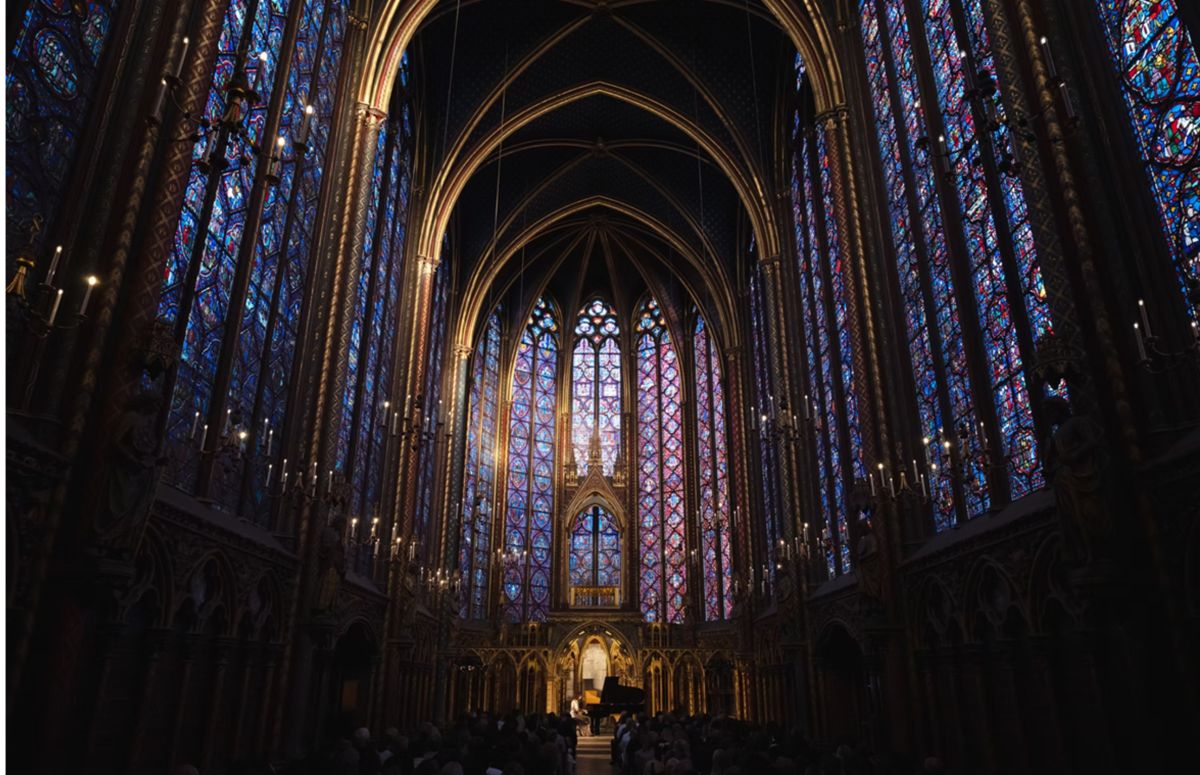
Take your eyes off the stained glass for a moment and look at the slender bundles of columns on the wall between the windows. These columns carry the ceiling's arches, and on each is a life-size statue: twelve in all. They are Jesus's twelve disciples, the apostles, attached to the columns. Medieval theologians compared the pillars holding up a church building to the apostles who supported the church community: the apostle is a pillar of the church. This chapel turned that metaphor, quite literally, into architecture.
In the 13th century this was a radical choice. Until then apostle statues were usually placed outside churches or at their main portals, as at Notre-Dame. Sainte-Chapelle brought them inside, into the space of light, and many churches later followed this arrangement.
But the statues are a mix of the real and the replica. In 1797, during the French Revolution, the chapel was used as a document warehouse and the apostles were torn from their bases; two shattered on the spot and were buried beneath the floor paving. In another revolution in 1830, four of the statues were beheaded. A devout old woman is said to have quietly picked up the severed heads and kept them. In the 1840s the restoration architect Duban gathered the scattered pieces, but the four beheaded and two broken statues, six in all, were too badly damaged to return to their places. So plaster copies of those six were cast and installed, while the genuine originals were sent to the Musée de Cluny.
So of the twelve apostles you see today, six are 13th-century originals, 800 years old, and six are plaster copies made in the 19th century. On site it's almost impossible to tell which is which, because the restorers painted them all in the same colorful 19th-century Romantic style.
Even more intriguing, the objects the apostles originally held, such as Peter's keys or Paul's sword, have almost all disappeared. So even scholars aren't sure exactly which statue is which apostle. After the Revolution, originals and copies were simply put back in no particular order, and there is no document recording their original positions. The one apostle you can identify with certainty is the beardless, youthful face of a young man: John, the author of the Revelation in the rose window. Find the youngest face and that is John.
Look at the craftsmanship too. Walk toward the entrance and look at the whole chapel, and you'll see that the apostles' styles differ slightly. One has very soft drapery and a serene expression, the style of the finest workshop of the day, the very sculptors who made the central portal of Notre-Dame. Another has folds cut as deep as knife blades, the hand of a different workshop. It means at least two or three workshops worked on them at the same time.
Finally, near some of the apostles you'll see a round disc with a cross carved into the wall. These are consecration crosses, marking the spots where the bishop anointed the walls with holy oil when the chapel was dedicated. Apostles and consecration crosses together signal that these apostles guard the holy house.
That is the twelve apostles who hold up this sanctuary of light.