Paris · Architecture
Esther and Kings: Windows 10 and 12
Sainte-Chapelle · Paris, France
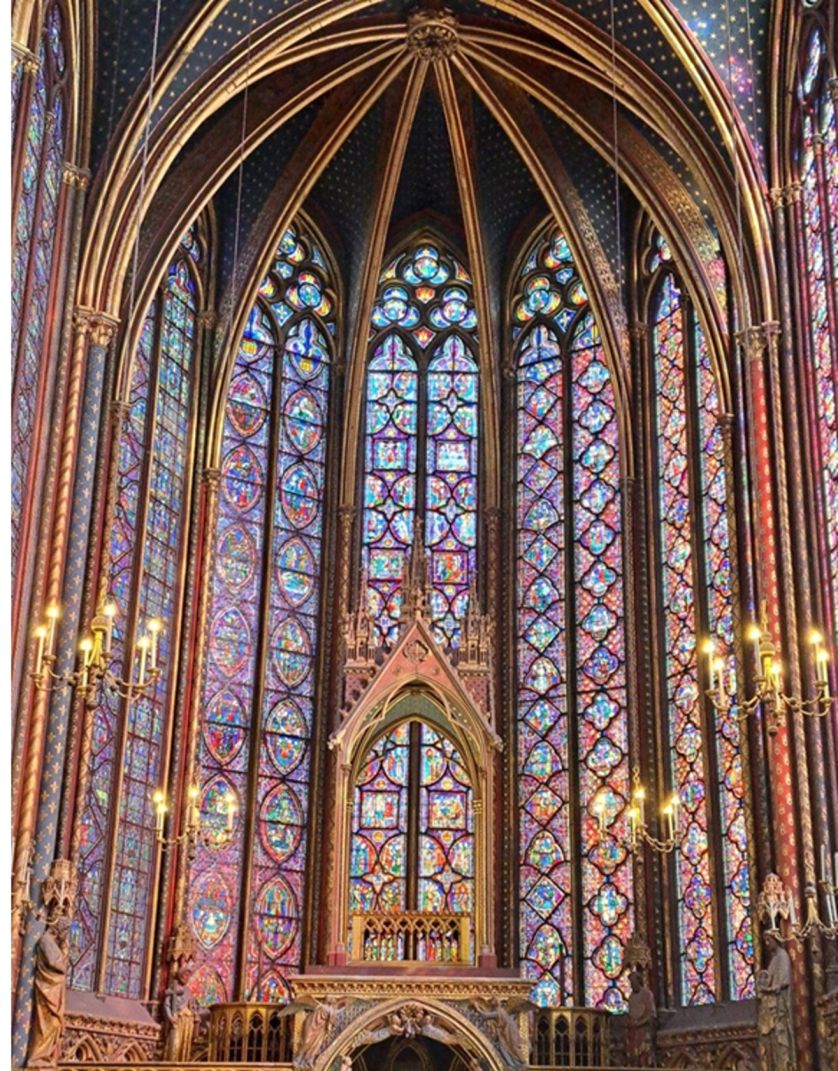
Window 10 is one step further toward the entrance along the south wall. After Judith and Job, its subject is Esther. In ancient Persia, Esther became queen while hiding the fact that she was Jewish. Even the king did not know her secret, until one day Haman, the king's closest adviser, plotted to wipe out every Jew in the empire. Esther faced two paths: keep her secret and survive alone, or reveal who she was and save her people.
At the bottom is a lavish Persian banquet, where Esther is chosen as queen and crowned. One tier up, the villain Haman seizes power; when a Jew named Mordecai refuses to bow to him, an enraged Haman plots a massacre. In the fourth tier, Esther risks her life by approaching the king, since Persian law put to death anyone who came before the king uninvited. Look for her in crown and veil before the enthroned king, as she pleads, "Spare my people." The top shows the ending: Haman is hanged on the gallows he built for the Jews, and the Jews are saved.
In the tympanum at the top, two small castles are set into the glass, the emblem of the House of Castile. As mentioned several times, look for them. The window reinterprets, in Old Testament light, the strong queen who saved her people, Esther, and the strong mother who protected her young son and the kingdom of France, Blanche.
Now on to the last of the side windows, Window 12, where David and Solomon await. Its subject is Kings, the stories of Israel's rulers, with two kings as the stars: David and his son Solomon. Of its five tiers, the bottom shows the childhood of the prophet Samuel, the rise of the first king, Saul, and Samuel anointing young David as the next king.
One tier up is the window's most famous scene, David and Goliath: a young shepherd facing a giant armored from head to toe. David slings a stone from a small leather sling and the giant falls; above, David draws Goliath's heavy sword and cuts off his head. The scene of David playing the harp for Saul is original 800-year-old glass. David was a warrior, poet and musician, and the songs he wrote are the famous Psalms.
In the middle, King Saul, jealous of David, tries to kill him, and David flees. David could have killed the sleeping Saul in a cave, but only snipped the hem of his robe and spared him. The scene of David meeting Bathsheba is nearby too. In the fourth tier, Saul dies in battle and David finally becomes king of Israel, with scenes of his anointing at Hebron and his joyful dancing.
The top tier and tympanum move to the reign of David's son Solomon. The scene to see here is the Judgment of Solomon. Two women both claim the same baby, and Solomon orders the child cut in two; the real mother cries out and gives up her claim, which reveals who she is. Look for Solomon on his throne, the two women and a guard with a sword. This scene is 13th-century original too. The tympanum shows Solomon and the Queen of Sheba, David handing the kingdom to Solomon, and Solomon praying after completing the Temple.
Window 12 is the second from the entrance on the south side, right beside the Relics window we introduced earlier. The message is probably that the faith and wisdom of great David and Solomon lead straight on to Louis IX in the neighboring window.
That completes the big side windows. A grand history of salvation has flowed along the walls, from the beginning of humanity to the kingdom of David and Solomon. Window 14 remains, saved as the climax of this tour. Next up are the windows of the apse and the west rose window.