Paris · Architecture
The History of Sacré-Cœur
Sacré-Cœur Basilica · Paris, France

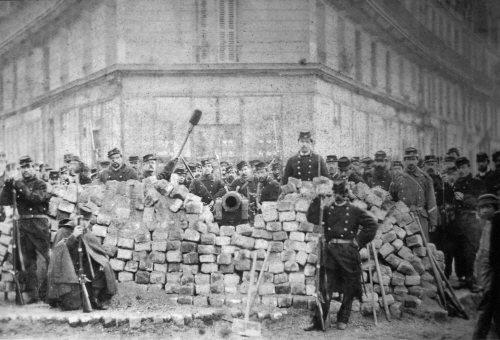
The idea for Sacré-Cœur took shape after the Franco-Prussian War of 1870. The war pitted Prussia's Bismarck, who was driving toward a unified Germany, against France's Napoleon III, who sought to stop him, and a dispute over the Spanish throne was the decisive spark. France declared war in 1870, but Prussia's military proved superior and France surrendered. The French read the defeat as punishment for the nation's spiritual and moral decline, and decided to build a church in atonement.
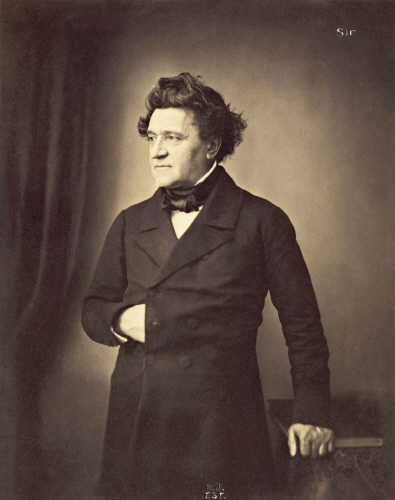
As soon as war broke out, Alexandre Legentil and the painter Hubert Rohault de Fleury had vowed to raise funds for a church if France came through safely. It did, with no invasion and no colonial rule, and the two set out to keep their promise. With the strong backing of Cardinal Joseph-Hippolyte Guibert, then Archbishop of Paris, and donations from Catholics, construction began. The names of the Parisians who gave money are still carved into the church walls. Building it was also a way to move past the string of upheavals that followed the defeat, including the Paris Commune of 1871, when Parisians and workers rose up and set up a revolutionary government.
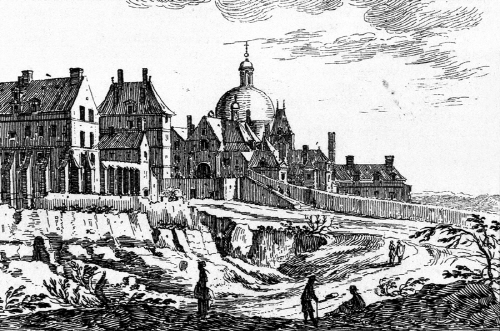
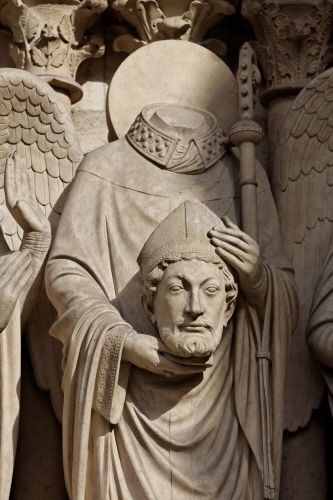
The site was chosen with care. Montmartre, whose name means "Mount of Martyrs", is traditionally the place where Saint Denis was martyred. In 210, a chapel was built here for Denis, the first bishop of Paris, said to be the world's first Christian sanctuary. According to legend, Paris's patron saint was beheaded by the Romans, and the spot where he fell is now the small church of Saint-Denis de la Chapelle in the 18th arrondissement. The hill was also home to a temple of the druids, the Celtic sages said to summon gods with magic and control the weather, and the ancient Romans reportedly built temples here to the local gods Mars and Mercury.
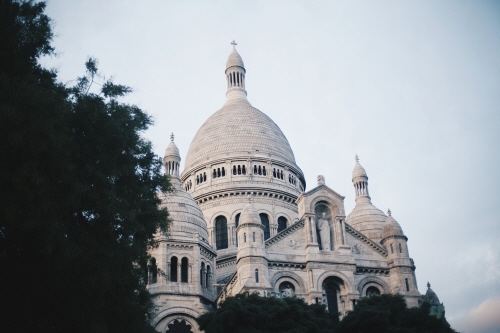
In 1874, a design competition drew 77 entries, and Paul Abadie's Romanesque-Byzantine plan won. Abadie had worked on the restoration of several medieval churches. He began his career auditing civil buildings, soon moved on to diocesan architecture, and took part in the restoration of Notre-Dame in 1845. Drawing on that experience, he designed Sacré-Cœur as an eclectic blend of features from other churches. His references included Saint-Front Cathedral in Périgueux in southern France, where he had worked, as well as Hagia Sophia in Constantinople and St. Mark's Basilica in Venice.
Construction ran from 1875 to 1914. Abadie died in 1884, and five architects took over in turn. The last of them built the bell tower and the reflecting pond for contemplation, now counted among Sacré-Cœur's loveliest features. With so many hands involved, and World War I breaking out along the way, the church was finished only in 1919, several years after the war ended.
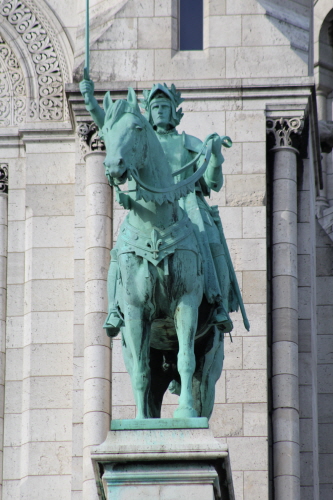
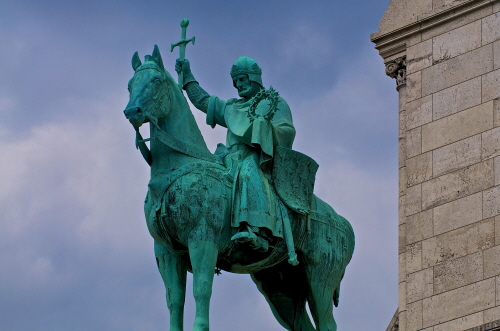
Sacré-Cœur was designed around the theme of nationalism. The columned portico has three arches, flanked by equestrian statues of Joan of Arc and Louis IX. Joan is the hero of the Hundred Years' War, the long struggle between France and England over the French crown. Most of the fighting took place on French soil and left the country devastated, and the war produced a national hero who went to the front after receiving visions from the Archangel Michael, Saint Catherine and Saint Margaret. Her bronze statue stands beside that of Louis IX, a just, peace-seeking, frugal king beloved by his people.
Then there is the dazzling white exterior. Many visitors wonder how such a large building stays so clean, and the secret lies in the stone. Abadie specifically requested limestone from Château-Landon, the same stone used for the Arc de Triomphe and the Pont Alexandre III. It is especially rich in calcite, the white mineral form of calcium carbonate that is the main component of limestone, marble and chalk. When humidity rises, the stone releases calcite on its own, making the building look even whiter, which is why Sacré-Cœur looks especially beautiful in the rain. Visitors thin out a little on overcast days, so an early cloudy morning is a lovely time to see the church glowing softly and mysteriously.
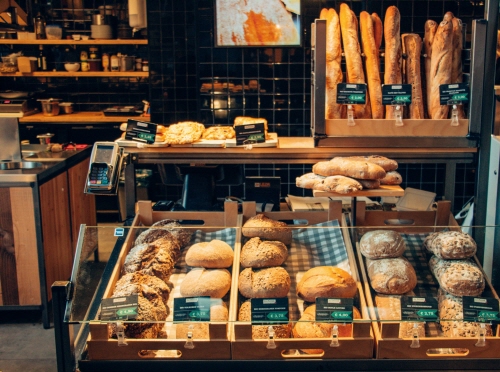
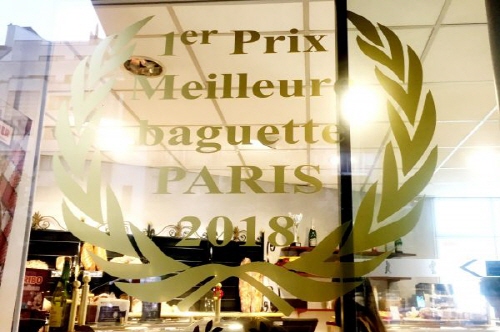
The neighborhood is also full of excellent bakeries, so a dawn visit pairs well with a stop at a boulangerie for breakfast. To pick a good one in Paris, look for a laurel pattern on the shop window along with a line announcing an award. Every year France picks its best bakeries and awards first to third place, and winners proudly post it on their storefronts. A fresh baguette is delicious with nothing on it at all.