Paris · Architecture
Inside and Out: Sacré-Cœur's Highlights
Sacré-Cœur Basilica · Paris, France
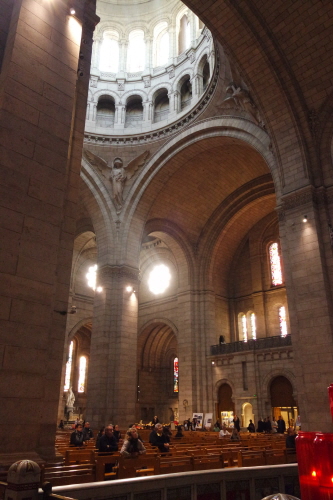
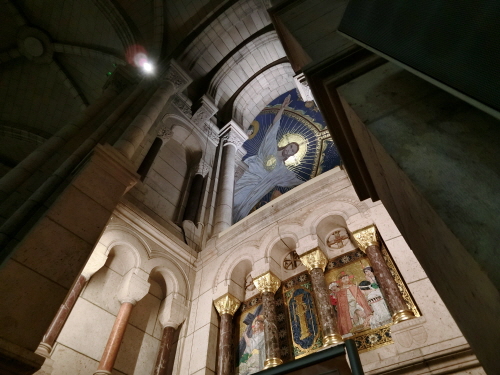
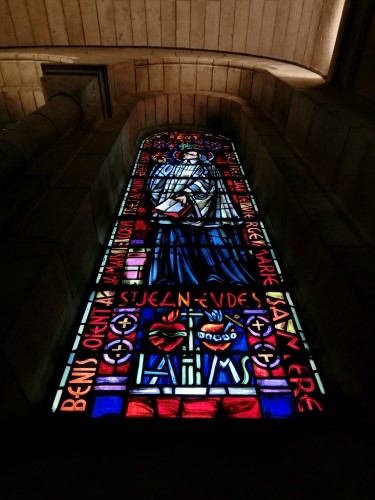
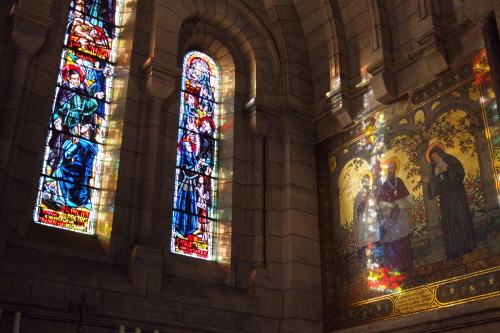
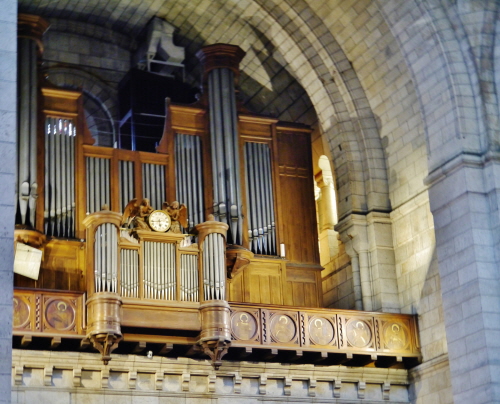
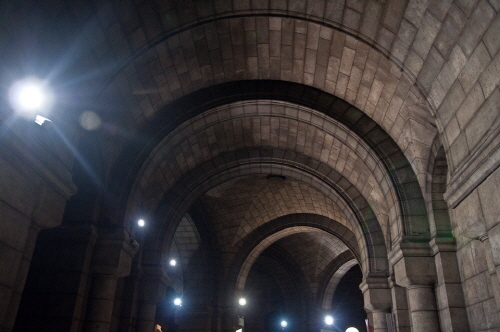
Once inside, staff direct visitors along a set route. You follow the person ahead in one big loop around the church, so wandering freely isn't really possible, but the interior is uncluttered and a slow circuit lets you take in most of the highlights in order. For an extra fee you can also climb the dome for an even better view over the city.
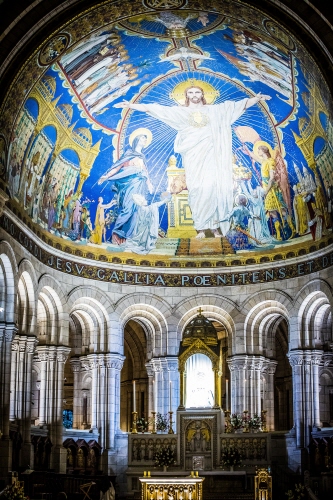
One of the most important spaces is the apse. Most churches have worship areas down both sides and a long, corridor-like stretch called the nave; the semicircular space that closes off the nave is the apse. This is where worship and the Eucharist take place, and what makes it special here is the mosaic. Completed over 22 years starting in 1900, this 475-square-meter depiction of the glory of Christ was designed by Luc-Olivier Merson, made by a mosaic workshop, and ranks among the largest mosaics in the world. At its center, the risen Christ in white robes opens his arms to reveal a golden heart, surrounded by France's patron saints, the Virgin Mary, Saint Michael, Joan of Arc, a woman personifying France, and Pope Leo VIII. The Holy Trinity appears on the mosaic's second tier. A Latin inscription below declares the basilica an offering from France to the Sacred Heart of Jesus: "Before the Sacred Heart of Jesus, France is fervent, penitent and grateful." The last word, "grateful", was reportedly added after World War I.
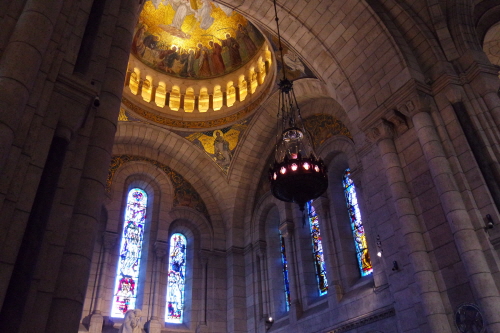
Among the interior's decorations, the stained glass stands out. Developed especially in northern France, it is one of the reasons people tour Europe's great churches, and it was made with great care. The windows at Sacré-Cœur were made and installed between 1903 and 1920, destroyed by a bomb in 1944 and restored in 1946. Scattered through the church are also modern-style windows. Some, with their rectangles and uneven straight lines that seem to echo the abstract painter Mondrian, feel a little at odds with the church's classical architecture, which is exactly what makes them catch the eye.
Turn around to take in the great organ facing the apse. Built by Aristide Cavaillé-Coll in 1898 as the private organ of Count Albert de Lespé in Biarritz, in southern France, it passed to the church in 1919 and was moved here. It has four keyboards, 109 ranks, 78 stops, 61-note manuals and a 32-note pedalboard. It was famous for its remarkably advanced design, which gave the player a wide range of expression, and was listed as a French national monument in 1981. It still keeps its original mechanical action and is regularly maintained, but its age is showing badly, and funds raised online from around the world are going toward its restoration. Because Sacré-Cœur is devoted to perpetual adoration of the Eucharist and is a place of quiet prayer, there are no organ concerts. The organ is played only for Sunday Mass and evening prayer, plus a single concert on Christmas Eve.
The crypt, reached through a separate entrance outside the church, is currently closed for security reasons. After touring the interior, you can climb the dome instead, but only by a staircase of about 300 steps. Both the dome and crypt entrances are found by exiting on the church's left side. Down in the crypt are the tombs and memorials of cardinals, an urn holding the heart of Alexandre Legentil, who pledged to build the church, the basilica's foundation stone, a memorial to clergy killed in the two world wars, and a small chapel dedicated to the Holy Family, along with many treasures given to the church. The central dome, with a keystone at 54.94 meters and a diameter of 16 meters, is the main axis of the building and the shape most people picture, offering views of up to 30 kilometers on a clear day.
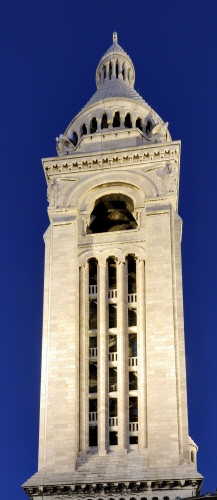
The bell tower holds one of the largest bells in the world. Sacré-Cœur has five large bells, four small ones and one enormous bell. During construction, people across France donated funds and materials, and the Savoie region in the Alps gave a bell three meters across, cast in Annecy by the Paccard company. Called La Savoyarde after its region, and officially named Françoise-Marguerite, it was hauled up to the top of Montmartre by dozens of horses in 1895. At 19.685 tonnes, it is the heaviest bell in France and the fifth heaviest in Europe, behind those of Cologne Cathedral, the Olympic Bell in London, the bell in Rovereto in Italy and the Pummerin in Vienna. It rings on major religious holidays such as Easter and can be heard up to 10 kilometers away. It stayed free of cracks for a very long time, but a small one was found in 1999. It is not open to the public, so you can't see it up close, but if you're nearby on a holy day you can hear its deep resonance.