Paris · City Walks
Notre-Dame de Paris: Hugo's Cathedral and the Story of the Bohemians
Paris · Paris, France
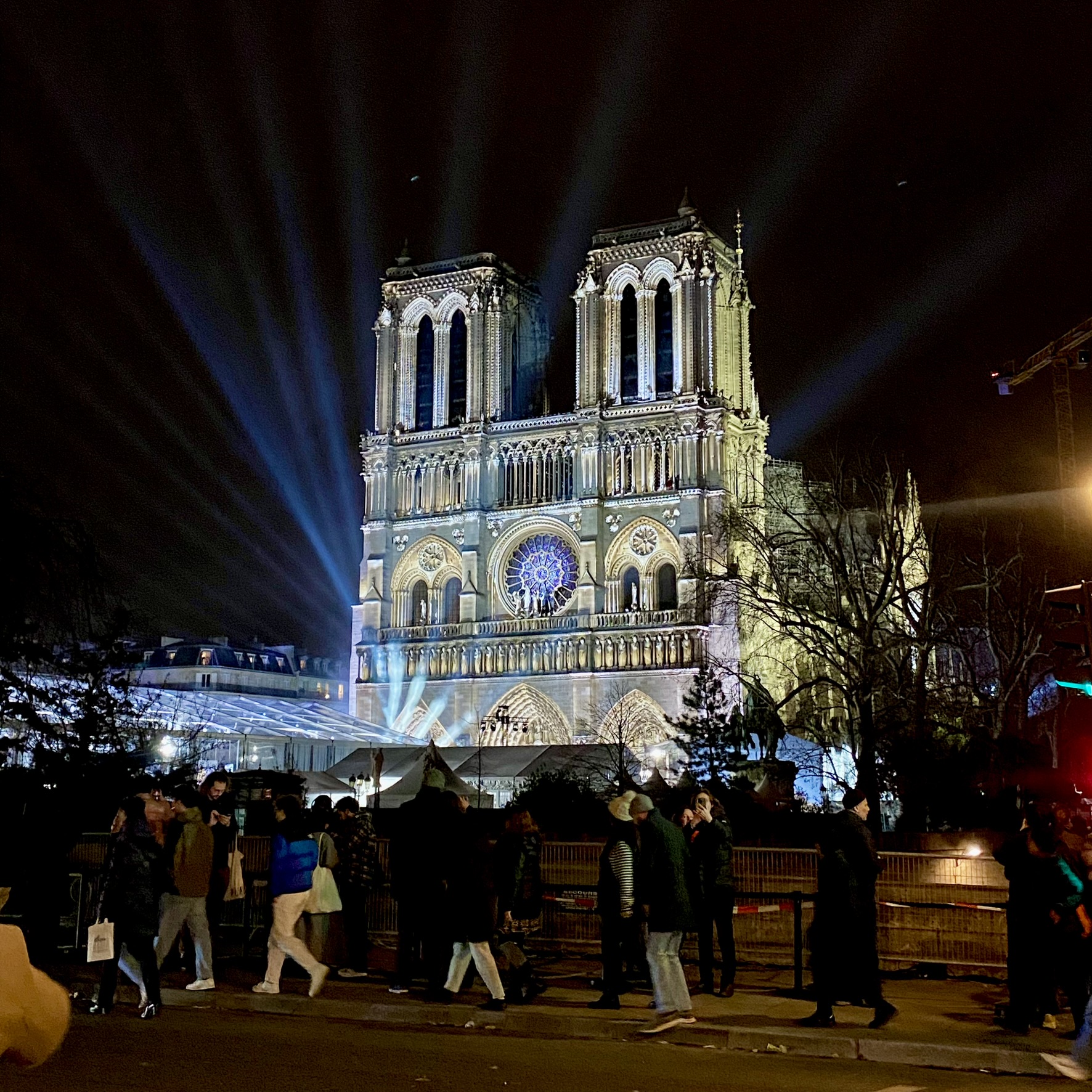

"A beautiful city, Paris, in an all-powerful age, in the year 1482, a tale of desire and love." Bell tower, bell-ringer, cathedral, Bohemians. Yes, this is Victor Hugo's novel Notre-Dame de Paris. Set in 1482, when the Church stood at the centre of the world and witch hunts raged, it tells a tragic yet beautiful love story around the Bohemian woman Esmeralda, the lonely bell-ringer Quasimodo, the confident captain of the guard Phoebus and the zealous bishop Frollo. The title means "Our Lady of Paris", referring to this cathedral dedicated to the Virgin Mary. In English, it is widely known as The Hunchback of Notre Dame.
Standing in the heart of Paris, Notre-Dame has been loved as a symbol of the city for hundreds of years, but it hasn't always been glorious. In the early 19th century, before Hugo published his novel, it had been nearly forgotten. During the French Revolution, the cathedral became a focus of religious and political conflict: its spire was taken down, statues of the Jewish kings, mistaken for statues of French kings, were destroyed, and for a time it was even used as a warehouse. The person who changed its fate was Hugo. His novel, published in 1831, reminded the public of the cathedral's beauty and its cultural and historical value, and it spurred a restoration movement. From 1845, large-scale restoration went on for some twenty years: Gothic style was revived, the spire was raised again, and damaged statues and stained glass were restored, giving the cathedral the form we know today. In 1991 it was listed as a UNESCO World Heritage Site. The musical Notre-Dame de Paris premiered in Paris on 16 September 1998 to huge success, reportedly earning a place in the Guinness World Records, and has since been staged in more than 20 countries.
Now let's follow the Bohemians of the story to uncover some of Paris's hidden history. Esmeralda is a free Bohemian, a so-called "gypsy" woman, bound by neither status nor restraint. But "gypsy" has historically also been used as a derogatory term for the Romani, a nomadic people. They are said to have lived communally, often with no fixed occupation or home, and music, storytelling and mystical arts were central to their way of life. Having left northwest India some 1,500 years ago and wandered for centuries, they went by many names in Europe: in England "gypsies", in France "Bohémiens". "Gypsy" came from the mistaken belief that they were from Egypt, and "Bohémien" from the belief that they came from Bohemia, in today's Czechia. There's a story behind that mix-up. In 1423, Sigismund, Holy Roman Emperor and King of Bohemia, unlike other European rulers, did not persecute them. He wrote a letter of protection asking that they be protected and shown favour. It reportedly said: "Wherever they appear in any city or village within our empire, we ask that they be received with the loyalty you would show us." When the Romani carried this letter into France, the French saw it, assumed they were people from Bohemia, and started calling them "Bohémiens".
The earliest record of them in France dates to 1427. According to the account, 120 Bohemians arrived in Catholic France, claimed to have converted, obtained permission from the Pope to receive support from the Church and settled in the village of La Chapelle-Saint-Denis near Paris. They then supported themselves through begging and fortune-telling and formed their own community. The area they lived in was called the "Court of Miracles", for a reason both absurd and sad: people who had been begging while pretending to be disabled to win sympathy would, on returning to their hideout, be miraculously cured. Their way of life caused controversy, and as they were accused of theft and witchcraft, relations with the villagers worsened. In the end, the Bishop of Paris excommunicated them and drove them out. In the musical's "Court of Miracles" scene, the Bohemian leader Clopin sings: "Beggars dance with thieves in this Court of Miracles. We all share the same fate; our fate is the gallows anyway." The lyrics sum up how the Bohemians lived at the time. Persecution wasn't only a medieval matter, either: during the Second World War, Nazi Germany murdered hundreds of thousands of Romani, and in 2010 French President Sarkozy's policy of expelling Romani people drew international controversy.
In the story, the Bohemians, with Esmeralda at their centre, symbolise the lives of oppressed outsiders who are free and passionate yet face a harsh reality. Early in the musical, in the number "La Sorcière", Bishop Frollo, revealing his lust for Esmeralda and his inner conflict, describes her like this: "Beware of that gypsy woman. She's a Bohemian witch. A beast who roams the streets barefoot like a wild cat. Even to look at her is a sin. The devil's daughter, that witch." Later, Esmeralda is ultimately put to death. In the number "Déportés", tragically, it is Phoebus, the very man she loves, who speaks to her: "In the name of the King, I proclaim the verdict of the Paris court. Esmeralda, for the crime of witchcraft, you are sentenced to hang. And you, illegals: expulsion, exile, forced removal."
Yet "Bohemian" isn't always negative today. It was in early 19th-century Paris that the word came to mean a life that prizes art and creativity and rejects social norms, or people who pursue such a life. In France, the US and elsewhere, people captivated by the Romani's free, unbound way of life got close to them or lived alongside them, were influenced by them and began living that way themselves. Many performances were inspired by the Bohemians, too. Besides Notre-Dame de Paris, examples include the opera La Bohème, about the lives, loves and friendships of artists in the Latin Quarter in the 1830s; the musical Rent, which transplants it to late-1980s New York; and the opera Carmen, about the free-spirited love and tragedy of the gypsy woman Carmen in 1820s Seville. Today, the place in Paris where you can best feel the Bohemian spirit is Montmartre, once home to artists like Picasso and Van Gogh, where traces of the Bohemian life remain.
In December 2024, Notre-Dame, which might have vanished into history, came back to us. A fire during renovation in April 2019 brought down the spire and destroyed most of the wooden roof, but after five years of restoration, the day it reopened to the public was moving and historic. At the celebration, three of the musical's signature songs, "The Age of Cathedrals", "The Bells" and "Belle", were performed as a medley. What stood out was that "The Age of Cathedrals", originally sung by another character, was performed by the actor playing Quasimodo. The lyrics go: "The age of cathedrals has come. The world is entering a new millennium. Man, who longs to reach the sky, writes his history in glass and stone." Seeing Quasimodo, who tolled the bells so faithfully out of sight that he lost his hearing, sing this to celebrate the reopening felt like a staging that gave strength to the weak and the marginalised.
Notre-Dame came close to vanishing twice. In the 19th century, amid public indifference, it nearly faced demolition, but Hugo's novel gave it a new life. In 2019, the fire badly damaged it, but thanks to the efforts of countless people it has returned. Today its bells still ring, telling an everlasting story that links past, present and future.