Paris · Painting
A Night Sky with No Black Paint: Van Gogh's Starry Night Over the Rhône
Musée d'Orsay · Paris, France
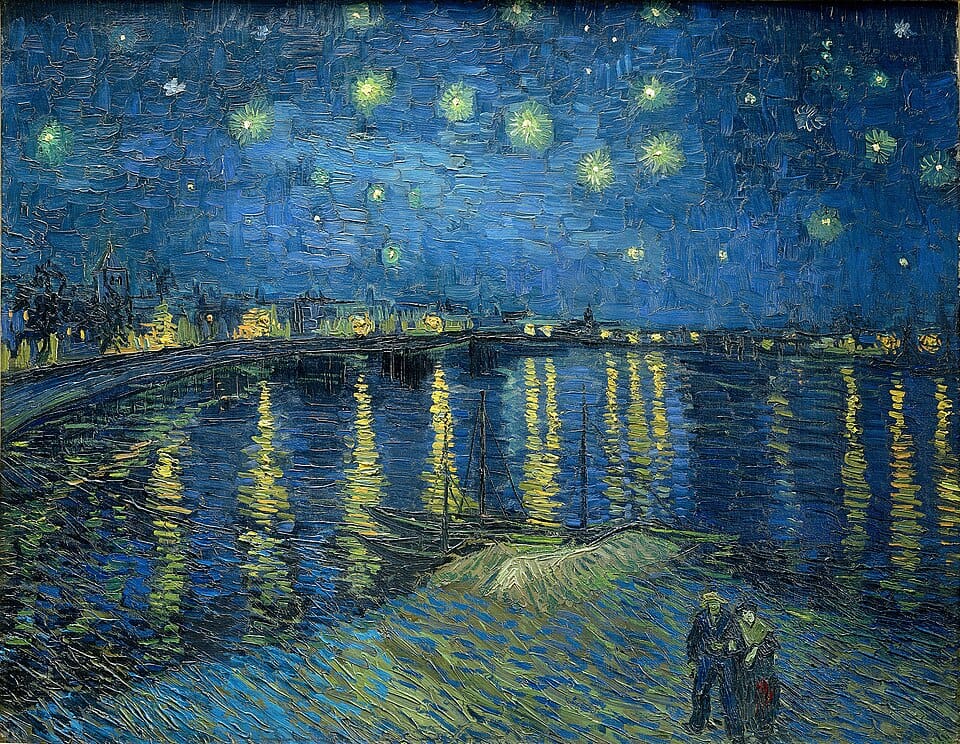
If you had to name the single most famous painting at the Musée d'Orsay, it might well be this one — Vincent van Gogh's Starry Night Over the Rhône. After leaving behind a difficult life in Paris for Arles, Van Gogh experienced some of the happiest moments of his life there, and that happiness is woven directly into this canvas.
The setting is an evening view of the Rhône River as it flows through Arles. Among the stars overhead, the seven at the center form the Big Dipper, and the orange glow scattered between the buildings across the river comes from the gas lamps that lit the streets at the time. That light stretches out in long reflections across the water, and in the lower right corner, a couple strolls together, rendered small.
What's worth paying closest attention to here is the color of the night itself. In Arles, Van Gogh became deeply fascinated with how to depict darkness. He told his brother Theo he wanted to paint a starry night, and told his sister that night held richer colors than day. He believed purple, blue, and green appeared far more intense after dark. Where we might see only blackness in a night sky, Van Gogh found purple, blue, and green — and as a result, not a single stroke of black paint appears anywhere in this night sky.
The color contrasts are worth noting too. Blue and yellow sit opposite each other on the color wheel, and placing them side by side makes each one pop more vividly — which is exactly why the yellow stars here look so bright and sharp. The village lights reflected on the water are built from short brushstrokes stretched out in long strokes, creating the effect of light rippling along with the river's current.
Van Gogh's paintings look noticeably different in person than they do in photographs or on a screen, largely because of the heavy texture of the paint. He favored a technique called impasto, and up close you can see the paint built up in thick ridges on the canvas.
People sometimes look at this painting and say it doesn't match the Starry Night they remember — what they're usually picturing is a different painting with the same title, held at the Museum of Modern Art in New York. Despite sharing a name, the two feel very different. The MoMA version is far more intense, dynamic, and somewhat chaotic. Van Gogh painted it while institutionalized at the asylum in Saint-Rémy, struggling with various mental health conditions, and that turmoil shows in the brushwork. By contrast, the Starry Night Over the Rhône we're looking at here feels far more peaceful. Van Gogh loved the warmth of Arles, and this was a period when he was discovering and refining his own style, full of dreams and hope — and that sense of happiness runs through this painting and everything else he made there. In fact, art therapists reportedly show this particular painting to people struggling with emotional instability, since the blue tones Van Gogh painted here are said to bring a sense of calm.