Paris · Painting
A Village Shared by a Hundred Painters: The Barbizon School
Musée d'Orsay · Paris, France
Barbizon is a small village about 50 kilometers from Paris. Artists who lived and painted there between the late 1830s and the 1870s are collectively known as the Barbizon School. Unlike Romanticism or Neoclassicism, this isn't really a single artistic style — it's a group identity defined simply by living in the same village, even though each painter's style and interests differed. That's what sets it apart from other art movements.
Several things drew painters to this particular village. As the Industrial Revolution reshaped cities at breakneck speed, it also, ironically, left many people unable to adjust to urban life, feeling a growing nostalgia for nature and the countryside. Rising rents in Paris pushed poorer artists further and further out into rural areas as well. Some also fled to the quieter, less densely populated Barbizon to escape the cholera outbreaks sweeping through Europe at the time.
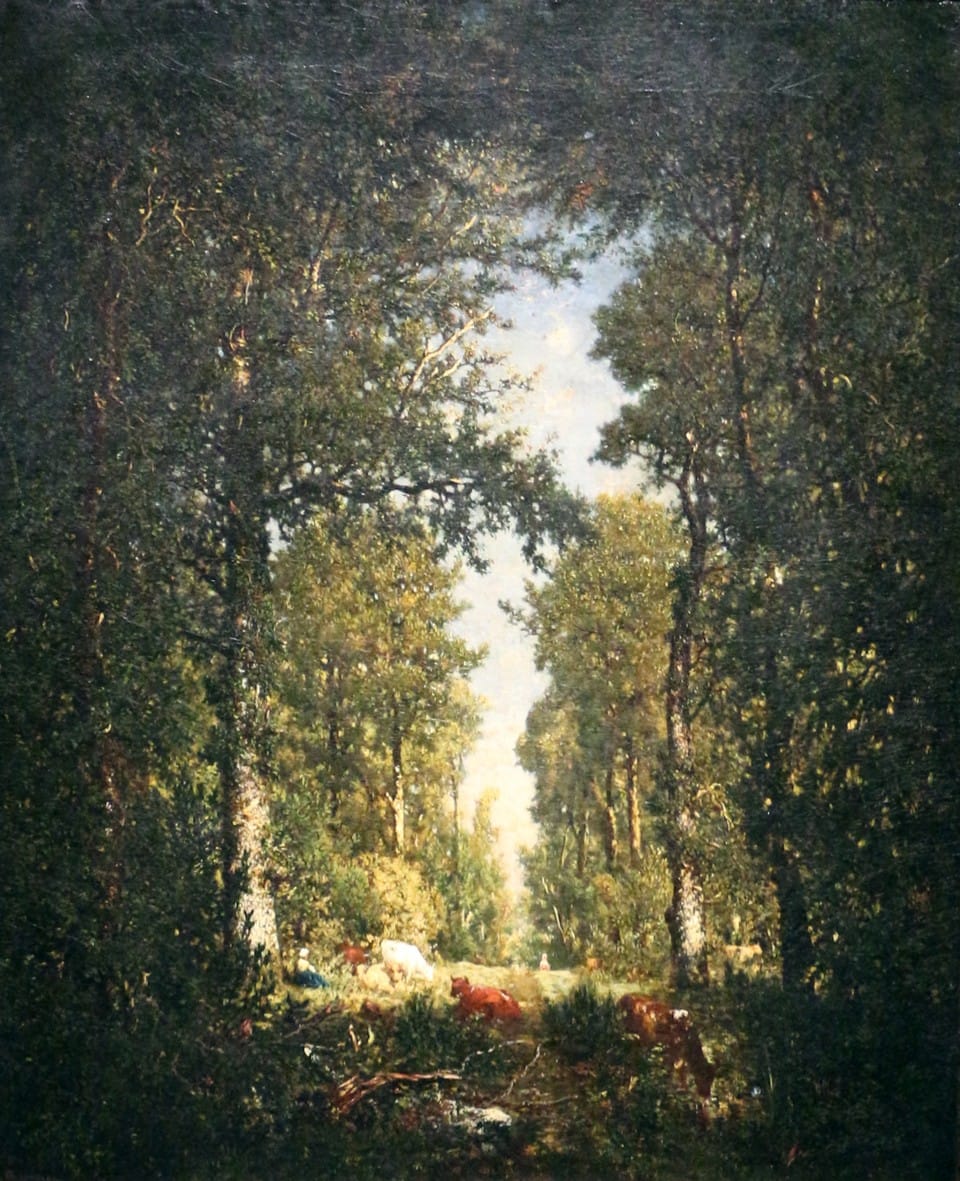
Whatever brought them there, and however different their styles, these painters shared one consistent interest: nature itself. Barbizon's own modest, unpretentious scenery was a draw, but so was the nearby Forest of Fontainebleau, which covers more ground than central Paris and offered an ideal setting for painting the natural world. At its peak, more than a hundred artists lived in the village, earning it the nickname "the painters' village." Seven of them — Millet, Rousseau, Corot, Daubigny, Dupré, Diaz, and Troyon — are collectively remembered as the "Seven Stars of Barbizon."
Each had a distinct approach. Rousseau, Corot, and Dupré focused on subtle shifts in natural scenery brought about by changing weather, grounded in deep studies of light — an approach that would later influence the Impressionists. Millet turned his attention to the everyday lives of farmers working the land around Barbizon. Troyon and others like him painted animals — cattle, dogs, horses — set against natural backdrops.
At the time, the French art world was dominated by historical and mythological subjects and portraits of great men, so these painters' work didn't receive anywhere near the recognition it enjoys today. But because they quietly kept to their own path, the generation that followed felt freer to take on landscape painting more boldly — and painting as a whole moved one step forward because of it.