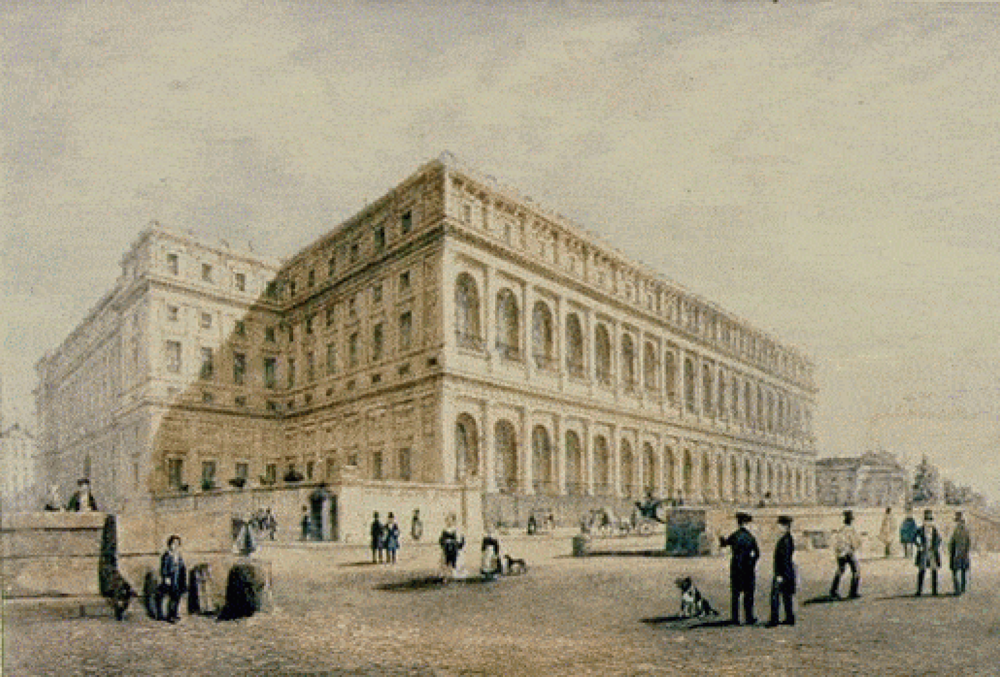
Paris · Painting
Quiet Devotion, or a Hidden Coffin: Millet's The Angelus
Musée d'Orsay · Paris, France
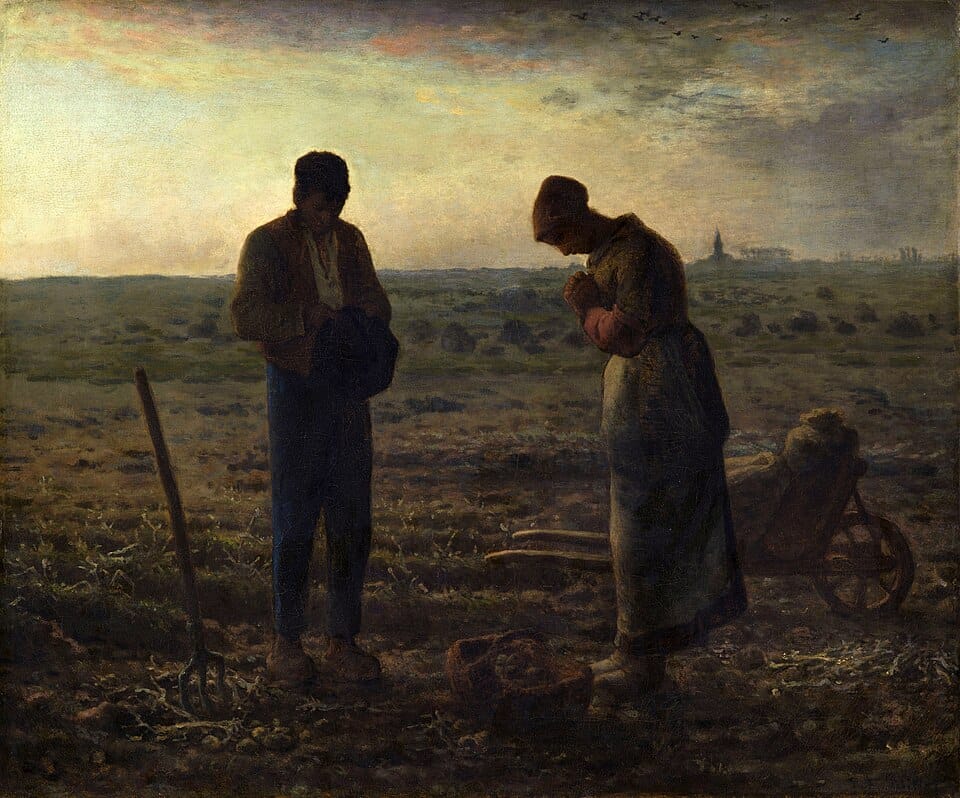
Two figures stand still in a field, hands folded in prayer, pausing their work at the sound of a church bell ringing out in the distance. Millet's best-known painting, The Angelus, is beloved precisely for that hushed, devotional stillness.
In Korean, the title translates roughly as "evening bell," but the original French title, L'Angélus, refers to the Angelus — a set of prayers Catholics recite three times a day, at morning, noon, and evening. Knowing the actual title makes the bell and the praying figures click into focus in a way the literal translation doesn't quite capture.
Millet painted this scene from memory, recalling how, as a child working in the fields, he'd watch his grandmother stop everything and pray whenever the evening bell rang. Millet himself came from farming stock and, aside from a brief stretch in Paris, spent nearly his entire life in the countryside. Rural life was, quite simply, his whole world — which is why the vast majority of his paintings depict it.
Given how famous this painting became, it's accumulated a rather colorful legend along the way. According to one theory, the potato basket sitting between the two figures was originally a coffin holding a dead infant, which Millet supposedly repainted as a basket of potatoes. The story traces back to the Spanish artist Salvador Dalí, who claimed the painting filled him with unease rather than reverence, insisted the basket concealed a child's corpse, and even painted works inspired by the idea. The theory gained traction when an X-ray of the canvas revealed that something else had, in fact, once occupied the spot where the potato basket now sits, painted over before the final version.
That said, painters of the era were often desperately poor and couldn't afford to discard canvases, so painting over an earlier composition was a common, unremarkable practice — and Millet, who could barely afford paint, was no exception. Scholars who study Millet's work generally reject the theory outright, pointing out that even the poorest burial would have required at least some basic implements, none of which appear anywhere in the painting.
The painting carries another story of its own. A buyer had originally agreed to purchase it, then abruptly backed out, leaving Millet in financial difficulty — until a sympathetic art dealer stepped in, bought the work as a show of support, and resold it. The painting went on to become enormously popular in the United States, where a culture of restraint and religious devotion was still strong at the time. At auction, it was contested between the American Art Association and the Louvre, with the Americans ultimately winning the bid. The Louvre, unable to match the price, eventually got the painting back when Alfred Chauchard, a French department-store magnate, bought it and donated it to the museum. When the Musée d'Orsay later opened, the painting was transferred here, which is how it ended up in front of us today.