Paris · Painting
The Crime of Painting an Uncomfortable Truth: Millet's The Gleaners
Musée d'Orsay · Paris, France
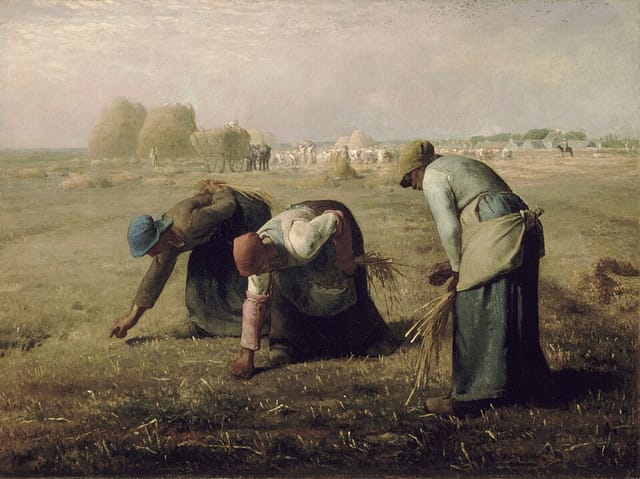
Millet spent ten years studying the practice of gleaning before completing this painting. Set in a field near Barbizon, it shows three women gathering stray grains left behind after the harvest. They aren't farmers themselves — they're poor women without land of their own, surviving on the scraps left in someone else's field.
The pouch at the waist of the woman on the right, caught mid-stoop, hangs empty — a stark contrast to the towering stack of harvested grain visible behind them, a detail that gives the whole scene a quiet ache. Millet painted each woman in a different stage of the motion — bending, gathering, rising back up — capturing, almost frame by frame, just how grueling this labor really was.
Landowners once allowed the poor to gather whatever grain was left over after harvest, a small gesture widely regarded as an act of charity. But by the mid-19th century, when Millet painted this, the Industrial Revolution had transformed cities, and grain from Barbizon — just 50 kilometers from Paris — was selling fast in the capital. Landowners eager to squeeze out every last bit of profit began restricting gleaning rights or charging for them, and public opinion toward landowners soured considerably during this period.
Against that backdrop, Millet submitted this painting to the Salon, and the reaction from the bourgeoisie and critics was sharply negative — the painting read, to many, as an implicit criticism of the growing gap between rich and poor. Other painters had depicted farmers before, but typically against picturesque, idealized rural backdrops; Millet instead painted rural life with unflinching honesty. Since most people with the leisure to attend art exhibitions at the time were themselves solidly middle-class or above, this uncomfortable truth didn't sit well, and some accused Millet of painting with a political agenda.
But Millet wasn't interested in making political statements — he was simply the painter who captured French rural life more honestly than anyone else. The painting remains in high demand for loans even today; in 2016, it spent roughly six months on exhibition at the Hangaram Art Museum in Seoul.