Paris · Painting
Resting Beside a Friend: Millet's Late Work, Spring
Musée d'Orsay · Paris, France
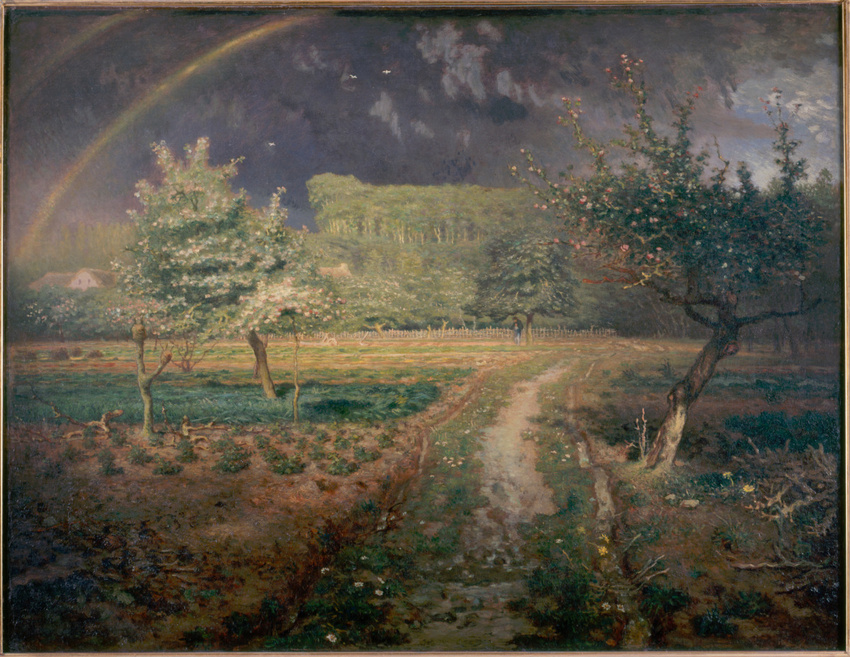
Spring, one piece from a seasonal series Millet painted late in life, shows a narrow path winding through an open field — bright spring light fills the left side of the canvas while rain clouds still linger on the right, capturing that exact moment when winter has just given way to spring. Millet set out to complete a full four-season cycle in his final years, but he died having finished only three — Spring, Summer, and Autumn — leaving Winter as nothing more than a preliminary sketch. That alone makes this one of his last major works.
It's often said that Millet moved to Barbizon out of a romantic love of nature, but the more accurate story is that financial hardship drove him there — Barbizon was simply cheap and full of other artists. It was there that he met Théodore Rousseau and formed a close, lasting friendship.
Spring reveals a softness and delicacy of color quite different from the heavy, earthbound peasant scenes Millet is best known for. Part of that shift came from his declining health in his later years, and part from the influence of Rousseau's landscapes, which steered him toward a calmer, more serene mood. Notably, this is one of the rare Millet paintings with no farmers in it at all — just nature, observed on its own terms.
Before his death in Barbizon in 1875, Millet asked to be buried "beside my friend Théodore Rousseau," and the two painters do, in fact, lie side by side today in the Barbizon cemetery. It sits near the Forest of Fontainebleau, and visitors can walk through the same woods and fields the two men loved throughout their lives — a fitting way to feel the depth of their friendship and shared artistic world.