Paris · Painting
A Painting Born of Grief: Signac's Women at the Well
Musée d'Orsay · Paris, France
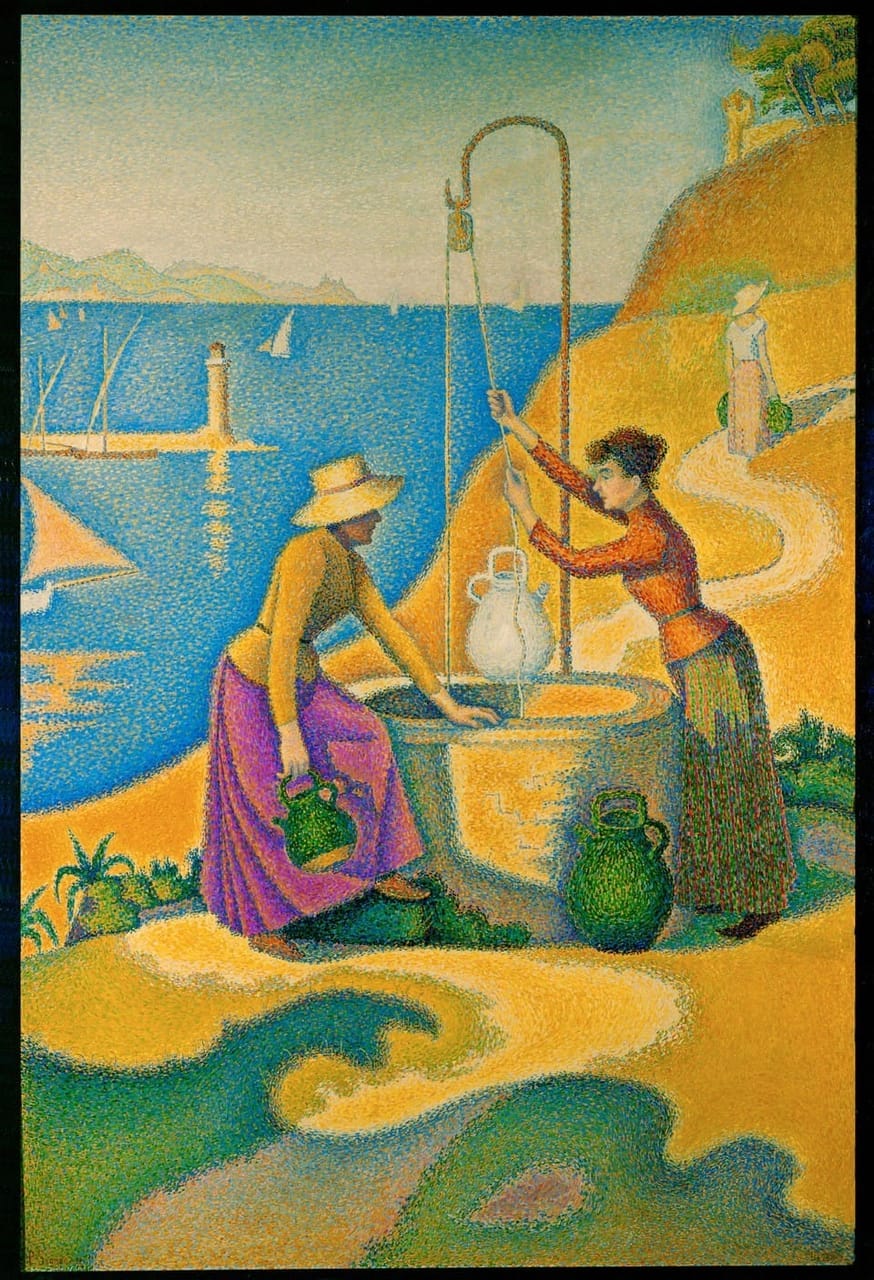
This painting is set in Saint-Tropez, a resort town on France's southeastern coast. Signac combined real landmarks from Saint-Tropez — a lighthouse, a well, a church — into a single composition, but what really deserves attention here isn't the setting itself, it's Signac's signature technique: pointillism, the method of building an image from dots rather than brushed color.
The painting dates to 1892, the year after Georges Seurat, pointillism's inventor, died. Signac had originally painted in an Impressionist style influenced by Monet, until he encountered a pointillist painting by Seurat at an independent exhibition and was captivated. He went on to learn the technique directly from Seurat and became a fellow Neo-Impressionist painter alongside him. But Seurat died suddenly at just thirty-two, and Signac's grief at losing a friend, a colleague, and the founder of the movement they shared must have been immense. He went to Saint-Tropez to find some solace, and it was there that he completed this painting, Women at the Well.
Experts note that, likely without Signac even realizing it, Seurat's final painting, The Circus, casts a long shadow over this canvas. On the right side of Signac's painting, women draw water in a scene full of motion, while the sea on the opposite side stays calm and still — a contrast that mirrors The Circus, where the center of the ring bursts with energy while the audience sits in stark stillness. The slightly strange patterning in the green grass at the bottom of Signac's painting echoes the pattern on the clown's head and collar in the same position in The Circus. And the winding hillside path in Signac's work recalls the curving whip the ringmaster cracks in Seurat's. Experts suggest that Signac, perhaps without even being aware of it, carried his friend's final work into his own painting — a measure of just how much he missed Seurat.
After Seurat's death, Signac continued working tirelessly as both a painter and theorist of Neo-Impressionism, and through his efforts the style went on to spread widely and influence generations of painters who followed.