Paris · Painting
Eternity Over the Instant: Signac's Woman with an Umbrella
Musée d'Orsay · Paris, France
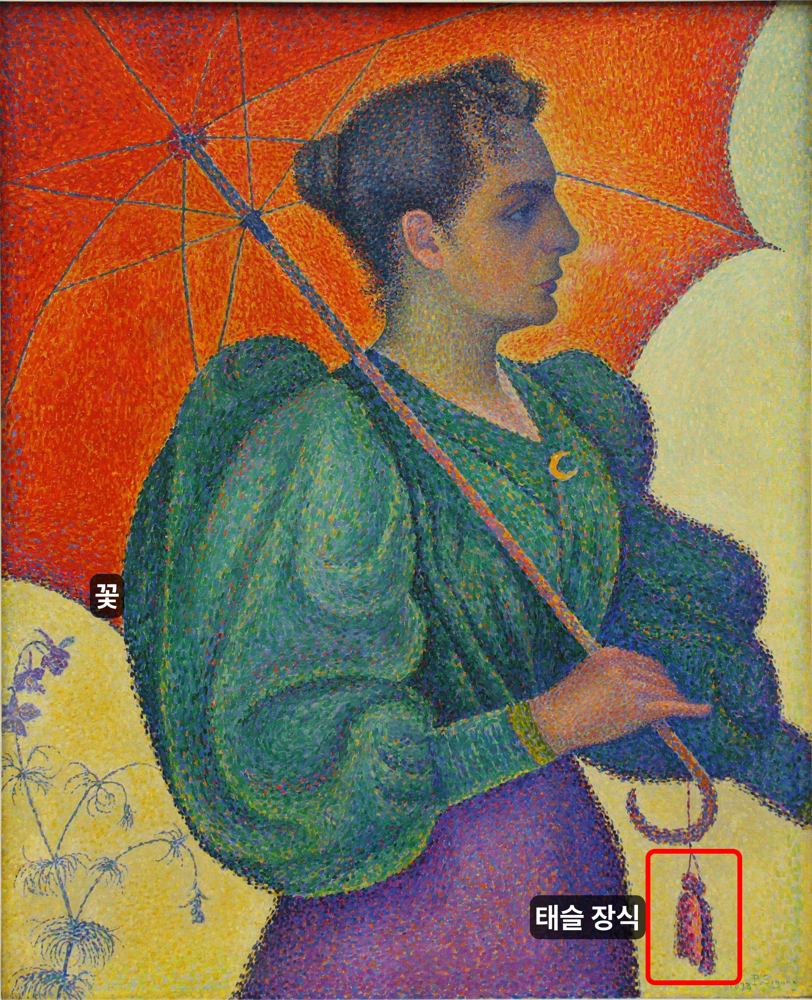
The model for this painting is Berthe Roblès, Signac's wife. Given that he was painting his own wife, it's easy to imagine him taking particular care with this work, and the first thing that stands out here is color. The umbrella is red; the woman's top, pressed right against it, is green — the two sit directly opposite each other on the color wheel. Her skirt's purple is likewise a complement to the green. Placing complementary colors side by side sharpens the contrast between them, making both colors read more vividly. Signac flattened the whole composition like a woodblock print, stripping away perspective and volume entirely, and relied instead on complementary contrast to make the color itself the main event. That pursuit of pure color is a defining trait of Neo-Impressionism.
The simplicity of its lines could easily have left this painting feeling a bit stiff, so Signac softened it with small touches — the tassel at the tip of the umbrella and a curling floral motif tucked into the lower-left corner.
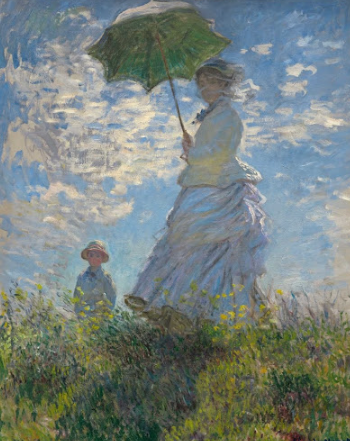
Neo-Impressionism and Impressionism share similar names and get mixed up often, but they're distinctly different movements. Monet, in fact, painted the same subject under the same title, Woman with a Parasol, also using his own wife as the model. Both paintings show a woman holding an umbrella, yet the impression each one leaves couldn't be more different.
Monet's painting captures the fleeting instant when wind sweeps through his wife's dress and the grass around her. Time never stops moving, and light and shadow shift constantly along with it, but Monet wanted to pin down one single passing moment onto his canvas — hence the quick, spontaneous brushwork. Signac's painting, by contrast, feels less like an instant and more like something permanently fixed in place. Neo-Impressionist painters weren't chasing a moment at all — they wanted to capture the unchanging essence of their subject, and instead of loose, free brushwork, they chose the disciplined, orderly repetition of tiny dots. Composition and order mattered enormously to them, and the slight stiffness of this painting is really a direct result of that pursuit of proportion and order.
Impressionism, with its light brushwork chasing a single instant, and Neo-Impressionism, built dot by painstaking dot in pursuit of something unchanging — the difference between the two movements comes through clearly when you set these two paintings side by side.