Paris · Painting
Beyond What the Eye Sees: How to Read Cézanne
Musée d'Orsay · Paris, France
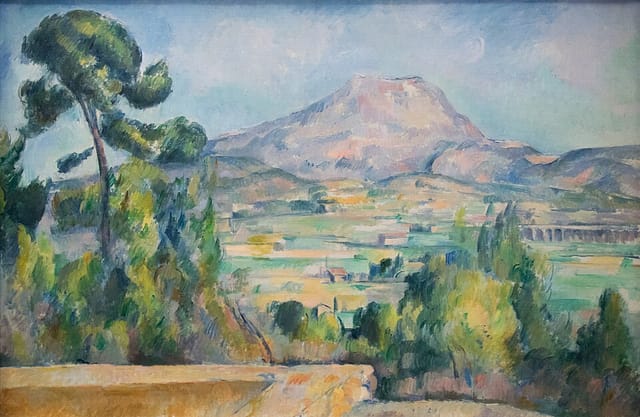
Cézanne is counted, alongside Van Gogh and Gauguin, as one of the defining figures of Post-Impressionism. His paintings, though, aren't easy to explain. Most of the paintings we've seen so far were either preoccupied with making a figure look more human, or with achieving realistic perspective, or told stories drawn from history or mythology — all of which made them relatively easy to describe and easy to follow. But once science advanced and the camera arrived, painting moved beyond all of that into something on a different plane entirely. Cézanne's work sits right at that turning point. Rather than simply reproducing what the eye sees, he was after the essential nature of things.
That's why his paintings don't come from a single fixed viewpoint. He layered multiple vantage points into a single canvas at once. And rather than depicting an object exactly as it appeared, he tried to find its underlying form through geometric shapes — triangles, cylinders — to get at something more fundamental.
This is exactly why Cézanne is called the father of modern art. Art tends to grow a bit more demanding the further it moves into the modern era, and Cézanne stands right at the beginning of that shift.