Paris · Painting
An Anxious Face Before a Departure: Gauguin's Self-Portrait with Yellow Christ
Musée d'Orsay · Paris, France
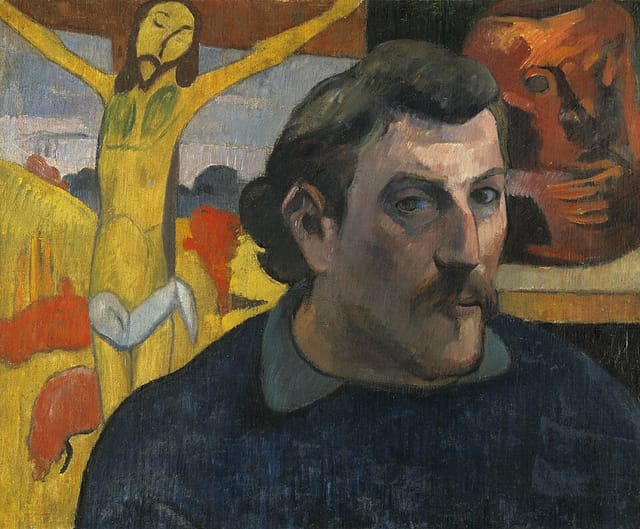
Painted before his departure for Tahiti, this is Gauguin's Self-Portrait with Yellow Christ. Gauguin, alongside Van Gogh and Cézanne, is classified as a Post-Impressionist, and while early Impressionism focused on the momentary movement of light, Post-Impressionism turned its attention instead to the true nature of things and the inner life of human beings.
The figure at the center of this canvas is Gauguin himself, and his expression reveals a coarse, highly strung personality. Behind him sit two actual works he made: on the left, a painting of Christ rendered in yellow, titled Yellow Christ — he colored Jesus yellow to needle contemporary prejudices, and gave the face his own features. Beside it sits a ceramic piece titled Self-Portrait Jar in the Form of a Grotesque Head, also one of Gauguin's real works. Interestingly, the Yellow Christ shown here has its head tilted in the opposite direction from the original painting, because Gauguin was working from his own reflection in a mirror. The original Yellow Christ now hangs at the Albright-Knox Art Gallery in Buffalo, New York, while the self-portrait jar is held right here at the Musée d'Orsay.
Gauguin had grown weary of civilized, urban life, and believed that untouched, unspoiled lands still held a kind of pure energy. That conviction led him to decide on Tahiti, an island in the South Pacific steeped in the exotic, and this self-portrait was completed just before he set sail there in April 1891. In the Yellow Christ panel on the left, Jesus stretches his arm out over Gauguin's head — a suggestion that God would watch over and protect him. The rough-textured jar on the right, along with Gauguin's own expression, convey the anxiety of setting off for unfamiliar territory — a mood that stands in sharp contrast to the gentle figure of Christ beside it. Through this self-portrait, Gauguin laid bare his own uneasy state of mind on the eve of a journey into the unknown.