Paris · Painting
Joy, in Tahitian: Gauguin's Arearea
Musée d'Orsay · Paris, France
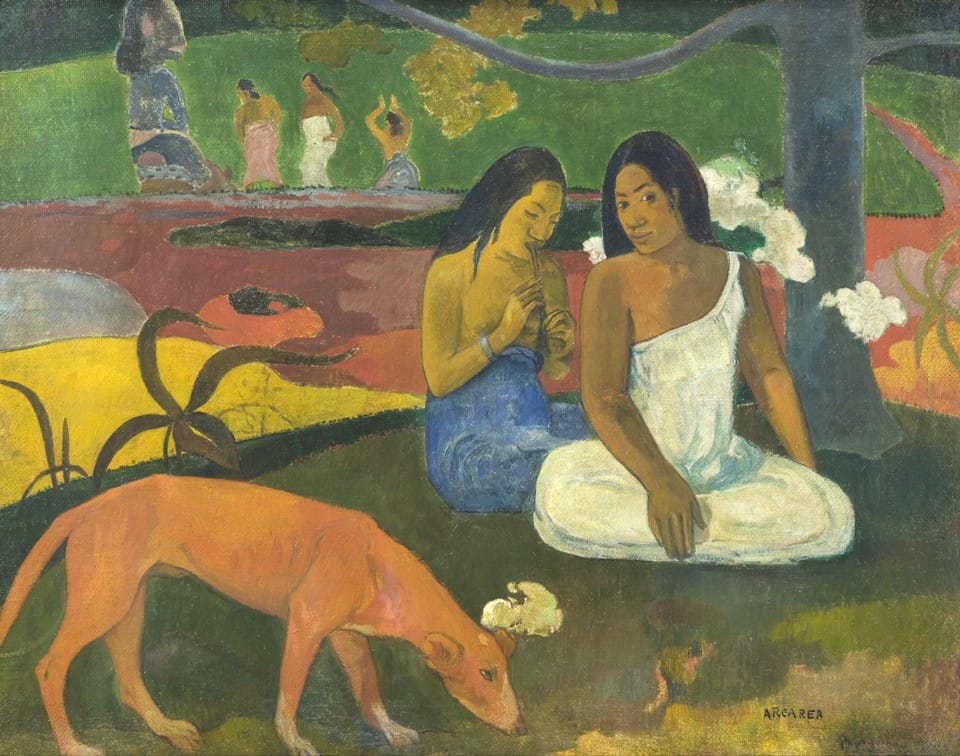
Arearea means "joy" in Tahitian. What exactly was the joy Gauguin found on the island?
Two women sit in the foreground of this painting. The one in blue plays a traditional flute called a vivo, while behind them, three more women dance the tamure, a traditional Tahitian dance, in front of a carved stone idol. That stone figure represents Hina, the moon goddess worshipped by the people of Tahiti; the real idol was actually small, but Gauguin enlarged it dramatically in the painting, emphasizing just how devoted the islanders were to their idol.
Every element in the scene is rendered in deep, vivid color, producing a striking contrast throughout, and the broad, flat fields of color flatten the sense of depth, giving the whole composition a simplified, almost two-dimensional quality. Spend enough time looking at this painting and it starts to feel as though reality and dream are coexisting on the same canvas. Gauguin drew not only from the landscapes he actually saw in Tahiti, but also from the island's folklore and the religion its people practiced, layering his own imagined embellishments onto the scenery before him. In the finished painting, people and nature, dance and music all blend together in harmony. For Gauguin, joy seems to have meant exactly that — a moment when everything comes together in peace.
Gauguin kept returning to this kind of primitive imagery, untouched by industrialization, throughout his career. It went unappreciated in his own lifetime, but there's no denying the sheer determination behind his effort to break free from the currents of existing art and build an entirely new world of his own.