Paris · Painting
Pixels Stamped by Hand: Seurat's The Circus
Musée d'Orsay · Paris, France
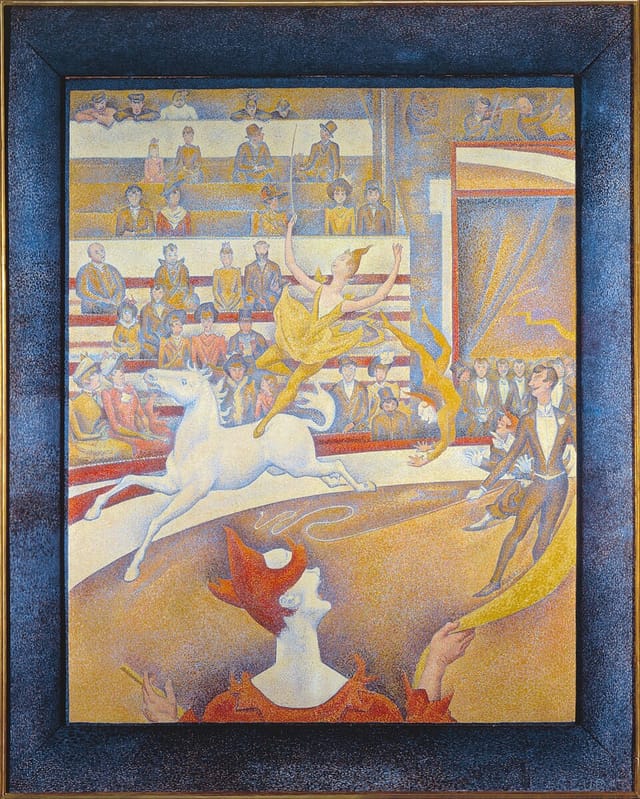
In an era of rapid industrialization and urbanization, the circus had become one of France's favorite pastimes. The audience in Seurat's painting is split into three tiers: at the bottom sit bourgeois, upper-class spectators; above them, on noticeably harder seats, sit people of a lower social standing; and at the very top, standing rather than sitting — since seating wasn't even permitted there — are working-class spectators leaning against a railing to watch the show. Seurat transferred the class-stratified seating of his era directly onto the canvas.
Step a bit closer and the painting reveals its true nature. It wasn't painted with brushstrokes of color at all — it's built from countless individual dots. This technique of forming an image from tiny dots is called pointillism, and Seurat was its inventor. The artistic movement that grew out of this technique came to be known as Neo-Impressionism.
It's often confused with Impressionism, but the two are quite distinct. Both shared a deep fascination with light and color and wanted to capture that on canvas, but where Impressionist painters chased a single instant of light, a fleeting color, Seurat wanted nothing to do with that spontaneity — he wanted to paint light and color as something permanent, unchanging.
Light grows brighter the more colors you mix together, but paint grows darker. Having studied that difference closely, Seurat realized that instead of physically mixing pigments, he could place different, unmixed colors right next to each other as countless tiny dots, and the brain would perceive them not as a blend but as distinct, vivid colors in their own right. Pointillism was a principle he arrived at through genuinely scientific investigation. It's a bit like what happens when you zoom in endlessly on a digital photo today — eventually you find it's made up of tiny pixels. Seurat's pointillism amounts to stamping out those same pixels by hand, one at a time.
Tragically, The Circus turned out to be Seurat's final work — he died at just thirty-two. It's hard not to wonder how much greater his reputation might have grown had he lived longer. This final painting is well worth lingering over, as a tribute to a man who approached art scientifically and carried that vision through with the sheer, painstaking labor of pointillism.