Paris · Painting
A Scandal Even at the Salon des Refusés: Manet's Le Déjeuner sur l'herbe
Musée d'Orsay · Paris, France
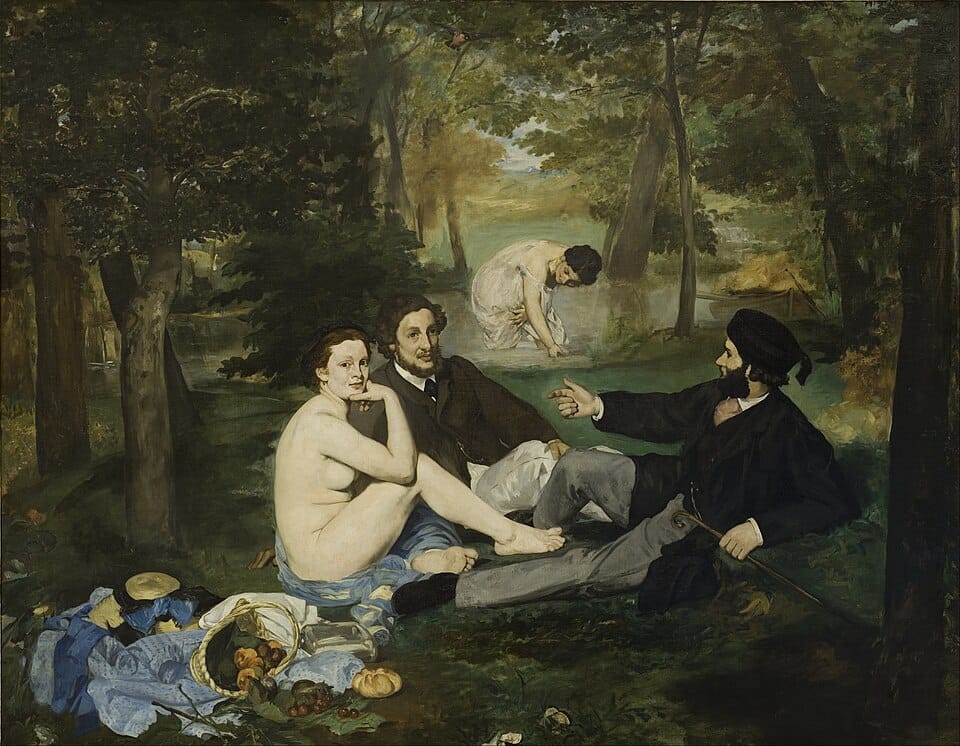
Submitted to the Salon of 1863, Manet's Le Déjeuner sur l'herbe was rejected. The jury that year was unusually strict, rejecting countless other works along with it, and the painters' collective outcry eventually reached the ears of Emperor Napoleon III himself. Finding their complaints reasonable, he couldn't reverse decisions already made, but offered instead to host a separate exhibition for the rejected works. For painters eager for any chance to show their work to the public, there was no reason to refuse.
That exhibition, the Salon des Refusés, became the setting for yet another round of harsh criticism directed at Manet's painting. The undressed woman in the scene is Victorine Meurent, Manet's regular model. Nude painting at the time was supposedly reserved for mythological goddesses or historical figures — yet here was an ordinary model, painted nude without any such pretense. Worse, while she sits undressed, the men around her remain fully, formally dressed. Viewers read this as an allusion to the discreet, widely practiced culture of bourgeois men keeping company with prostitutes, and since most of the exhibition's visitors were themselves solidly middle-class or above, the painting felt uncomfortably close to an exposure of their own private lives.
Whether Manet actually intended any of that remains unclear. A more convincing theory holds that Manet, hoping to win approval from a jury devoted to tradition, deliberately drew on two classical works the judges were known to favor. The poses of the figures were lifted from an engraving by Marcantonio Raimondi, while the background echoes The Pastoral Concert, a work attributed to either Titian or Giorgione. To the public, though, none of that classical lineage registered — all they saw was an ordinary nude woman, which struck them as simply obscene.
Manet weathered fierce criticism for the painting at the time, but his bold experimentation went on to inspire the generation of Impressionist painters who followed, pushing art forward in ways that would prove far more lasting than the scandal itself.