Paris · Painting
Thirty-Six Years of Brushwork: Ingres's The Source
Musée d'Orsay · Paris, France
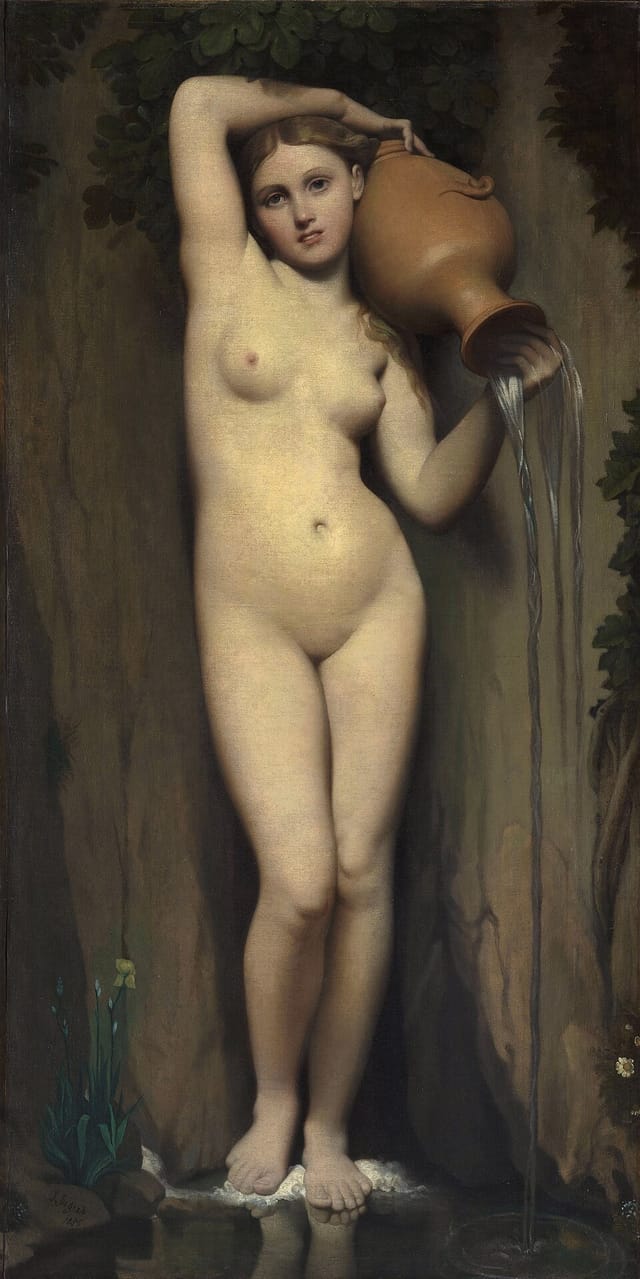
The Source, one of the signature works by the great Neoclassical painter Ingres, took him from age 40 to age 76 to complete. Two of his students helped out with the jug and the background, but Ingres painted everything else himself — across a staggering 36 years.
Look closely at the woman's body and you'll notice a softness so convincing it almost reads as real skin, with brushwork laid down so patiently over the decades that no individual stroke is visible. It's the kind of detail you can only really appreciate standing in front of the actual canvas, and it says everything about how much care Ingres poured into this piece.
The painting is a textbook example of Neoclassical style. The woman stands in contrapposto, the weight-on-one-leg pose borrowed from classical Greek sculpture, which keeps the figure from looking stiff and gives it a natural, relaxed quality. The subject, too, comes straight out of Greek mythology — it depicts Echo, a nymph of the woods and springs, and her doomed love for Narcissus. Punished by Hera, Echo could never speak first, only repeat the last words spoken to her, and so she was never able to tell Narcissus how she felt. Narcissus himself, too in love with his own reflection to love anyone else, eventually drowned after falling for the image he saw in a pool of water. The flower that bloomed where he died was the narcissus — which is exactly where the flower's English name comes from. You can spot a single one of those flowers at the lower left of the painting. And the water endlessly pouring from the jug the woman carries, pooling at her feet, is a symbol of her role as the spirit of the spring.
By the time Ingres finished this painting at 76, he was already a celebrated figure, serving as president of the École des Beaux-Arts, France's leading art academy. The work was an immediate success. Count Duchâtel purchased it, and after his death his wife donated it to the French state, which placed it in the Louvre's collection — though today it hangs here, at the Musée d'Orsay.