Paris · Painting
A Shadow of a Lost Masterpiece: Delacroix's Lion Hunt
Musée d'Orsay · Paris, France
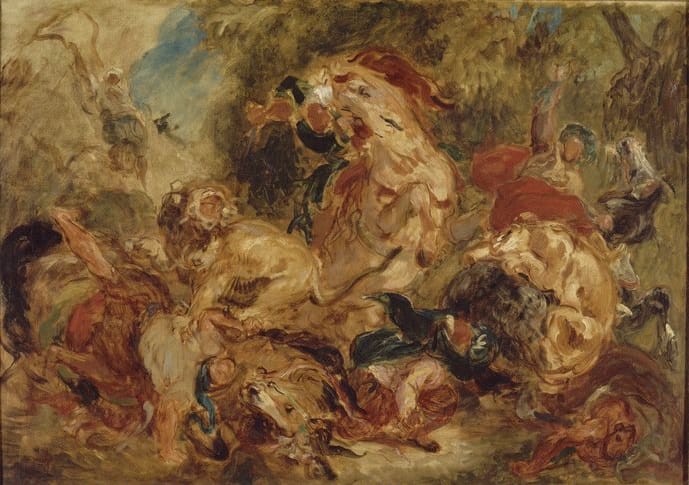
Lion Hunt, by the great Romantic painter Delacroix, has a raw, emotional intensity that sets it worlds apart from Neoclassicism. Its color is extraordinary — the poet Baudelaire once said of this very painting that "the color perceived by the eye pierces straight through to the soul."
And yet, for all that color, the actual shapes in the painting are surprisingly hard to make out. Look closely and you'll find mounted hunters attacking two lions, but the brushwork is loose enough that you might miss it entirely without a guide pointing it out. There's a reason for that. In 1854, Delacroix was commissioned to paint a subject he'd long wanted to tackle — a lion hunt — and the finished canvas went on display in Bordeaux, in southern France. Tragically, that finished version was destroyed in a fire in 1870. What you're looking at now isn't that lost masterpiece; it's the preliminary sketch Delacroix made beforehand just to work out the composition, never intended for exhibition — which explains its rough, unfinished quality. Fortunately, a smaller version with nearly the same composition survives today at the Nationalmuseum in Stockholm, giving us a sense of what the lost original must have looked like.
Delacroix had a particular fascination with hunting scenes and animal combat, shaped largely by a trip to Morocco in North Africa, where he fell under the spell of landscapes and sights utterly foreign to Europe. In the Stockholm version, you can see that the figures aren't dressed in European clothing, and the swords they carry are styles used in the Islamic world. To paint these scenes convincingly, Delacroix studied North African life and visited zoos repeatedly to observe lions and tigers firsthand.
What ultimately drew him to the subject, though, was his deep admiration for Rubens's Hunt series. The dynamic, dramatic composition, the restless energy, and the rich, layered color in Delacroix's work all trace back to Rubens's influence.