Paris · Painting
The World Inside My Studio: Courbet's The Painter's Studio
Musée d'Orsay · Paris, France
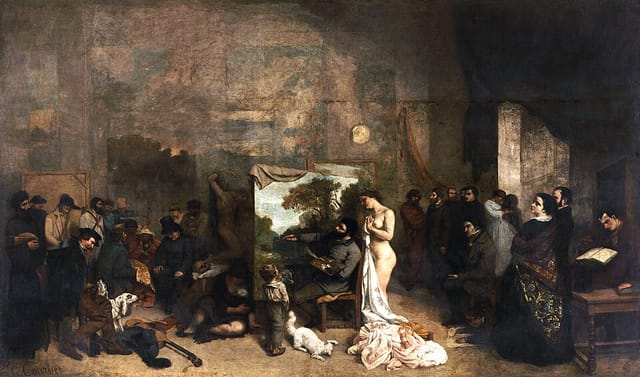
Another monumental work by Courbet, formally titled The Painter's Studio: A Real Allegory Summing Up Seven Years of My Artistic Life. The word "allegory" means conveying meaning through symbolic representation — in other words, this painting translates what Courbet felt over seven years of artistic life into visual form.
The setting is Courbet's own studio. The figure at the center of the canvas, painting a landscape, is Courbet himself. Behind him stands a nude woman gazing at the canvas — a figure generally read as representing the nude-model tradition of Academic art, which Courbet turns his back on in favor of landscape painting, a genre that had little prestige at the time. The gesture is widely interpreted as a pointed jab at an art establishment still clinging to classical tradition. Some read this woman as a personification of Truth, though her exact meaning remains debated.
To Courbet's right are the people who supported him, both spiritually and financially. The figure seated farthest right, reading a book, is the poet Baudelaire, a lifelong champion of Courbet's work. A figure originally painted beside him depicted Jeanne Duval, Baudelaire's partner at the time — but after the couple separated, Baudelaire asked Courbet to remove her from the painting, leaving only a faint trace visible today. The red-bearded man is Alfred Bruyas, one of Courbet's patrons, and another seated figure is the critic Champfleury, another supporter of his work.
To Courbet's left, by contrast, is a cross-section of contemporary society. In a letter to a friend, Courbet described these figures as "people who live in the world of death" — a crowd that includes Napoleon III, along with merchants, hunters, beggars, and even a Chinese figure, spanning a wide range of social classes. A man bound as if to a cross behind the canvas is said to represent the death of Academicism, while a guitar and dagger discarded on the floor to the left symbolize the decline of Romantic art.
Through this painting, Courbet was essentially declaring: this is the world that gets made inside my studio. After completing it, he submitted the work to the Paris World's Fair, where it was rejected — officially for being too large, though the real reason was more likely lingering resentment over A Burial at Ornans five years earlier. The Fair that year displayed roughly 5,000 works from countries around the world.
Shut out of the official exhibition, Courbet erected his own temporary pavilion right next to the Fair grounds and displayed 40 of his own works there. He named this show "Réalisme" — Realism — marking the birth of the term. Confident in his work, he reportedly charged the same admission fee as the Fair itself. Delacroix, who visited the show, is said to have praised The Painter's Studio in particular, declaring that "people have rejected one of the most singular works of our time."
Even so, the painting failed to draw much public interest at the time. It later passed to Courbet's sister, changed hands through several auctions, and was eventually acquired by the Louvre before being transferred here to the Musée d'Orsay. Given its enormous size, the painting proved difficult to store and maintain over the years and suffered some damage; in 2014, it was partially restored through public donations and funding from the Louvre.