Paris · Painting
A Commoner's Funeral on a Royal Canvas: Courbet's A Burial at Ornans
Musée d'Orsay · Paris, France
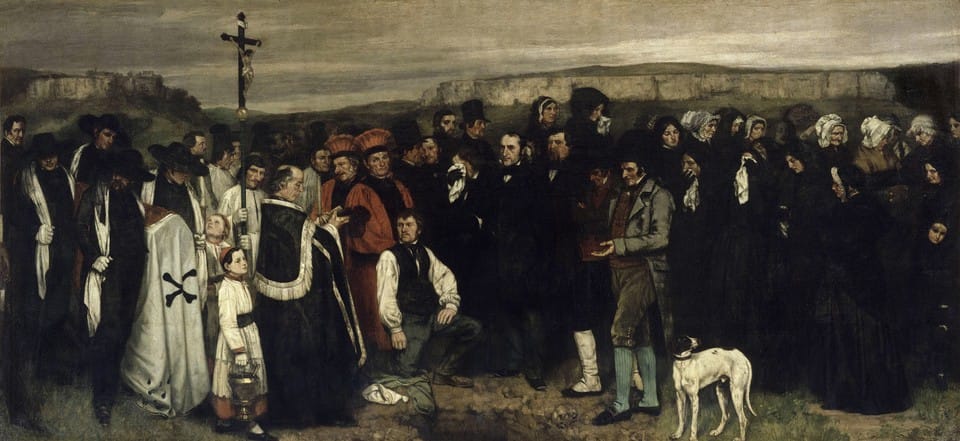
Measuring roughly 6.68 meters wide and 3.15 meters tall, A Burial at Ornans is one of Courbet's defining works, depicting the funeral of his maternal grandfather in his hometown of Ornans.
A painting of an ordinary funeral might seem unremarkable today, but at the time it was a genuinely radical move. Depicting the funeral of an ordinary citizen was unusual enough on its own; doing so on a canvas this massive pushed things even further. Large canvases demanded expensive paint and enormous amounts of time, which meant that, at the time, only royalty or wealthy aristocrats could typically commission work on this scale. Courbet instead used that scale to depict exactly the kind of people who could never have afforded to commission such a painting themselves.
The 46 figures in the painting are all Courbet's own family members and acquaintances. He divided the composition into three sections — clergy on the left, men in the center, and women on the right. Among the women are Courbet's mother, his three sisters, and a niece.
What makes the painting especially striking is how varied the expressions are. Some mourners appear deeply grieved; others seem barely affected at all. Funeral paintings typically show everyone united in sorrow, but in reality, only close family and intimate friends tend to grieve deeply, while those attending more out of obligation often don't. Courbet captured that reality without softening it. One of the two clergymen on the left has an unmistakably red nose, as if he'd had too much to drink the night before — a detail that makes sense given that, for men like him, officiating funerals was simply routine work.
This kind of unvarnished realism drew harsh criticism from contemporary critics, but Courbet finished the painting knowing full well how it would be received. As a committed socialist, he wanted to prove that anyone — not just the wealthy — could claim a monumental canvas for a subject rooted entirely in unembellished reality.
Courbet submitted the painting to the Salon of 1850, where it was accepted, but the controversy it generated was severe enough that, five years later, it was rejected outright from the 1855 World's Fair.