Paris · Painting
One Canvas, Two Viewpoints: Cézanne's Apples and Oranges
Musée d'Orsay · Paris, France
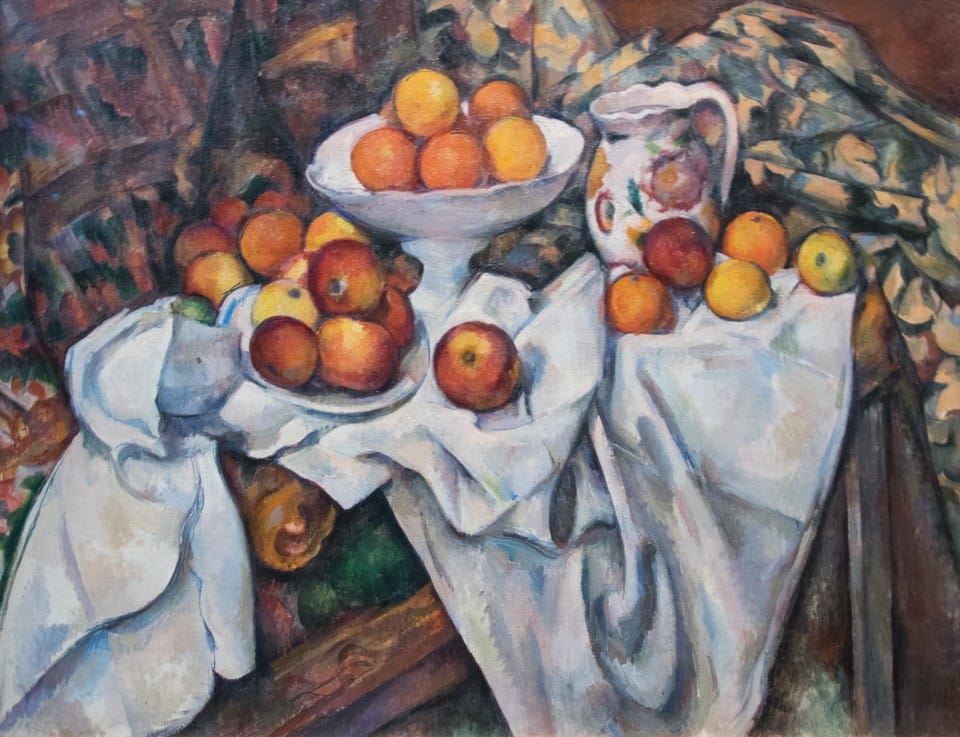
People often name four famous apples in the history of ideas: the apple of Adam and Eve, Newton's apple, the apple in this Cézanne painting, and the Apple of Steve Jobs. Why does Cézanne's apple deserve a place alongside a fruit symbolizing the creation of humanity and another marking the dawn of modern science?
At first glance, this looks like an ordinary still life of apples and oranges. Look more carefully, though, and a distinctly Cézannian experiment emerges. The oranges in the painting are rendered from the same eye level as ours — a direct, frontal viewpoint. The apples, by contrast, aren't painted from the front at all; they're viewed from above, looking down, which is why we can see the tops of the apples so clearly. In other words, two different viewpoints — the orange seen straight-on, the apples seen from overhead — coexist within a single canvas.
Most paintings are built from one fixed viewpoint, but Cézanne believed multiple perspectives could coexist within a single image, and he painted accordingly. Because this work completely shattered the long-held assumption that a painting must be seen and rendered from only one viewpoint, Cézanne's apple is considered the starting point of modern art. Before leaving for Paris to study art, Cézanne reportedly said, "I will conquer the world with an apple" — and in the end, that's more or less exactly what happened.
There's also a practical reason Cézanne returned so often to apples and oranges in his still lifes: unlike most other fruit, they resist spoiling for a long time, letting him keep their shape steady while he painted at his own pace.