Paris · Painting
Time to Stop Fighting: David's The Intervention of the Sabine Women
The Intervention of the Sabine Women · Paris, France
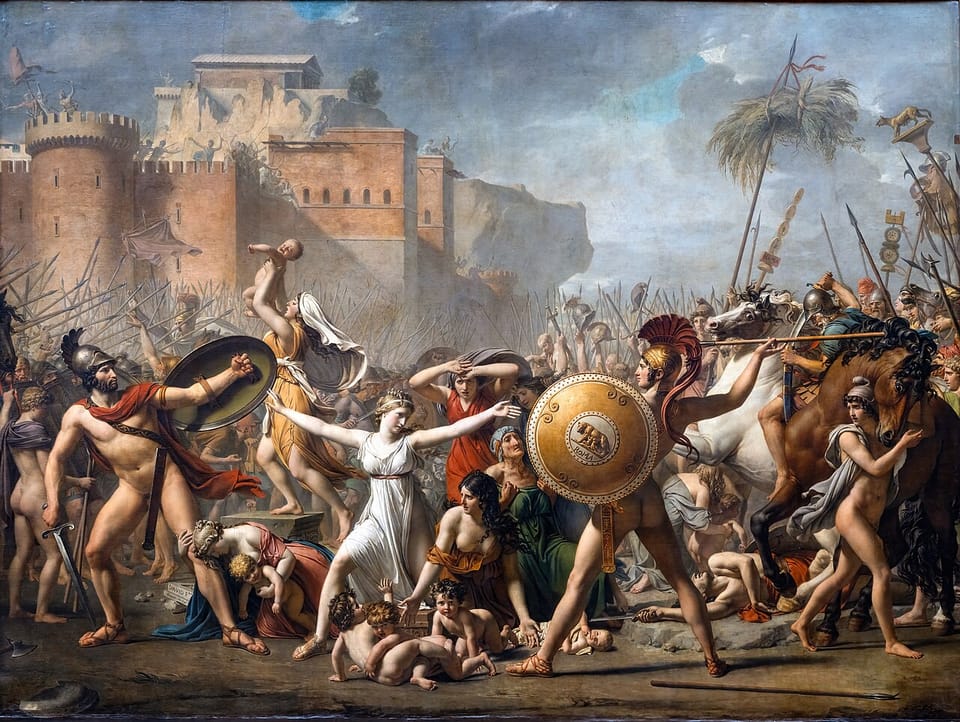
The Intervention of the Sabine Women is the work of Jacques-Louis David, a leading figure of Neoclassicism, a movement known for its fascination with Greek and Roman history and mythology — fittingly, this painting draws on the legendary founding of ancient Rome.
The story is set when Rome was still a small city-state, long before it became an empire. On the left, holding a shield and lowering his sword, stands Titus Tatius, king of the Sabines; on the right, with shield and spear, is Romulus, Rome's founding king. Romulus is famous for the legend that he and his brother Remus were abandoned in the forest as infants and raised on wolf's milk, before Romulus later killed Remus in a dispute and founded Rome alone. The wolf and two infants engraved on Romulus's shield are a direct reference to that founding myth.
Why are these two kings squared off against each other? Because Roman soldiers had abducted the women of the Sabines. As Rome's power grew, it faced a critical shortage of women, and when neighboring peoples refused Romulus's requests for intermarriage, he devised a scheme: host a festival, invite the Sabines, and abduct their women during the celebration. Enraged, the Sabines spent three years preparing before finally attacking Rome — and that attack is exactly the battle depicted here.
But something unexpected happens. The Sabine women, who by then had already built families with their Roman husbands, rush into the middle of the battlefield to stop the fighting. The woman in white at the painting's center, physically separating the two sides, is Hersilia — daughter of Titus Tatius and wife of Romulus — and around her you can see children born of Roman fathers and Sabine mothers. In the end, the two peoples reconcile and unite into one nation, laying the foundation for the powerful Rome that would follow.
Although the real battle took place on the Palatine Hill, David painted the Bastille prison of Paris into the background — a deliberate choice. David had originally painted in service of Louis XVI, then switched to the revolutionary cause when the French Revolution erupted, and later found himself facing execution when the political tide turned again, only to be saved by Napoleon's rise to power. Unlike most painters, who depicted the abduction itself, David chose to paint this moment of intervention instead — a message urging an end to senseless bloodshed and a call for reconciliation, reinforced by the Bastille, a symbol of revolution, in the background. By painting exactly what Napoleon wanted to see, David won his trust so thoroughly that he later went on to paint Napoleon's own coronation.