Paris · Painting
The Day the Painter Rewrote: David's Coronation of Napoleon
The Coronation of Napoleon · Paris, France
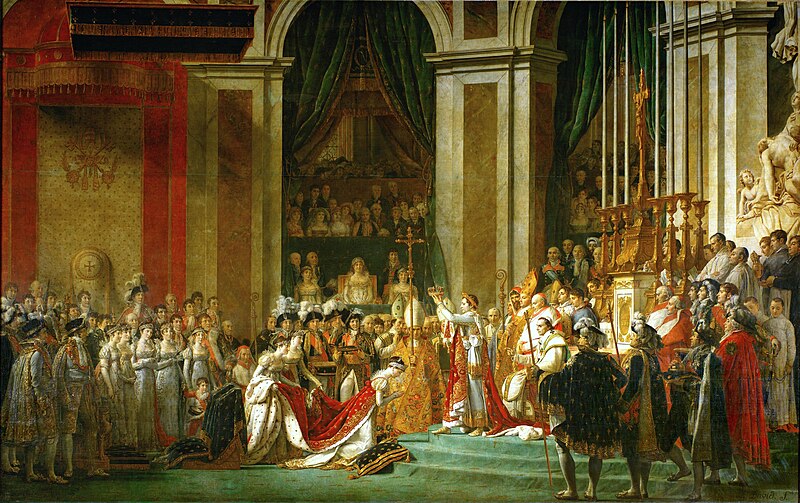
This is The Coronation of Napoleon by Jacques-Louis David. It depicts the ceremony held on December 2, 1804, though the painting itself wasn't finished until two years later, completed between 1805 and 1807.
Every major figure of the era turned out for the occasion, and the painting is packed with them. At the center, Napoleon stands dressed as an emperor, his clothing alone declaring his ambition to build "an empire like Caesar's Rome." In front of him, Empress Joséphine kneels to receive her crown, while behind him Pope Pius VII raises a hand in blessing. Napoleon originally rejected the traditional coronation site of the Invalides as too small and moved the ceremony to Notre-Dame Cathedral instead.
Here's the interesting part: the moment most people picture as the highlight of any coronation — the pope placing the crown on the ruler's head — isn't actually shown in this painting. In reality, Napoleon crowned himself with his own hands, and personally lifted Joséphine's crown to place it on her as well. The pope simply sat behind him, a spectator to his own ceremony. Napoleon staged the event precisely to demonstrate that he outranked the pope, and David, eager to please his patron, painted the pope's expression as perfectly composed — showing no hint of the displeasure he must have felt.
Several other details in the painting depart from what actually happened. The woman watching approvingly from the gallery above, identified as Napoleon's mother, wasn't actually present — she'd stayed away, reportedly out of anger at her son. Napoleon's older brother, shown standing in elaborate dress on the left, wasn't there either; Napoleon hadn't even sent him an invitation, the two being bitterly estranged. Perhaps reflecting his mother's disapproval of the marriage, Joséphine — who was actually 40 at the time, five years older than the 35-year-old Napoleon — is painted looking closer to twenty. Among the women standing behind her are Napoleon's sisters and Joséphine's own daughter, whose husband happened to be none other than Napoleon's younger brother, making for a rather tangled family tree.
The white-haired man seated between Napoleon and the pope is Julius Caesar — an anachronistic addition representing the historical figure Napoleon admired most. David also tucked a small self-portrait into the scene: look to the upper left gallery, near where Napoleon's mother sits, and you'll spot a man sketching — that's David himself. In reality, he never painted on location; he noted where everyone stood, then built life-size cardboard figures in his studio and painted each person individually from those.
An identical version of this painting hangs in the Palace of Versailles, differing in only one detail: the dress of one of Napoleon's three sisters, shown in pink there instead. One story holds that David secretly loved this particular sister and used the color to express his feelings. Having earned Napoleon's deep trust through works like this, David feared for his own safety after Napoleon's fall from power and fled into exile in Brussels, where he continued painting portraits of nobility until his death at 77.
Included in the Paris tour.
Open the free appFree iPhone app