Paris · Painting
A Waist Stretched on Purpose: Ingres's La Grande Odalisque
La Grande Odalisque · Paris, France
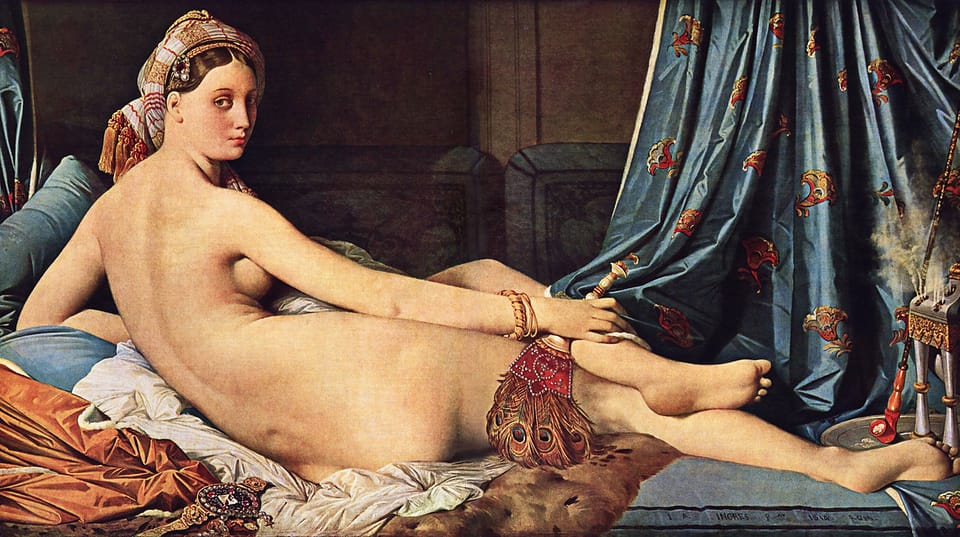
This is Ingres's La Grande Odalisque. Orientalism was all the rage in 19th-century French art, and an "odalisque" refers to a woman who served an Islamic sultan.
The painting sparked controversy on two fronts when it debuted. First, it played into a Western fantasy about the harem — a private space in Islamic culture that outsiders could not enter, but which Western imaginations had distorted into a scene of forbidden pleasure. Unusually for the time, Ingres painted a nude modeled after a real person rather than a goddess or mythological figure — and that person was Caroline, Napoleon's sister. She had originally commissioned the painting for her own private collection, but Napoleon's fall from power sent the family fleeing before Ingres could be paid, leaving him stuck with a painting no one had bought. He ended up exhibiting it at the Paris Salon of 1819 instead.
The second point of controversy was anatomical. Look closely and her back appears to have roughly two extra vertebrae compared to a real spine, and her legs are twisted into a pose — left calf resting atop the right thigh — that's genuinely difficult, even uncomfortable, to hold in real life. Critics at the time mocked Ingres, the king's own chief painter, for apparently not knowing how to draw a human body correctly. But this wasn't a mistake at all — Ingres deliberately elongated the waist and adjusted the proportions elsewhere to maximize the sensuous curve of the body. What struck contemporaries as strange is now regarded as one of the defining works of Neoclassicism.