Paris · Painting
A Last Flicker of Hope Amid Despair: Géricault's The Raft of the Medusa
The Raft of the Medusa · Paris, France
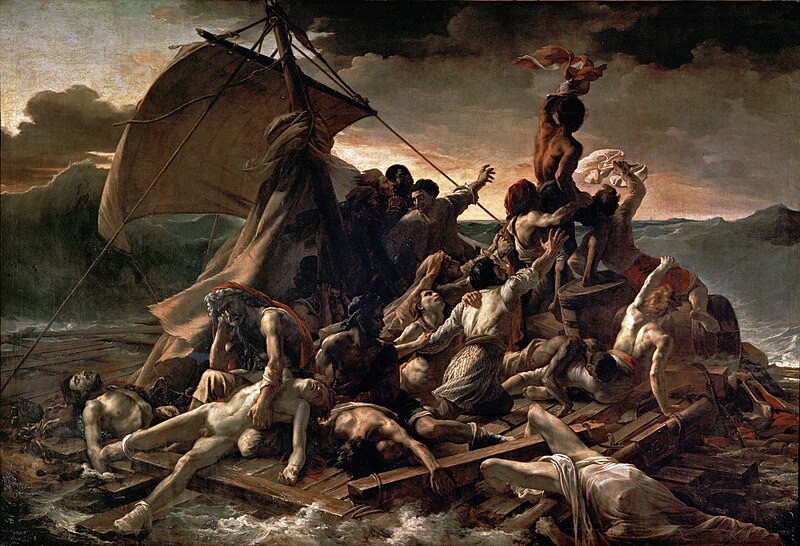
The Raft of the Medusa depicts a real shipwreck that occurred in 1816. The painter, Théodore Géricault, was born in 1791 and died at just 33 after a horse-riding accident; he completed this painting in 1818, the year after the disaster took place.
The Medusa had set sail from France to establish a colony in Senegal. Its captain, Hugues Duroy de Chaumareys, lacked the skill to command a ship of that size but had secured the post through royalist aristocratic connections. He loaded 400 people onto a vessel built for 326 and, pushing to reach their destination as quickly as possible, ran the ship onto a reef, sinking it. What followed was even worse: Chaumareys loaded only the highest-ranking passengers onto the lifeboats, left the rest on a hastily built raft, and then cut the towline and abandoned them. The 159 people left on the raft drifted without food or water, and eventually resorted to cannibalism. When the raft was found two weeks later, only 15 remained alive; five more died shortly after, leaving just 10 final survivors.
The French monarchy tried to suppress the story, but it eventually came to light after a survivor published an account of the ordeal. Géricault based his painting on that testimony. On the right side of the canvas, a bloodstained axe hints at the desperate violence that unfolded on the raft. The bottom of the composition is filled with corpses, including an elderly man clutching the body of his dead son, his blank stare capturing the depth of his shock and grief. Yet at the center and top of the painting, figures still cling to hope, waving toward a tiny, barely visible ship approaching in the distance. Even while depicting this horrifying true event with unflinching realism, Géricault used these figures — refusing to give up even at the edge of death — to gesture toward hope and a better world beyond the horror.
Eleven years after this painting was completed, in 1830, the French Bourbon monarchy itself collapsed. Géricault went to extraordinary lengths for accuracy, reportedly rowing out on an actual raft to study the shape of the waves firsthand.
Included in the Paris tour.
Open the free appFree iPhone app