Paris · Antiquities
A Law Carved in Stone: The Code of Hammurabi
Code of Hammurabi · Paris, France
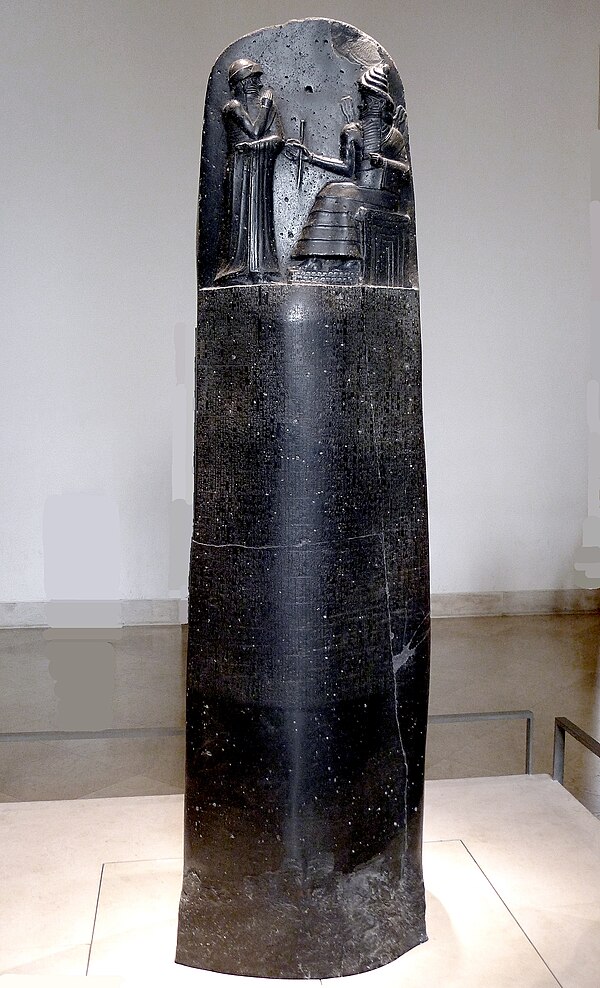
This is the famous Code of Hammurabi. People often picture something like a book, but it's actually carved into stone. It's also widely believed to be the world's oldest legal code — though that distinction actually belongs to the earlier Code of Ur-Nammu.
The Code of Hammurabi was created roughly 3,800 years ago by Hammurabi, the sixth king of Babylon's First Dynasty, as a way to govern more efficiently once his kingdom — and the population under his rule — had grown. At the top of the stele, two figures are carved: on the left, praying, is King Hammurabi; seated beside him, receiving the prayer, is the sun god Shamash. The smoke-like rays rising from Shamash's shoulders represent the sun's heat, and the rod in his hand symbolizes powerful leadership. The sun god handing this rod to Hammurabi signals that the king rules as the god's representative on earth.
Below this relief, the stone is densely inscribed with cuneiform script. Like Chinese characters, cuneiform began as pictographs — sun, moon, stars, birds, fish — before gradually evolving into a phonetic writing system. Cuneiform itself began to be cracked in 1802, when Georg Friedrich Grotefend, a German schoolteacher, found the first clues to its decipherment after making a bet with a friend; later scholars built on his work, and today the code's full text can be read.
The code contains 282 laws in total, and if you had to sum it up in one phrase, it would be "an eye for an eye, a tooth for a tooth." In its opening lines, the king introduces himself: "I am the sun of the city of Babylon, the all-powerful king." Just as Egyptian pharaohs were called the sun god Ra, and Louis XIV styled himself the Sun King, the sun has long served as a symbol of absolute royal power — a tradition that traces all the way back to Mesopotamia.
The main text is dominated by retributive laws in the spirit of "an eye for an eye." Article 22 sentences thieves to death. Article 195 states that if a child strikes his father, his hand shall be cut off. Articles 196 and 200 declare that if a free man injures another free man's eye or breaks his tooth, the same shall be done to him — the very origin of "an eye for an eye, a tooth for a tooth." Here, "free man" means an awīlum, a member of the free upper class; commoners and slaves were judged by different rules, and punishments varied by social class, a clear reminder that inequality was simply taken for granted in this society.
Fitting for a highly commercial society, the code also demanded careful record-keeping — anyone who traded without a witness or contract, for instance, was to be treated as a thief and put to death. There are more unusual clauses too: under Article 108, a woman who kept a tavern and cheated customers on the price of drink was to be thrown into the water.