Paris · Antiquities
The Guardian Lamassu and Ancient Assyria
Lamassu of Khorsabad · Paris, France
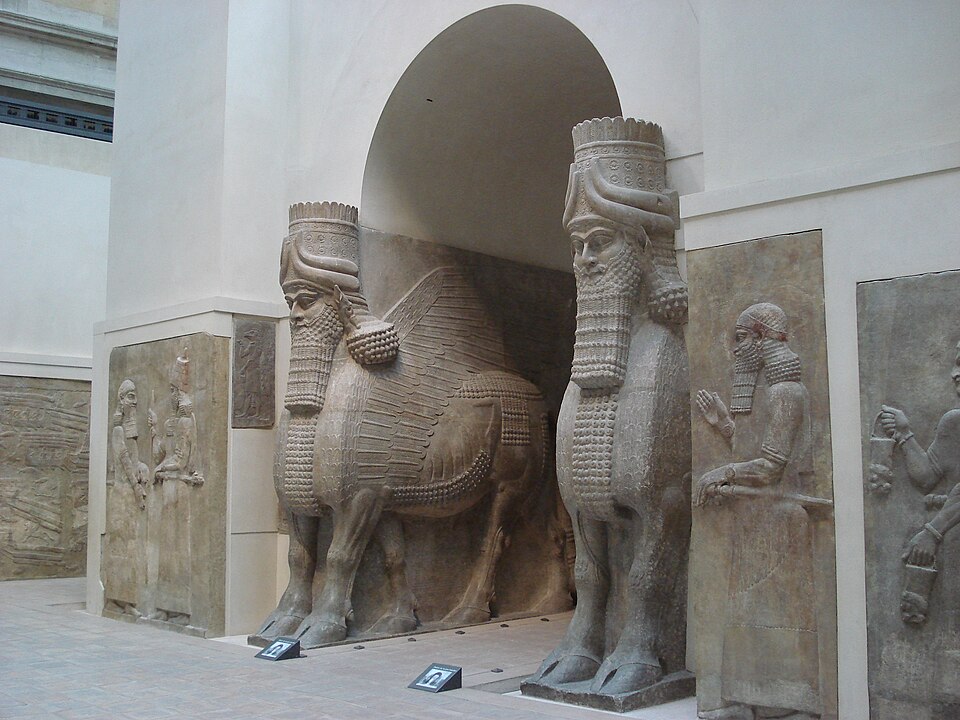
We move forward roughly a thousand years from when the Code of Hammurabi was created. By this time, Assyria held dominance over the region, and its king, Sargon II, built an entirely new city called Khorsabad. Unlike the usual pattern of the era, where villages formed naturally and grew into cities, Khorsabad was planned from the very start — making it an early example of a planned city.
This great city was eventually buried under sediment following a major flood and shifts in the landscape, and it lay hidden deep underground for centuries — as deep as six meters below the surface. Among the European archaeologists who searched for traces of Mesopotamian civilization, it was the French physician Paul-Émile Botta who, working with local residents around 1844 near present-day Mosul in Iraq, finally uncovered Khorsabad. Because the excavated pieces were brought directly here, everything on display in the Louvre today is original.
The massive sculptures here are Lamassu, protective spirits that guarded the royal palace. Each wears a crown and has a long beard and long hair — not something everyone could have at the time, so the crown, beard, and hair together marked royal status. Nearby, a relief shows a procession of officials carrying a cart on their shoulders; the figures in front have no beards, while those behind have short ones, suggesting that beard length signaled social rank.
The Lamassu's body takes the form of a bull, since the bull was the region's symbol of strength at the time. The muscles and veins carved into its body represent the power and energy of the Assyrian Empire, while its eagle wings symbolize the empire itself. Between its legs, cuneiform inscriptions densely record how Sargon II built the city and list his achievements as king.
Seen from the front, the Lamassu appears to be standing still; from the side, it looks like it's walking. That's because it was carved with five legs instead of four — a deliberate choice meant to capture motion. It's a striking example of the naturalism and realism this art aimed for.
Another sculpture nearby shows a figure cradling a lion almost like a house cat — this is Gilgamesh, the hero-king of the Epic of Gilgamesh, humanity's oldest known epic. Even the lion's teeth and claws, along with Gilgamesh's bracelet and earrings, are rendered with striking realism. Interestingly, ancient Egypt, not far away geographically, took the opposite artistic approach, aiming to capture a subject's essence and eternal nature rather than its literal appearance — which often gives Egyptian art a somewhat unnatural feel. It's a fascinating contrast between two neighboring civilizations with completely opposite artistic instincts.
As a side note, the name Syria itself comes from Assyria. At its height, this ancient empire stretched across what are now Syria, Israel, Iraq, and parts of Turkey.
Included in the Paris tour.
Open the free appFree iPhone app