Paris · Painting
The Orangerie: Monet's Room of Water Lilies
Giverny · Paris, France
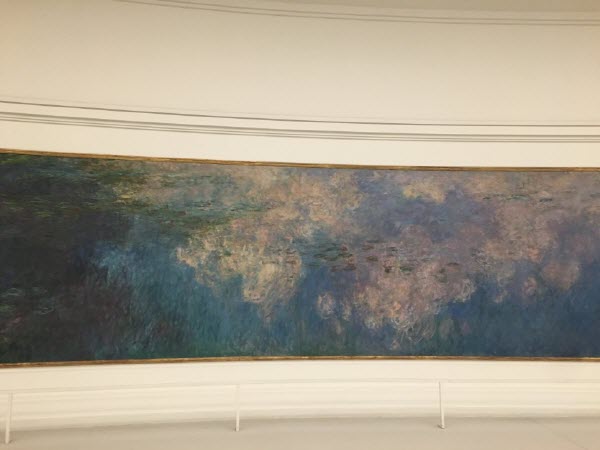
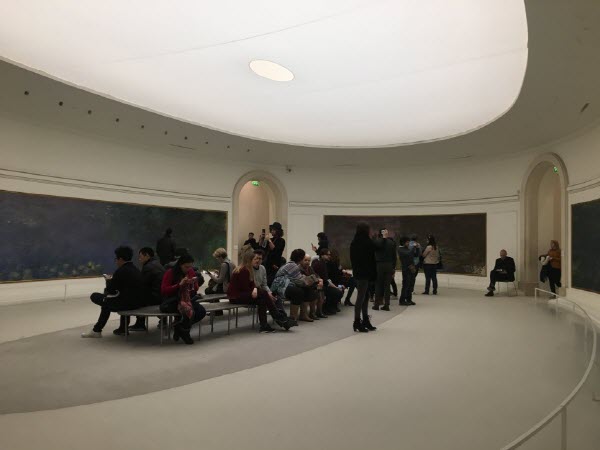
If the Musée Marmottan Monet is an existing museum to which Monet's works were added, the Musée de l'Orangerie was created specifically to display them. Standing at the edge of the Tuileries Garden, it was originally a greenhouse for orange trees, with a glass roof to let in light. The French word for an orange-tree greenhouse is "orangerie," which gave the museum its name. The person who chose it as the site of a museum was Claude Monet himself.
Monet lived through World War I in Giverny. As a quiet village, it was barely touched by the fighting, and he could paint in calm and security even during the war. When the war ended in 1918, he donated eight monumental Water Lilies panels to the French state as a symbol of peace. He hoped war-weary Parisians would find comfort and healing in that sense of calm. By then Monet was a recognized master, so the paintings could not be hung just anywhere. On his instructions, the museum was designed with natural light, white walls and circular rooms. A glass-roofed orangerie was the perfect fit for natural light.
On the ground floor (the 0 floor in French numbering), you can view Monet's enormous Water Lilies. Unlike in other museums, the paintings wrap around you in a circular gallery, and you can sit in the middle or stroll slowly along the edge. This is how Monet wanted the Water Lilies to be seen. He wanted visitors not to see them merely as artworks but to feel as though they had stepped into his Water Garden at Giverny. That is why he wanted natural light rather than artificial lighting, and why the white walls and the frames are kept to a minimum, so it doesn't feel as if you're looking at artworks at all. Surrounded by the lilies, you find yourself gazing dreamily. The lilies and the reflected sky and willows will bring back the Giverny you saw today. It is well worth a visit.
The lower level has plenty of Impressionist works too. It feels as though the famous painters of the late 19th and early 20th centuries are all gathered here: Monet, Renoir, Cézanne, Matisse, Modigliani, Picasso, Rousseau, Sisley and Maurice Utrillo, names you will recognize. How these works came here is a story in itself. They come from the collection of Paul Guillaume and Jean Walter.
Guillaume was an art dealer, but unlike many collectors and dealers, who tend to be wealthy, he was born into an ordinary family and worked as a car mechanic. While importing car parts from Africa, he became interested in African art, began buying and selling it, and did well, and became a full-time dealer. With a keen eye, he bought huge numbers of works by the Impressionists and Neo-Impressionists mentioned earlier, and used the money to support struggling artists. But he died at the young age of 42, and his entire collection passed to his wife, Domenica. She remarried Jean Walter, a wealthy architect, and the two organized and expanded the collection. Walter later died in a car accident. She then entrusted the entire collection to the French state, and it is shown at the Orangerie as the Walter-Guillaume Collection, named for both of her husbands.