Paris · Architecture
Gustave Eiffel and the Making of the Tower
Eiffel Tower · Paris, France
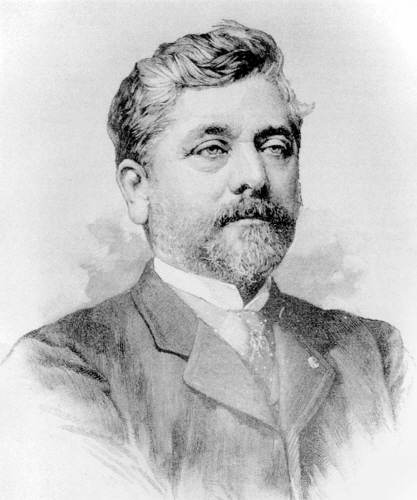
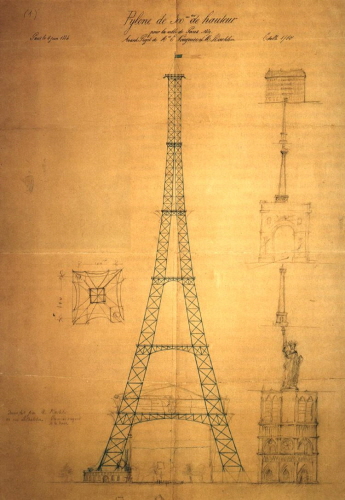
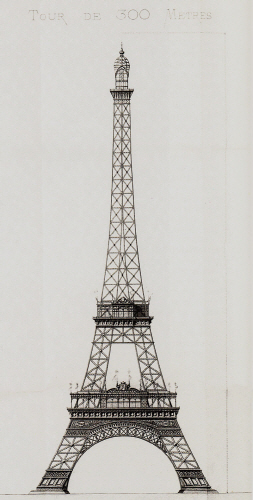
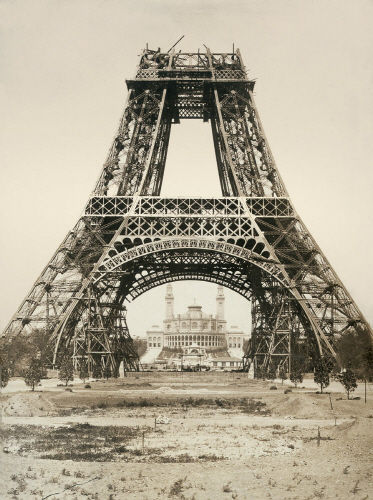
The tower takes its name from French architect Alexandre Gustave Eiffel. Yet he didn't draw up its design himself. That was done by two employees at his firm, Maurice Koechlin and Émile Nouguier, who worked with architect Stephen Sauvestre and entered a competition for a structure to stand at the entrance to the exposition. Their proposal was selected. Since Eiffel ran the project, though, many of his own ideas were built in. One fun example: he created a private apartment at the top where he could host guests. Friends such as the inventor Thomas Edison reportedly stayed there, and it is now open to the public. Edison, who is said to have designed the tower's elevators, first visited on September 10, 1889, and left this message in the guest book:
"To Monsieur Eiffel, the brave builder of so gigantic and original a specimen of modern engineering, from one who has the greatest admiration and respect for all engineers, including the good God, the Great Engineer. Thomas Edison."
Between 120 and 200 workers labored on site, with more than 300 more preparing materials at a workshop in northwest Paris. In a remarkably short two years and two months, they assembled 18,038 wrought-iron pieces with about 2.5 million rivets.
The tower's metal structure weighs 7,300 tons, and over 10,000 tons including non-metal materials. It originally weighed 11,000 tons, but 900 tons have since been shed, and today it stands at around 10,100. There's a reason Eiffel built it mostly from open ironwork. A structure this tall is greatly affected by wind pressure, so letting the wind pass through is safer, a trick that came from Eiffel's wide experience in civil engineering. Even so, on very windy days the tower sways, and the top level is closed for safety. With no outer walls to speak of, the open design also made construction dangerous.
But Eiffel took thorough precautions, with guardrails and screens, and only one person died, reportedly off duty and away from the site. Eiffel designed the tower to sway up to 70 centimeters in the wind. The biggest recorded sway was about 13 centimeters, in 1999, in winds of 240 km/h. Yet something affects the tower even more than wind: the sun. In summer, heat can make the metal expand so the tower grows up to 17 centimeters taller, then shrinks again in winter. In 1976, under a blazing summer sun, the top moved about 18 centimeters.
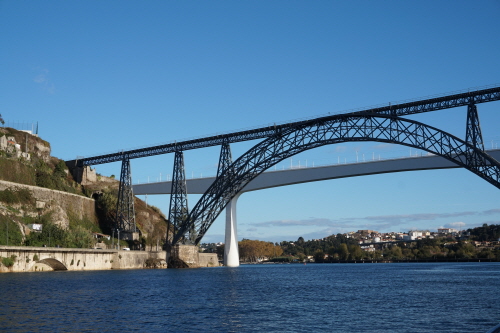
The Eiffel Tower isn't his only famous work. The best known is the Statue of Liberty in New York, to whose design Eiffel contributed in part. His other works include the railway station in Toulouse, theaters, churches and schools in Paris, and structures across the Iberian Peninsula and Latin America, including Bolivia, Peru, Chile, Hungary, Portugal, Venezuela and Mexico. The Maria Pia Bridge in Porto, Portugal, is like a bridge version of the Eiffel Tower, with the sturdy, spare, elegant design that marks his style. Unlike the stone buildings common across Europe, the Eiffel Tower's iron frame struck people at the time as a shocking sight.
As a structural engineer from civil works, Eiffel used new materials more boldly than typical architects and had a keen eye for design. France prepared the exposition with an eye to two London landmarks: the Crystal Palace, designed by Sir Joseph Paxton for the first world's fair, held in Hyde Park in 1851 (it no longer stands), and St Pancras Station, still a hub for trains like the Eurostar. Mindful that St Pancras has a column span of 73 meters, France built the Gallery of Machines, with a 115-meter span, and the Eiffel Tower, over 300 meters tall. The tower's legs, incidentally, are a very wide 72.75 meters apart.
Because it was built to show off technology and lift national morale, the tower was actually due to be demolished 20 years after it went up. It's still here, and now a beloved attraction, for good reasons. Construction cost so much that Eiffel paid for most of it himself, and in return he was granted the right to operate it exclusively for 20 years. Eiffel, who believed in his creation, was proved right: he recovered the full investment in three years. Add to that his persuasion against demolition and a proposal by senior military figures to use it as a transmission tower, and the tower became the symbol of France that it is today. It was indeed used as a communications relay in World War I, and during the First Battle of the Marne, when the French army sent Paris taxis to the front, it was reportedly used to broadcast. In 1925 the first radio broadcast was transmitted from the tower, and it was later used for television too.
Eiffel often compared his tower to the pyramids of Egypt. If such a tall, magnificent human creation stood in Egypt it would be praised, he argued, so how could it be called a monstrosity in Paris?