Paris · Painting
Brothers Side by Side: Vincent and Theo
Auvers-sur-Oise · Paris, France
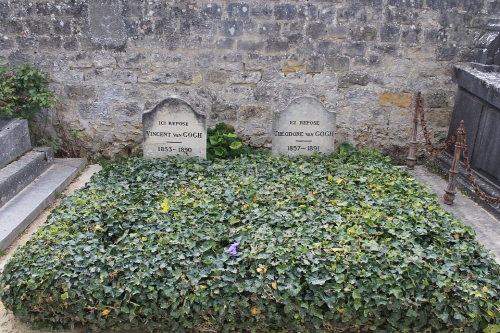
Two headstones sit side by side: the graves of Vincent van Gogh and his brother Theo. In some ways they are the humblest in the cemetery. In French cemeteries, families often show off their wealth through the material and height of their tombs, but these graves have no such display, a sign of how modest the brothers' means were.
Van Gogh's bond with Theo is well known. He never married or raised a family, so his family meant his parents and siblings. He was the eldest of six children, and Theo, the third, was the only sibling who stayed in regular touch with him. His sisters Anna and Elisabeth were not close to him and are said to have disliked him. What drew the brothers together was perhaps that both worked as art dealers, careers rooted in art. Only his fifth sibling, his sister Wil, recognised his art, and the two corresponded now and then. By most accounts, Theo was the only sibling Vincent could really call family. It was Theo who encouraged him to become a painter, and Theo alone who supported him emotionally and financially until the end of his life. One wonders how things might have gone if his parents had recognised and backed his talent as Theo did.
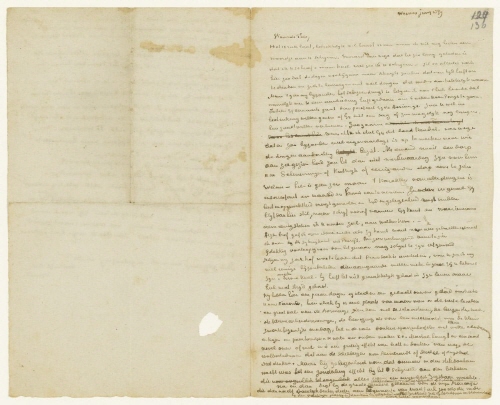
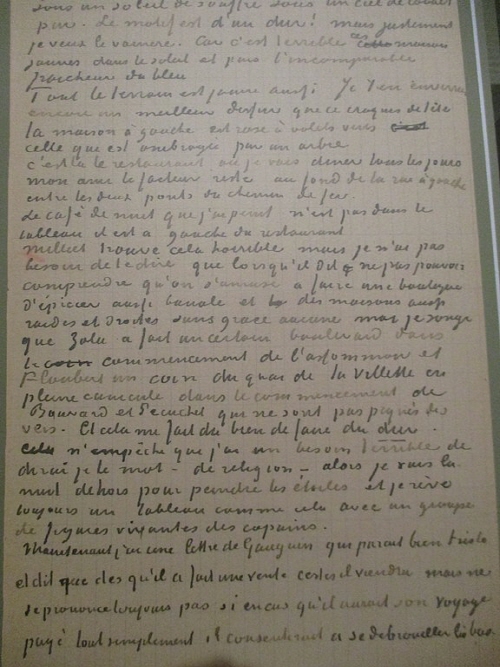
Vincent constantly exchanged drawings and letters with Theo, and wrote hopeful messages to others around him, Gauguin among them, to keep them posted on his situation. These letters survive as precious records, as valuable as his paintings, and about 700 of them were addressed to Theo, which shows what a pillar of support his brother was. One of the best-known lines reads:
"Once again, I tell you: either lock me up in an asylum right now, or let me paint with all my strength. If I am not mad, the day will come when I can send you the paintings I have promised since I began. You must have been poor all this time, supporting me. I will pay you back without fail. If I cannot, I will give you my soul."
How does that last phrase, "I will give you my soul," strike you? To me it lands like a line from a film and leaves me stunned. Theo's devotion to his brother was such that he even gave his own son the name Vincent. While Van Gogh was at the asylum in Saint-Rémy, he received this letter:
"Poor brother, it breaks my heart. We have finally had a lovely baby boy, so why can't you escape your suffering? What on earth does God want from you? We have a baby boy, brother. My wife is well, and as I told you before, we will name him Vincent after you."
Confined to the asylum, Van Gogh could not visit the adorable nephew who bore his name, so he decided to express his feelings in a painting. A letter Theo later wrote to their mother shows how freely the brothers loved each other:
"You cannot imagine how great a sorrow my brother's death has been to me. I will have to carry this sorrow all my life. Only now do people appear to praise his work. But it is too late. He was my one and only brother, whom I would not trade for anything."
Six months after his brother's death, Theo's health suddenly declined and he died. His body had been laid to rest in the Netherlands, but in 1914 his wife, who had watched how deeply her husband loved his brother, had it moved to lie beside Vincent. With a brother who believed in him and loved him, Van Gogh may well have been the happiest painter in the world.
As you leave the cemetery and look straight ahead, you can see in the distance the field that is the subject of our next stop, Wheatfield with Crows. Shall we head there?