Paris · Painting
Wheatfield with Crows
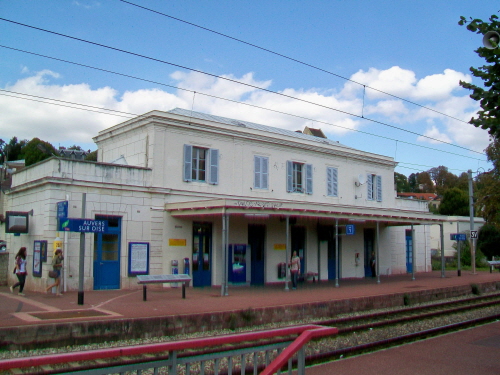
Auvers-sur-Oise · Paris, France
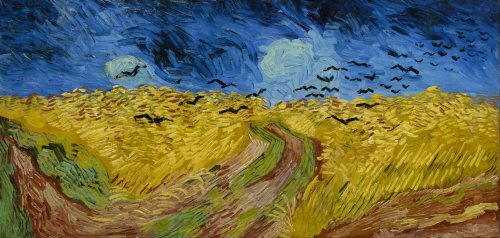
Painted in the last phase of his life by Van Gogh, who left some 800 works in a decade, this oil painting is held by the Van Gogh Museum in Amsterdam. At 103 cm wide by 50.5 cm tall, its format, nearly twice as wide as it is tall, is rare among his works. The canvas carries a foreboding air, as if his troubled life were nearing its end. Some claim it was his final painting, but he went on to paint several more afterwards, so that cannot be taken as fact.
After Arles and almost a year of recuperation at the asylum in Saint-Rémy, Van Gogh came to Auvers-sur-Oise, the last place he settled. The painting is sometimes read as a metaphor for the loneliness and fear of death that lay deep within him. A minority view sees it instead as a sign of his will to live, even on the threshold of death. Beneath a wild, stormy sky, he set out to capture the "sorrow and extreme loneliness" he was feeling. The rough brushwork, the warped landscape and the ominous black crows vanishing from view all convey that mood strongly.
He applied paint without mixing or thinning it, each stroke deliberate yet very rough. Bright yellow stands for the wheat and brown for the earth, and the murky, dark blue sky provides a dramatic contrast. It is, you might say, a picture painted with "impressions" on the canvas of nature as he saw it. The coarse lines, the loss of classical harmony and the absence of refined tones heighten the effect, and an ordinary wheatfield soon warps in shape and colour to mirror the artist's anxiety. Over the path through the wheat, white clouds swirl so distinctly that they seem to reflect his state of mind, placed right in the centre of the canvas. Ignoring even the basics of perspective, it is a landscape that pours out his own situation, yet it holds the eye in a strange way. The brushstrokes layered over the wheat and the ochre path are so thick and distinct that you could count them, and this style would greatly influence 20th-century art, especially Expressionism.
In a letter to Theo about this painting, Van Gogh wrote: "This painting of a wheatfield beneath a stormy sky expresses my sorrow and loneliness." That is one reason many people link the work to death.
France is, perhaps surprisingly, an agricultural country, and wheat is said to be harvested around three times a year, depending on the weather. Visit in late June or early July, when Van Gogh painted this scene, and you can stroll through the fields just before the harvest. Walking the path, you will understand why painters could not resist setting up their easels here. Shall we take a walk?