Paris · Painting
The Church Van Gogh Painted
Auvers-sur-Oise · Paris, France
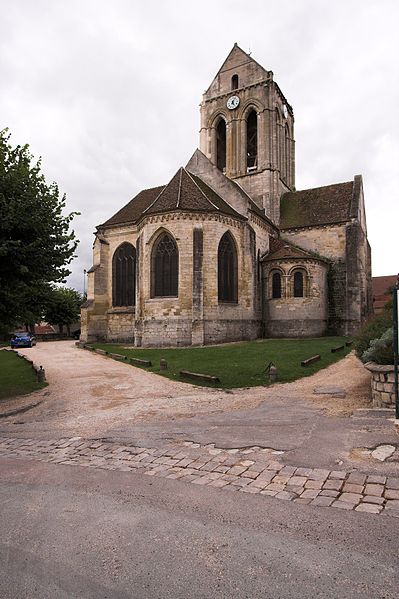
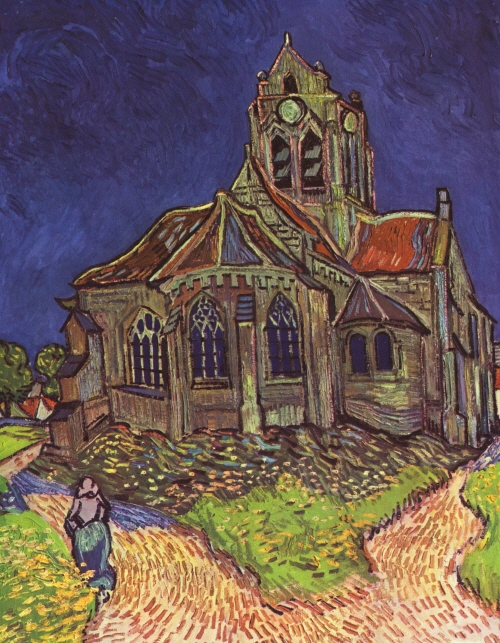
You are now standing before the real-life subject of one of Van Gogh's best-known paintings, The Church at Auvers, which hangs in the Musée d'Orsay. How does the painting compare with the building in front of you?
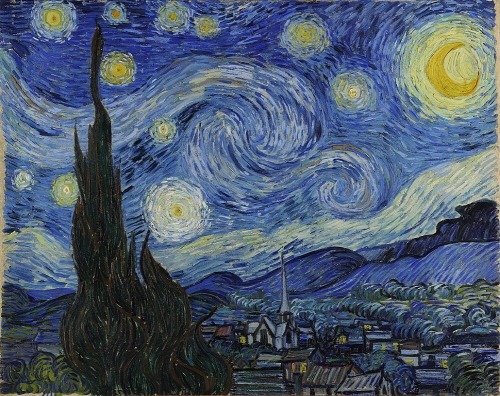
Back at the asylum in Saint-Rémy, where he painted The Starry Night, Van Gogh often found himself homesick for Zundert, where he was born, and for Nuenen. In a letter to Theo written a few weeks before leaving the asylum, he said: "Though I am ill, I have nonetheless painted a few small pictures from memory. Later you will see the pictures I painted thinking of my home." The Church at Auvers expresses that longing beautifully. The front of the church glows in sunlight, while the building itself stands wrapped in its own shadow. The simple, deep blue also appears in Portrait of Adeline Ravoux, painted in Auvers at the same time, and the road splitting in front of the church echoes the one in Wheatfield with Crows.
The church was begun in the early 12th century in the Gothic style and later enlarged in the 17th century with Romanesque additions. Van Gogh's vivid brushwork turns it into a richly coloured, monumental structure that seems to lift off the ground, with the path splitting on either side as if a torrent of lava or mud were about to swallow the building. His intense colour and brushstrokes are on full display. Some say this was his last painting, which gives it special meaning for him and for us.
Two paths run along either side of the church, and a few women walk along one of them. Their clothing is typical of Flanders, the Dutch homeland of Van Gogh, and speaks of his homesickness. Oddly, the church in the painting has no door anywhere, because he painted its rear. Having preached the gospel in the Belgian coalfields, Van Gogh sided with the miners and was dismissed as an evangelist. Perhaps the closed door expresses his feelings toward the church that blocked his path to the ministry, or his own existence amid deep poverty and pain.
One more observation: in the cobalt blue of the sky, the upper part shows thick lines while the lower part has almost none. Oil painting normally depends on layering, and the heavily lined areas suggest he worked in a hurry. To paint 80 oils in 70 days, he had no time to wait for paint to dry, so he must have skipped the layering and painted quickly. This is purely a personal impression from studying the canvas, but the painting seems to me both a pure expression of Van Gogh's style and a masterpiece that reveals his inner world.
Step inside to light a candle and say a short prayer, and it may become a good memory. You might also sit on a bench outside, feel the cool breeze and take in the church Van Gogh painted.
Next is the grave of Vincent and Theo. With your back to the church painting, follow the road on the left uphill for about five minutes until you see the cemetery.