The Gates of Hell
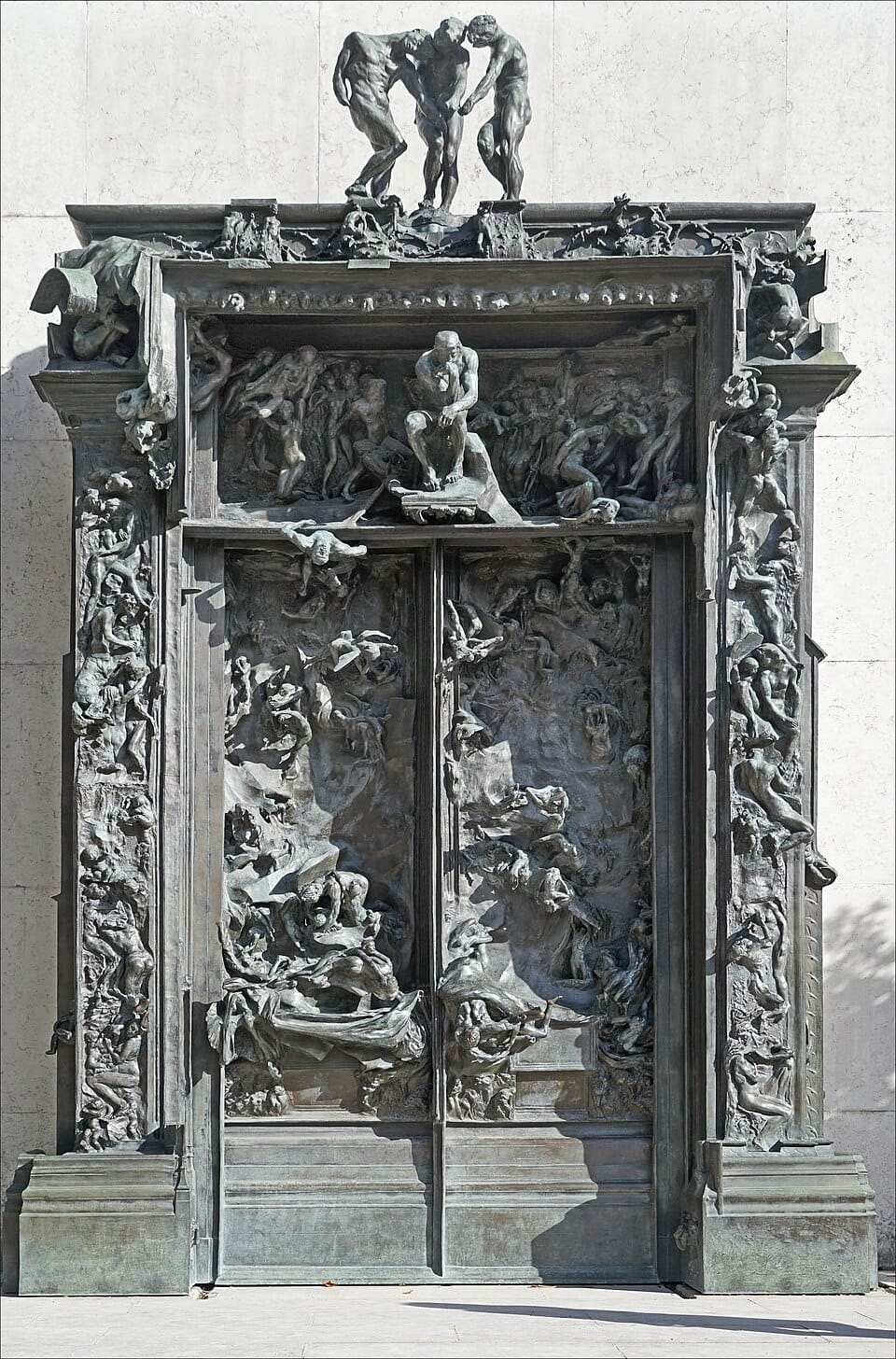
The sculpture you're looking at is The Gates of Hell, one of Rodin's most important and iconic masterpieces.
This track is a little longer than the others, and it includes quite a few reference images.
But since this is one of Rodin's most important works, it is worth taking the time to examine it closely.
Before we look at The Gates of Hell itself, let's begin with the story of how Rodin came to create it.
When Rodin was 40 years old, he received a commission from the French government to design the entrance doors for a new Museum of Decorative Arts that was to be built next to the Louvre.
Determined to make the most of this important opportunity, Rodin devoted himself wholeheartedly to the project.
When designing the doors, he once again drew inspiration from the great masters of the Renaissance.
The two Renaissance masters who influenced him most were Ghiberti and Michelangelo.
The basic structure of the doors was inspired by Ghiberti's Gates of Paradise at the Baptistery of San Giovanni in Florence.
At first glance, however, the two works may not appear very similar.
To really see the resemblance, you first need to look at Rodin's original design for The Gates of Hell.
In that first model, the overall structure, with its two large doors, is remarkably similar to Ghiberti's Gates of Paradise.
From there, Rodin continued to develop and refine the design.
The second and third models show how the sculpture evolved from there.
After several stages of development, the fourth version finally became the Gates of Hell we see today.
This final transformation was strongly influenced by Michelangelo's The Last Judgment in the Sistine Chapel at the Vatican.
From the position of The Thinker, which corresponds to the position of Christ in Michelangelo's fresco, to the countless figures filling the scene, the similarities are striking.
In this way, Rodin drew inspiration from both Ghiberti and Michelangelo when creating The Gates of Hell.
The sculpture is generally believed to be based on The Divine Comedy by the famous Florentine writer Dante.
It is also believed that Rodin was influenced, at least in part, by The Flowers of Evil, the celebrated collection of poems by Charles Baudelaire, which was widely admired in France while he was working on the project.
Rodin devoted nearly twenty years to creating The Gates of Hell.
In the end, however, Rodin never completed The Gates of Hell.
Even so, the 186 figures he created for the project became a major turning point in his career.
Using the plaster molds he had made for these figures, Rodin was able to combine, enlarge, reduce, and rearrange them into entirely new sculptures with far less effort. This approach allowed him to create an extraordinary variety of works, and it became one of the keys to his success as a sculptor.
That's why The Gates of Hell is considered one of the most important works of Rodin's entire career.
Now, let's take a closer look at some of the figures on the doors.
You'll probably recognize many of them from earlier in the tour.
So rather than explaining them all again,
I'll introduce a few figures that we haven't covered yet or that have particularly interesting stories.
Let's begin with Fugit Amor. The title means "Love Flees."
You'll see a man clinging to a woman below him.
These two figures represent Paolo and Francesca, the tragic lovers from Dante's Divine Comedy.
Incidentally, these are the same two lovers featured in Rodin's famous sculpture The Kiss.
We briefly talked about them when we looked at The Kiss earlier in the tour.
Originally, Rodin intended to include The Kiss in The Gates of Hell. However, the sculpture was considered too beautiful and too romantic to fit the tragic atmosphere of the doors, so he removed it.
Instead, he carved a much smaller scene with a similar theme near the bottom of the right-hand door.
Now, back to this sculpture. Paolo was the younger brother of Francesca's husband.
The two fell in love, even though theirs was a forbidden relationship.
When Francesca's husband discovered the affair, he killed them both, and according to Dante's Divine Comedy, they were condemned to Hell.
That's why Rodin portrayed them locked together, yet filled with suffering.
The male figure was created by reusing a figure from another of Rodin's sculptures, The Prodigal Son.
Rodin also combined different figures from The Gates of Hell to create entirely new sculptures.
Now, take a look at The Thinker on The Gates of Hell.
To its right, you'll find a figure called Crouching Woman.
And to the left of The Thinker, you'll see a figure that looks as though he is about to fall to the ground.
This figure is commonly known as The Falling Man.
Rodin combined these two figures to create yet another sculpture.
The result was I Am Beautiful.
As you've probably noticed throughout this tour, Rodin often created new works by separating, recombining, and reusing existing figures.
Here, you can see another fascinating example of that process.
That concludes our look at The Gates of Hell.
The bronze doors you're looking at today were actually cast after Rodin's death.
During his lifetime, Rodin completed only the plaster model. It was after his death that it was cast in bronze.
Because of that, some people have questioned whether it should truly be considered the original. Even so, it is generally regarded as an original work.
Today, seven bronze casts of The Gates of Hell can be found in museums around the world.
And finally, here's one last detail that many visitors ask about. On either side of The Gates of Hell, you'll see two separate sculptures.
The figure on the left is Adam, and the one on the right is Eve.