The Burghers of Calais
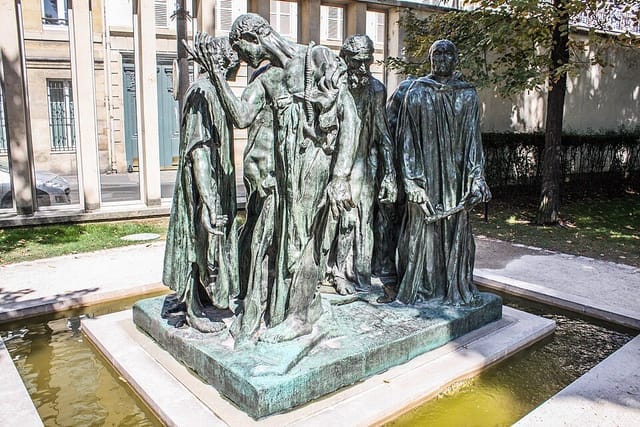
The sculpture you're looking at is one of Rodin's most famous works, The Burghers of Calais.
The story behind it comes from Chronicles, a fourteenth-century historical account written by the French court historian Jean Froissart.
Knowing this story makes the sculpture much easier to understand, so let me tell you the story first.
In his Chronicles, Froissart recounts episodes from the Hundred Years' War between France and England over the French crown.
Among the French cities, Calais was the closest to England across the English Channel. Because of its location, it was almost always the first city to be attacked whenever England invaded France.
This time was no different.
The people of Calais held out against the English army for nearly a year, but in the end, the city fell.
After capturing Calais, King Edward the Third of England initially planned to execute all of its citizens. After negotiations, however, he agreed to spare the city on one condition. Six citizens would have to sacrifice themselves instead.
The people of Calais struggled to decide who those six should be.
Then, Eustache de Saint Pierre, one of the city's leading citizens, stepped forward and volunteered to die.
Following his example, five other leading citizens also volunteered.
Representing the people of Calais, the six men came out wearing simple sackcloth with ropes around their necks, ready to give up their lives.
However, Queen Philippa, who was pregnant at the time, pleaded with the king to spare them. She feared that executing the men might bring a curse upon their unborn child.
The king was eventually persuaded and granted them their lives.
The story has long been regarded as one of history's greatest examples of noblesse oblige, with leaders choosing to sacrifice themselves before asking others to do the same.
Because of that, many people still believe this story happened exactly as it is told.
The events themselves did take place, but historians generally agree that Jean Froissart greatly embellished the story in his Chronicles.
In reality, King Edward the Third never intended to execute the people of Calais.
There is also no evidence that he demanded the sacrifice of six citizens.
As the official historian of the French court, Froissart is believed to have dramatized the story to inspire patriotism among his readers.
Because the story is so moving, it has inspired countless works of literature and art over the centuries.
So when the city of Calais commissioned Rodin to create a monument, he gladly accepted.
To prepare for the project, Rodin carefully studied Froissart's Chronicles and chose to depict the story's most dramatic moment.
Now, let's take a closer look at the sculpture itself.
As you can see, it depicts six men.
These are the six citizens who volunteered to sacrifice themselves for the people of Calais.
After they were chosen, they were made to wear simple sackcloth with ropes around their necks. They then walked to the town square, where they were to be executed by hanging.
Rather than portraying them as fearless heroes, Rodin wanted to capture them as ordinary human beings facing death.
If you look at their faces, you'll notice the deep sorrow and anguish in their expressions.
The man standing in the center with his head bowed is Eustache de Saint Pierre, the first to volunteer.
To his left, as you're facing the sculpture, is Pierre de Wissant.
Does he look familiar?
Earlier, inside the Rodin Museum, we saw a sculpture of Pierre de Wissant without its head and hands.
The figure you see here is the completed version of that sculpture.
As you can see, Rodin also added his clothing.
Rodin must have been especially fond of this figure.
If you have a good memory, you may remember seeing him earlier in the museum.
In The Hand of God, the right hand belongs to Pierre de Wissant.
Now that we've taken a closer look at the figures, let's continue with the story.
Once the sculpture was completed, it was supposed to be installed in front of Calais City Hall.
But when the people of Calais saw it, they were deeply disappointed.
They had expected a monument celebrating six heroic saviors of their city. Instead, Rodin portrayed six ordinary men confronting their own mortality. To many people at the time, the sculpture simply didn't look heroic enough.
Rodin even insisted that it should not be placed on a tall pedestal where people would have to look up at it.
He wanted visitors to stand at the same level as the figures and share in their fear, sorrow, and humanity.
The people of Calais strongly opposed this idea.
As a result, the monument was installed in a park some distance away from City Hall
and placed on a high pedestal, just as many residents had wanted.
Over time, however, Rodin's reputation continued to grow, and people gradually came to understand what he had been trying to express. Eventually, the monument was moved to its current location in front of City Hall, and the pedestal was lowered to better reflect Rodin's original vision.
Feel free to spend a little more time looking at the sculpture. When you're ready, let's move on to the next stop.