Monument to Balzac
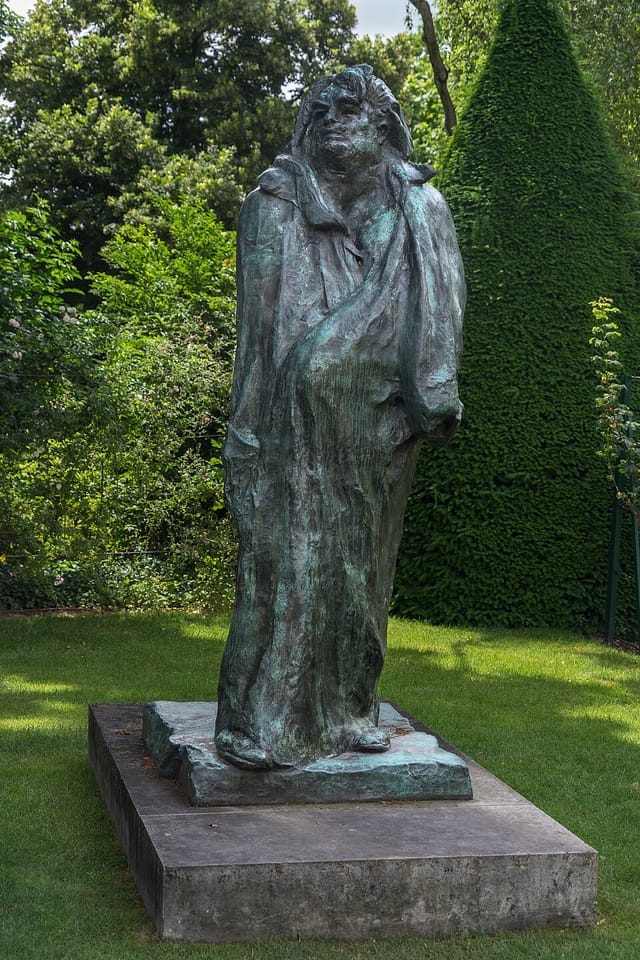
The sculpture you're looking at is Rodin's Balzac.
Balzac may not be a familiar name to many people outside France, but he is regarded as one of the country's greatest writers.
Rodin received the commission to create this monument from Émile Zola, who was serving as president of the Société des Gens de Lettres, the French society of writers.
Rodin devoted 7 years to the project, including 4 years of research before he even began sculpting.
During that time, he studied not only Balzac's face and physique, but also his daily habits.
For example, he even made a plaster cast of the actual dressing gown that Balzac was said to wear whenever he wrote.
Rodin's dedication went even further. While visiting Balzac's hometown, he happened to meet a man who looked remarkably like the writer and used him as the model for Balzac's face.
The sculpture you see here is the result of all that effort.
More precisely, this bronze version was cast after Rodin's death,
while the original plaster model was completed during his lifetime.
But when the members of the Société des Gens de Lettres saw the sculpture, they were deeply disappointed rather than impressed.
They had expected a grand monument celebrating Balzac as a national literary hero. Instead, Rodin presented them with a strikingly realistic portrait.
Rather than an idealized hero, they saw a heavyset man who looked far removed from the noble image they had envisioned.
Critics were merciless. Some compared the sculpture to a lump of salt left out in the rain, while others said it looked like a melting candle.
The real Balzac was also a large, heavyset man, just as Rodin portrayed him.
Rodin's goal was to represent Balzac as truthfully as possible.
At the time, however, such an approach was considered radically unconventional, which is why the sculpture received so much criticism.
What Rodin wanted was not to create an idealized heroic image. Instead, he hoped people would see Balzac as he truly was and discover the greatness of his character beneath his outward appearance.
Of course, it isn't always easy for ordinary people to understand the vision of a genius.
Even today, we are often more influenced by outward appearances than by what lies within. Seen in that light, it's not hard to understand why people reacted so negatively to this sculpture.
In the end, the Société des Gens de Lettres refused to accept the monument.
It remained in Rodin's studio and was cast in bronze only after his death.
As time passed, however, people gradually came to understand what Rodin had been trying to achieve.
Today, Balzac is regarded as one of his greatest masterpieces.
Take your time enjoying the sculpture, and when you're ready, let's move on to the next one.