The Thinker
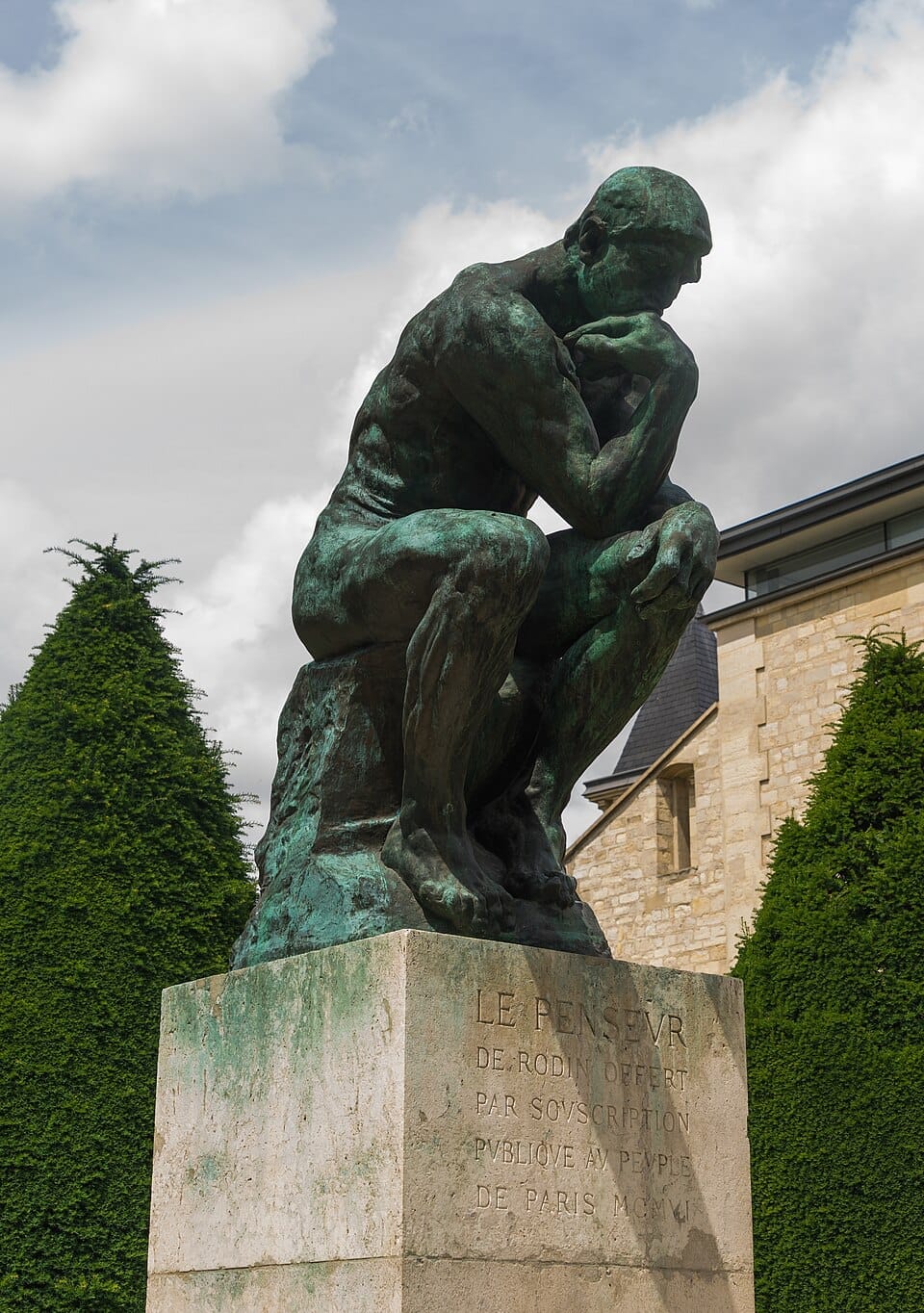
The sculpture you're looking at is The Thinker, Rodin's most famous work.
When people around the world think of Rodin, this is probably the first sculpture that comes to mind.
So, why has it remained one of the world's most beloved sculptures for so many years? Let's find out.
Originally, The Thinker was created as part of The Gates of Hell.
The figure sits at the very top of the gates, looking down over the scene of Hell below.
At that time, however, the sculpture attracted very little attention.
It wasn't until Rodin enlarged it into a monumental standalone sculpture that it began to capture the public's imagination.
People naturally wondered who this mysterious figure was.
Since The Gates of Hell was inspired by Dante's Divine Comedy, the most widely accepted interpretation is that the figure represents Dante, contemplating the Hell he imagined in his poem.
Others believe it portrays the French poet Charles Baudelaire, whom Rodin greatly admired. Still others see it as a self-portrait of Rodin himself.
Personally, I think all three interpretations are possible. Rodin never identified a single individual as the model or inspiration for The Thinker.
That's why each of these interpretations can be seen as valid—and at the same time, none of them can be proven with certainty.
When it was still a small figure on The Gates of Hell, it attracted very little attention. But once Rodin created the larger standalone version you see today, it quickly captured the public's imagination.
Now, let's take a closer look at the sculpture itself.
Notice how the figure rests his chin on one hand.
What's unusual is that his right elbow rests on his left knee rather than his right.
Why not try the pose yourself?
If you do, you'll notice that your upper body naturally twists slightly to the left.
Instead of depicting the figure sitting perfectly upright, Rodin deliberately gave the body a subtle twist, making the lines of the torso appear more dynamic and expressive.
There's another detail worth noticing. Rodin intentionally sculpted the hand supporting the chin larger than it would be in realistic human proportions. This was a deliberate distortion.
It's one of the defining characteristics of modern sculpture.
Rather than following perfect anatomical proportions, Rodin emphasized the parts of the body he considered most important, enlarging or reducing them to strengthen the sculpture's expressive power.
That's one of the reasons The Thinker is considered such an iconic work of modern sculpture.
The bronze sculpture you see here was cast after Rodin's death.
However, it's still considered an authentic work because it was cast from Rodin's original models and molds.
So, how many versions of The Thinker do you think exist?
Ten? Fifteen?
The answer is probably more than you'd expect.
A total of 40 bronze casts have been produced,
and the one you're looking at is one of them.
Take your time enjoying the sculpture, and when you're ready, let's move on to the next one.