Young Girls at the Piano
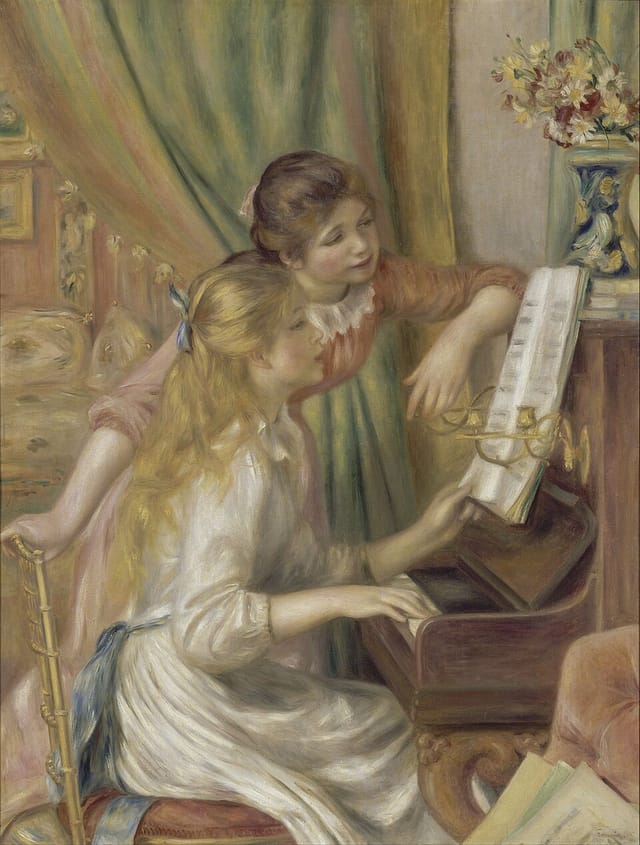
The painting you're looking at now is Girls at the Piano by Pierre-Auguste Renoir.
This is one of Renoir's later works.
As I mentioned earlier when we looked at Dance in the City and Dance in the Country, Renoir was deeply inspired by classical art during his trip to Italy, and from that point on, his style began to change.
As a result, this painting contains very few of the Impressionist qualities that characterized his earlier works.
Now, let's take a closer look.
You'll see two young girls happily playing the piano together.
At the time, owning a piano was a symbol of wealth, so we can tell that this was a well-to-do family.
This was the home of Renoir's friend, Henri Lerolle.
The two girls are Lerolle's daughters.
You can think of this painting as Renoir's portrayal of an ordinary moment in the life of a wealthy Parisian family, inspired by a visit to his friend's home.
The painting is filled with soft pastel colors, giving it a bright and peaceful atmosphere.
Ironically, while creating this beautiful work, Renoir was suffering from severe rheumatoid arthritis. The pain had become so intense that he could no longer hold a paintbrush properly.
Even so, he placed the brush between his fingers and tied it to his hand so that he could continue painting.
Nearly all of Renoir's later works were created while enduring this constant pain. One day, after seeing Renoir paint under such difficult conditions, one of his friends asked him, "Why do you keep painting like this?"
Renoir replied with a famous quote: "Pain passes, but beauty remains."
Thanks to that determination, we can still enjoy beautiful paintings like this today.
But there was another reason why this painting was so important to him.
It was commissioned by the Musée du Luxembourg, France's first national museum of contemporary art.
For Renoir, this was a truly significant moment.
He hadn't begun his career as a painter. He started out as a porcelain painter.
Because of that background, he had never been fully accepted by the Academy or the Salon.
So he never imagined that a national museum would one day commission a painting from him. You can imagine how thrilled he must have been.
He poured everything he had into this project.
Since he didn't know which version the museum would choose, he painted six versions of almost the same composition, each with slight differences.
One of them was selected and purchased by the Musée du Luxembourg for 4,000 francs.
The painting you're looking at now is that very work.
At the time, 4,000 francs was a considerable amount of money. With the proceeds, Renoir was able to buy a house in Essoyes, about two hours and forty minutes from Paris by car.
Quite remarkable, isn't it?
Of the other versions Renoir painted at the time, one is now in the Musée de l'Orangerie in Paris,
and another is in the Metropolitan Museum of Art in New York.
The remaining versions are held in private collections.
The other two hang at the Musée de l'Orangerie and the Metropolitan Museum of Art.
Personally, this version is my favorite. Which of the three do you like best?
I'd love to know why.
If you'd like to share your thoughts, please leave a comment in the comments section for this track. Now, take your time enjoying the painting.
When you're ready, we'll move on to the next artwork.