The Birth of Venus
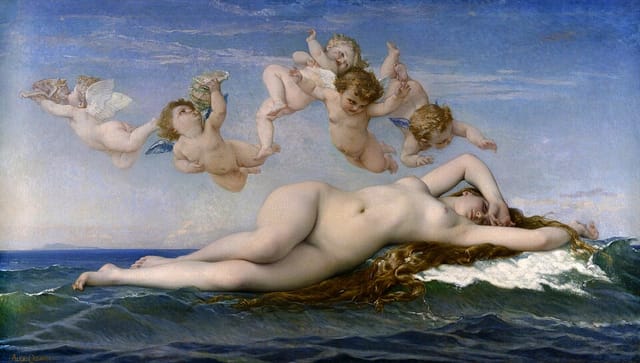
The painting you're looking at now is The Birth of Venus by Alexandre Cabanel.
Take a look at the painting. A beautiful nude Venus floats gracefully on the sea, while small cherubs hover above her.
The subject comes from Greek mythology.
According to the myth, Cronus cut off the genitals of his father, Uranus, and threw them into the sea. From the sea foam, Venus, the goddess of beauty, was born.
This painting is considered one of the finest examples of Academic art.
But what exactly is Academic art? It is a style of painting that emphasizes accurate anatomy, perspective, and classical techniques while depicting subjects from history, mythology, or religion.
In other words, it was the classical style of painting taught in the art academies.
Can you see how balanced the composition is and how accurately the proportions of the human body have been rendered?
Cabanel exhibited this painting at the Paris Salon in 1863.
At the time, the Salon was the most prestigious art exhibition in France and served as the gateway to a successful career for aspiring artists.
Just how popular was the Paris Salon? At its peak, it attracted nearly one million visitors a year
—almost the entire population of Paris at the time.
That gives you an idea of just how important Paris was as a cultural capital, and how deeply people cared about art.
For artists, having a painting accepted into the Salon could launch a successful career.
That's why Cabanel chose to exhibit this work there.
Now, let's take another look at the painting.
Look at Venus, the main figure of the painting.
She is portrayed in a very sensual way.
Cabanel painted her with the kind of feminine beauty that was admired in France at the time.
It may be difficult to see from a distance, but if you look at Venus's eyes, you'll notice that they aren't completely closed. They are slightly open, giving her a dreamy, almost seductive gaze.
Details like this are said to have stirred the imagination of male viewers at the time.
From our perspective today, we might wonder, "Is this really an erotic painting?" But in 1863, there was no internet, no television, and no visual media like we have today. For many people, paintings like this were one of the few ways to experience visual sensuality.
But if a painting was too openly provocative, it was criticized.
A famous example is Manet's Olympia.
In the same year, 1863, Manet also submitted a nude painting to the Salon, just like Cabanel. But the reactions to the two works were completely different.
We'll talk more about that later when we look at Olympia.
Even with the same subject of the nude, public reaction could change completely depending on how it was presented. At the time, The Birth of Venus was the perfect subject. Because it came from classical mythology, it allowed artists to introduce eroticism without appearing to offend public morals.
And Cabanel used that opportunity very skillfully.
As a result, the painting delighted audiences and received widespread praise from art critics.
It became one of the greatest successes of the Salon.
Emperor Napoleon III was especially impressed by the painting and purchased it on the spot.
Once word spread that the Emperor had bought it, Cabanel's reputation soared.
After that, requests for Cabanel's paintings poured in, and he went on to create two more versions of The Birth of Venus.
In total, there are three versions of the painting. One is here at the Musée d'Orsay, another is in New York at the Dahesh Museum of Art, and the third is at The Metropolitan Museum of Art.
Favored by Emperor Napoleon III, Cabanel also became one of the most sought-after portrait painters of his time.
His reputation was so great that wealthy Americans traveled all the way to Paris, offering generous commissions in the hope that he would paint their portraits.
Cabanel had an extraordinary understanding of what people admired and wanted to see.
As a result, he achieved both wealth and fame, and later became one of the leading professors at the École des Beaux-Arts, one of France's most prestigious art schools.
That concludes our look at Cabanel's The Birth of Venus.
Now, let's move on to the next painting.
The Neoclassical and Romantic artists we've seen so far were among the most celebrated painters of their time.
But the artists we're about to meet had a very different experience. Today, their paintings are admired around the world. But when they were first exhibited, many people dismissed them, asking, "Can this really be called art?"
It's fascinating how the way we judge art can change over time.
So, are you curious to see what these revolutionary paintings looked like?
Let's head to the next masterpiece together.