The Gates of Hell (plaster)
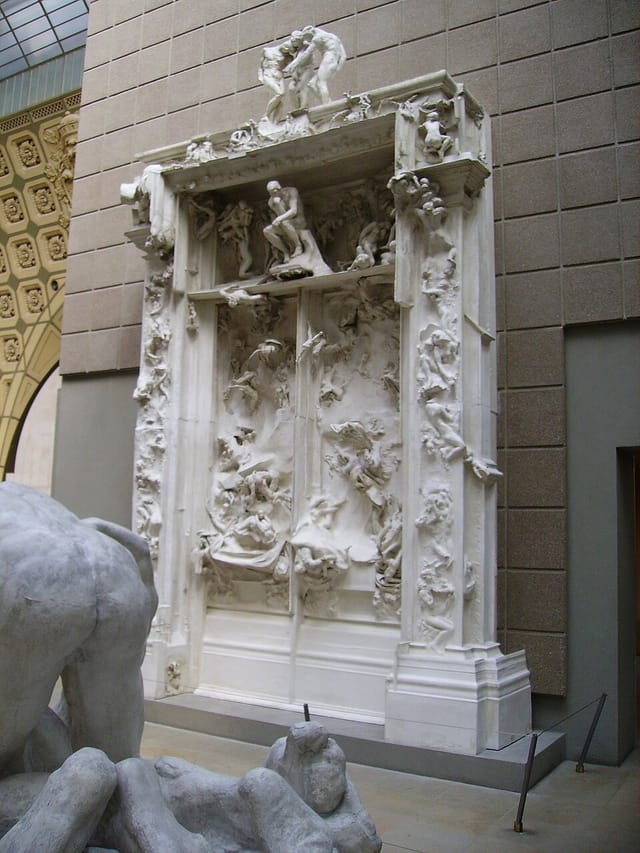
The work you're looking at is The Gates of Hell by Auguste Rodin.
This is the original plaster model that Rodin created before casting The Gates of Hell in bronze.
Unfortunately, he never completed the bronze version during his lifetime. So this plaster model is the only version of The Gates of Hell that Rodin himself actually made.
If you've visited the Rodin Museum in Paris or the National Museum of Western Art in Tokyo, you might be thinking,
"Wait, I've seen The Gates of Hell there." And you'd be right.
Today, there are seven bronze casts of The Gates of Hell in museums around the world, including the Rodin Museum in Paris.
However, all seven were cast from this plaster model after Rodin's death.
So the only Gates of Hell that bears Rodin's own hand is this plaster model.
Personally, I think this is one of Rodin's best deals.
Why? Because many of the sculptures carved into this door later became some of Rodin's most famous works.
Now, let's move a little closer and take a look at them one by one.
First, look up at the top of the sculpture. At the center, you'll see a man resting his chin on his hand, deep in thought.
Have you found him?
He probably looks familiar.
That's right. It's Rodin's most famous sculpture, The Thinker.
Here, he is gazing down at the scenes of Hell, lost in deep contemplation.
Now, before we continue, I have a quick quiz for you.
Can you think of the famous Italian writer from the Middle Ages who wrote a great epic poem about Hell, Purgatory, and Heaven?
That's right.
It's Dante.
The long poem he wrote about Hell, Purgatory, and Heaven is The Divine Comedy.
I'm sure many of you have heard of it.
Rodin's The Gates of Hell was inspired by the Inferno, the first part of Dante's The Divine Comedy.
So then, who is the man gazing down at Hell in deep thought?
That's right. The Thinker is Dante himself.
As he looks down upon the scenes of Hell, he is contemplating human life and the meaning of existence.
Now, if you look at the very top of the sculpture,
you'll also notice three figures.
These three figures appear in Dante's The Divine Comedy and symbolize lust, pride, and greed.
If you look to the left, you'll also find a figure of a falling man. Just below him is Ugolino.
And at the far right, you'll see another of Rodin's masterpieces, The Kiss.
So why did Rodin never finish The Gates of Hell, even though it already contained so many of his greatest sculptures?
At one point, Rodin exhibited this plaster model before it was completed.
Many of the comments he received were negative.
Some even said that adding more figures would only make the work worse. Rodin was deeply disappointed by those reactions, and according to one account, he never worked on the sculpture again.
It may seem like an unusual reason, but in the end, The Gates of Hell remained unfinished.
Even so, it's such an extraordinary work that it still feels complete in its own way.
Now, take your time and enjoy The Gates of Hell. When you're ready, let's move on to the next artwork.