The Luncheon on the Grass
Transcript
Here's what your guide tells you about this work in the MuseCat app.
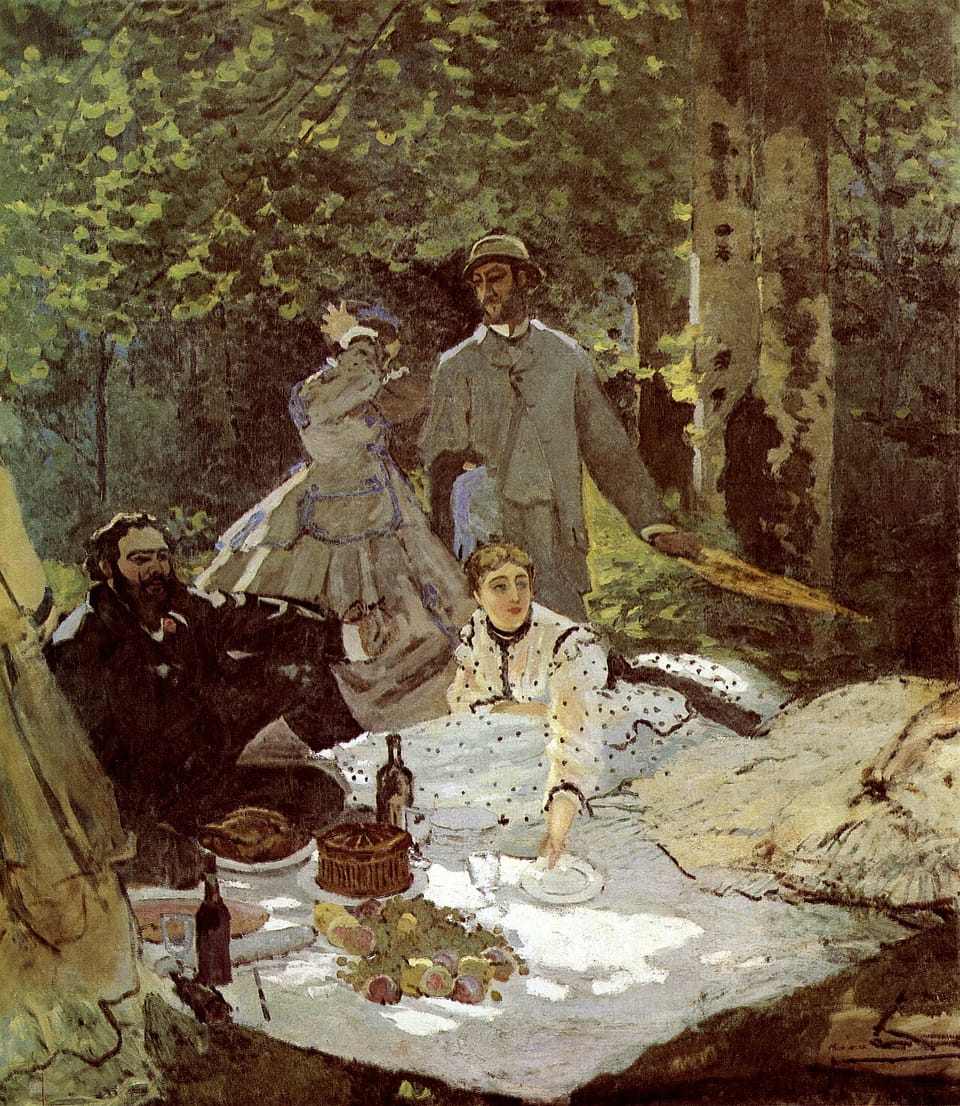
The painting you're looking at now is Luncheon on the Grass by Claude Monet. As you can see, it isn't displayed as a single painting, but in two separate sections. It wasn't originally like this. It was once a single painting.
At the time Monet was working on it, he was so poor that he couldn't even afford to pay his rent. So instead of paying his landlord with money, he gave him the painting. Some time later, after Monet had earned enough money, he went back to retrieve it. But when he saw the painting, he discovered that it had been badly damaged by mold because it had not been properly cared for.
If the landlord had known that Monet would one day become famous, he probably would have taken better care of it. But at the time, he had no reason to think so. After getting the painting back, Monet had no choice but to cut away the damaged sections and preserve only the parts that had survived. That's why the painting is now displayed in two separate pieces. In a way, this painting carries some painful memories for Monet.
As you can see, it's enormous. Because of its size, the cost of paint became so expensive that Monet was ultimately unable to finish it. He had intended to submit the painting to the Salon, but in the end, he never did.
Most of the Impressionist painters at the time were living in poverty. Since they couldn't afford to hire professional models, they often asked friends and acquaintances to pose for them instead. The people you see in this painting are all people Monet knew personally.
Among them is one person you may recognize. It's the bearded man in the black suit standing near the center of the painting. He is the Realist painter Gustave Courbet. Courbet knew about his friend Monet's difficult circumstances, so he gladly agreed to pose for the painting.
When creating this work, Monet took inspiration from Luncheon on the Grass by Édouard Manet, an artist he greatly admired. At first, it may seem surprising that Monet chose to model his painting after a work that had caused such a controversy. But that's how much he admired Manet. At the same time, Monet also hoped to have his work accepted by the Salon. So, to avoid the controversy that surrounded Manet's painting, he omitted the nude female figure and painted all of the women in his own work fully clothed.
Although this was painted early in Monet's career, you can already begin to see the development of his own artistic style. Take a look at the picnic blanket. Can you see the sunlight filtering through the trees? Although he was still learning how to capture light at this stage, he painted those patches of light with remarkable attention to detail.
That concludes our introduction to Monet's Luncheon on the Grass.