Woman with a Parasol
Transcript
Here's what your guide tells you about this work in the MuseCat app.
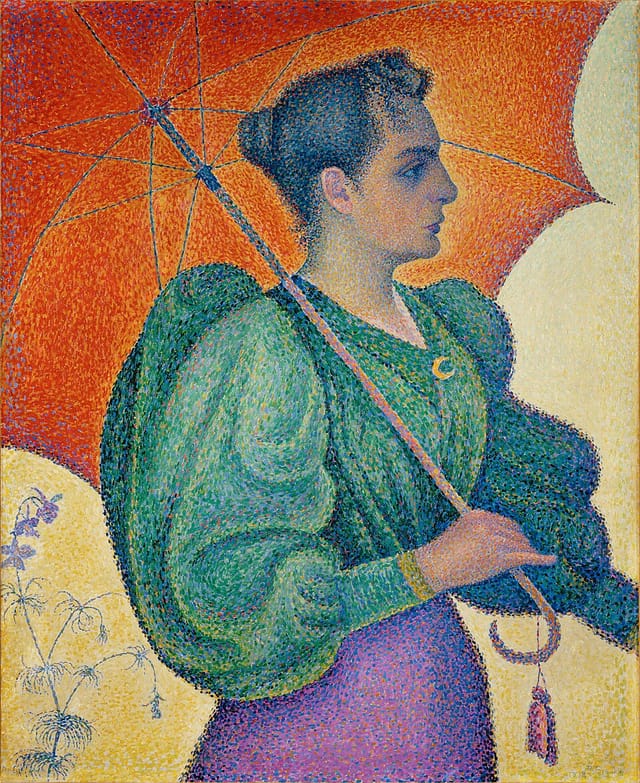
The painting you're looking at is Woman with a Parasol by the Neo-Impressionist painter Paul Signac. The woman in the painting is Signac's wife, Berthe Roblès. Since he chose his own wife as the model, he must have devoted a great deal of care to this painting. Let's take a closer look and see how he created it.
The first thing you'll notice is its use of color. The parasol is red, while the woman's blouse, right next to it, is green. Red and green are complementary colors.
Now look at her skirt. It's purple. Green and purple are also complementary colors. You can think of complementary colors as colors that contrast with one another. When they're placed side by side, the contrast becomes much stronger, making both colors appear more vivid.
Signac painted this work in a flat, print-like style, so it doesn't create a strong sense of depth or three-dimensional form. Instead, he composed the painting to make the colors stand out by using complementary colors. You could say that this pure expression of color is one of the defining characteristics of Neo-Impressionism.
Because the lines in the painting are so simple, the composition can feel a little stiff. To soften that effect, Signac added details such as the tassel hanging from the tip of the parasol and the winding flowers in the lower left corner, giving the painting a gentler feel.
Because the names Neo-Impressionism and Impressionism are so similar, many people confuse the two. As I mentioned earlier, Paul Signac was a Neo-Impressionist painter. To help you understand the difference between Neo-Impressionism and Impressionism, let's compare it with Woman with a Parasol by Claude Monet, one of the leading Impressionist painters. Like Signac's painting, it also portrays the artist's wife holding a parasol.
But even at first glance, you can see that the two paintings are completely different. Monet captured a fleeting moment as the wind swept through his wife's clothes and the grass around her. Time is always moving, and with it, light and shadow are constantly changing. Even so, Monet wanted to capture one brief moment on canvas. That's why his brushwork was quick and spontaneous.
Signac's painting, on the other hand, doesn't feel like it captures a single moment. Instead, it feels as though it depicts something permanent, fixed within the painting. Rather than capturing a fleeting moment, Neo-Impressionist painters sought to express the enduring qualities of their subjects.
Instead of using free and expressive brushstrokes, they repeatedly applied tiny dots of color in a careful and orderly way. Because of this, composition and order were especially important to them. That's why Signac's painting may appear somewhat rigid. When he painted it, he deliberately pursued balance, proportion, and order.
So, what do you think? Impressionist painters used quick, lively brushstrokes to capture a fleeting moment, while Neo-Impressionist painters carefully placed one tiny dot after another in search of something that would never change. Can you see the difference between the two?
Take your time and enjoy the painting.