The Circus
Transcript
Here's what your guide tells you about this work in the MuseCat app.
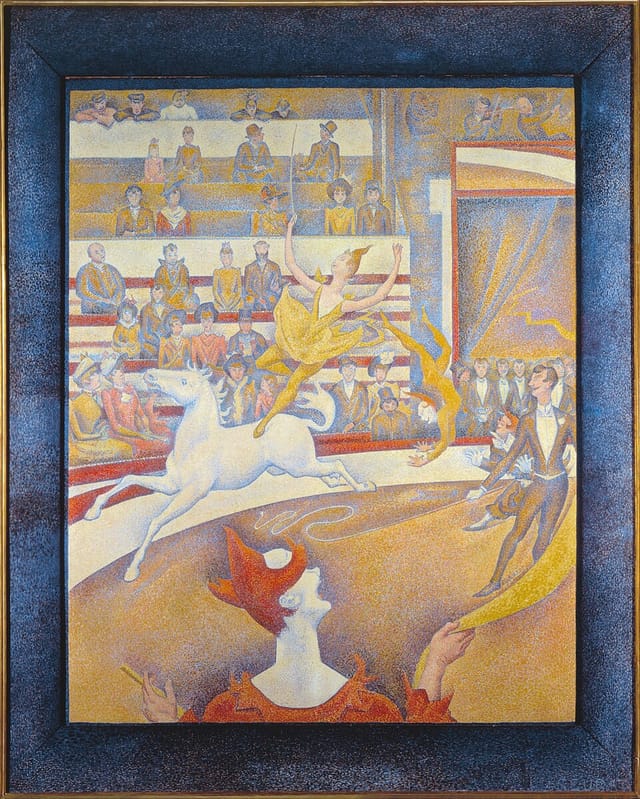
The painting you're looking at is The Circus by Georges Seurat. It captures a lively scene from a circus performance. At the time, the circus was one of the most popular forms of entertainment in France. As industrialization and urbanization progressed, circus culture emerged alongside them.
Now, take a look at the audience. You'll notice that the seating is divided into three sections. In the front rows sit members of the upper class, including the bourgeoisie. Behind them are people from lower social classes. Unlike the seats in the front, the chairs here look much harder and less comfortable.
Finally, look at the very top. There, members of the working class are standing behind the railing, watching the performance because they weren't even allowed to have seats. Seurat faithfully captured the social hierarchy of his time, when even circus seating was divided according to class.
If you look carefully, you'll notice that this painting wasn't created with traditional brushstrokes. Instead, it was made up of tiny dots. This technique is called Pointillism, and Seurat was its founder. It later became an artistic movement known as Neo-Impressionism.
Most people are more familiar with Impressionism than Neo-Impressionism. Because of their names, you might think the two are almost the same, but they're actually quite different. Neo-Impressionism shared the same basic philosophy as Impressionism. Both movements were deeply interested in light and color and sought to capture them on canvas.
The difference is that Impressionist painters were interested in capturing a fleeting moment of light and color, while Seurat wanted to create something more permanent rather than something spontaneous. Rather than capturing just a single moment of light and color on canvas, Seurat wanted to capture light and color that would never change. That's why he chose to paint using tiny dots.
Light and paint behave very differently. When light is mixed, it becomes brighter. But when paint is mixed, it becomes darker. After learning this, Seurat devoted himself to studying color. Instead of mixing paints together, he applied countless tiny dots of different colors side by side without overlapping them. He discovered that our eyes perceive each color individually, rather than seeing them as mixed together. Pointillism was based on this scientific principle that Seurat carefully studied and developed.
It's a bit like a digital photograph today. At first glance, it looks like a single image. But if you keep zooming in, you'll eventually see that it's made up of countless tiny pixels. You can think of Seurat's Pointillism as creating those tiny pixels by hand. It really was an extraordinary discovery.
Unfortunately, The Circus became Seurat's final work. He passed away at the young age of just thirty-two. It's hard not to wonder how much greater his influence on the art world might have been if he had lived longer. As you continue looking at The Circus, Seurat's final masterpiece, remember his determination to approach art through science and his dedication to bringing that idea to life through the painstaking technique of Pointillism.
Take your time with the painting.