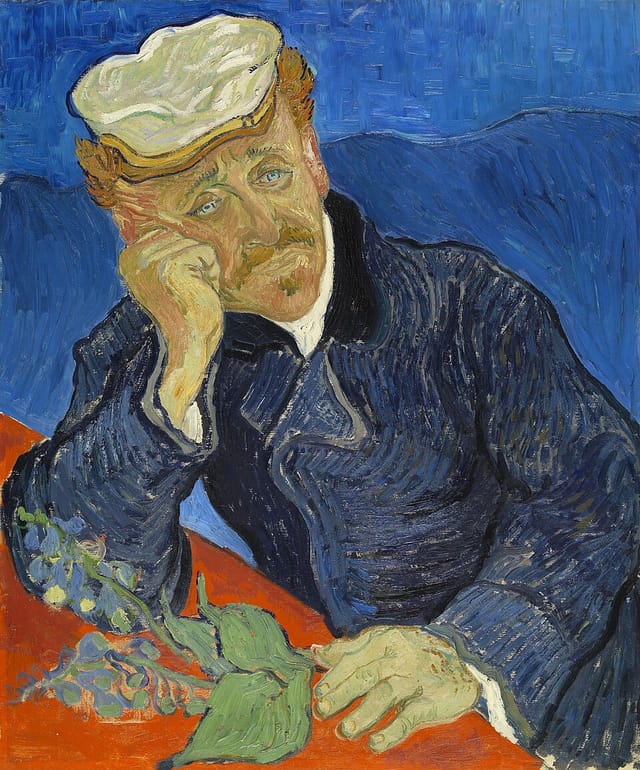
Portrait of Doctor Gachet
Transcript
Here's what your guide tells you about this work in the MuseCat app.
This painting is Portrait of Dr. Gachet, created by Vincent van Gogh. The man you see here is Dr. Paul Gachet, the physician who cared for Van Gogh during the final months of his life.
Let's take a closer look at the painting. One of the first things you'll notice is Van Gogh's use of cool colors. Blue dominates the composition, creating a quiet, melancholy atmosphere. Dr. Gachet's pose adds to that feeling. Resting his head on one hand, he wears a worried, sorrowful expression that makes the painting feel even more somber.
Van Gogh himself once described this portrait as "the expression of the loneliness of our time." In many ways, this reflected how Van Gogh personally felt about Dr. Gachet.
After leaving Paris behind, Van Gogh moved to Arles in 1888. But the following year, as his mental health worsened, he was admitted to an asylum in Saint-Rémy. Then, in 1890, at the suggestion of his younger brother Theo, he moved to the small village of Auvers-sur-Oise, just outside Paris. Even today, Auvers-sur-Oise is best known as the village where Van Gogh spent the final months of his life. Theo sent his brother there because Dr. Gachet lived in the village.
Although Dr. Gachet was a physician, he had a deep love for art. And he was close friends with many Impressionist painters, including Manet, Monet, Renoir, and Cézanne. It was actually Camille Pissarro who suggested to Theo that Van Gogh should be sent to Dr. Gachet.
At first, however, Van Gogh didn't seem to like Dr. Gachet. In a letter to Theo, he wrote that Dr. Gachet seemed even sicker than he was, making him difficult to trust. Before long, though, Van Gogh realized how much they had in common, and the two became close friends. The loneliness, melancholy, and solitude that Van Gogh sensed in Dr. Gachet are all reflected in this portrait.
Perhaps thanks to Dr. Gachet's care and support, Van Gogh was incredibly productive during the two months he spent in Auvers, completing around seventy paintings. This portrait is one of them. Sadly, not long after finishing this work, Van Gogh took his own life with a gunshot. Knowing what happened afterward may make the painting feel even more poignant. This concludes our look at Portrait of Dr. Gachet.
Feel free to spend a little more time with the painting.