The Church at Auvers
Transcript
Here's what your guide tells you about this work in the MuseCat app.
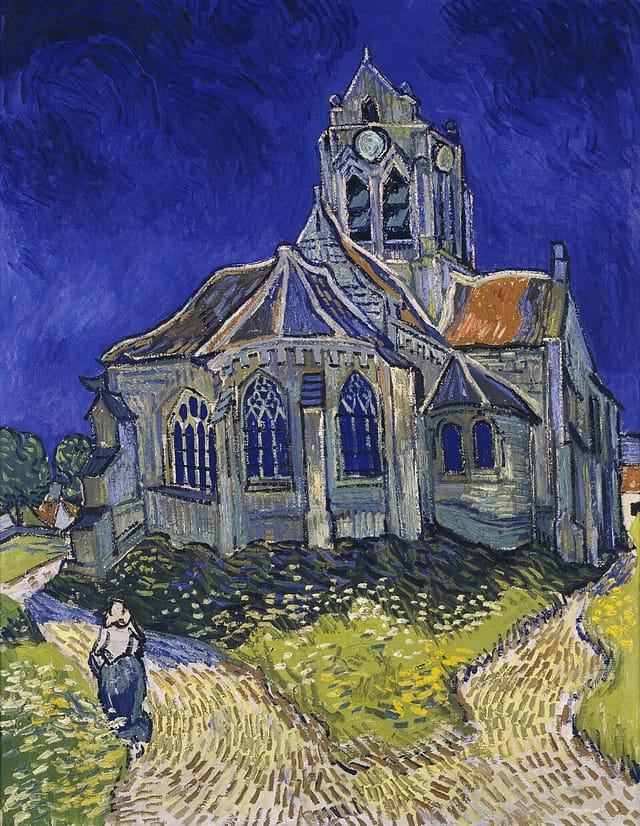
The painting you're looking at now is The Church at Auvers by Vincent van Gogh. Auvers-sur-Oise was a small village near Paris where Van Gogh spent the final two months of his life. This painting depicts the village church.
Now, let's take a closer look. The most striking feature of this painting is its use of light. Notice the forked paths in front of the church. Both paths are brightly lit.
Now look at the church. What do you think? Does it seem just as bright? The sky surrounding the church is dark, as if heavy storm clouds have gathered overhead. The church itself also appears damp, heavy, and shadowed, almost as though it has just been soaked by rain.
And do you see the deep shadow stretching out in front of the church? Since sunlight comes from a single direction, if the church is casting a shadow toward the front, then the woman walking along the path on the left should also be casting her shadow in the same direction. But look for her shadow. You won't find one. That tells us the darkness surrounding the church wasn't created by natural light. It was something Van Gogh deliberately painted into the scene.
Now take a look at the outline of the church. Notice how the walls seem to bend and twist, almost as if the building is about to collapse. The overall composition is similar to the real church. But unlike the painting, the real church doesn't appear warped at all. Built in the early thirteenth century in the Gothic style, it has strong, straight lines and a solid structure.
So why did Van Gogh choose to paint the church as dark and unstable? Van Gogh's father was a minister, and as a young man, Van Gogh did volunteer work in Belgium while preparing to become a minister himself. However, he was eventually expelled by the Church. In one of his letters to Theo, he compared the Church's God to the god of a drunken priest in a play by Shakespeare. He also wrote that the Church's sermons felt empty and meaningless. It seems that Van Gogh had become deeply disillusioned with the Church. Perhaps those feelings are what led him to paint the church as dark and twisted.
Auvers-sur-Oise, the setting of this painting, is a small village not far from Paris by train. It's a peaceful, quiet, and beautiful place. There, you can visit the house where Van Gogh lived during his final years, the church you see in this painting, and the wheat field depicted in another of his works, Wheatfield with Crows. Since Van Gogh spent the final days of his life there, you can also visit his grave. If you have enough time during your stay in Paris, I recommend taking a trip there.
Take your time enjoying the painting.